Part I — What Counterfeits Reveal
A Forgery Lab Investigation
Every counterfeit begins with an intention. Someone decides what they want people to believe, and then they build an image to match that goal. But the moment a manipulated picture enters public space, it does more than mislead — it exposes the pressure points within the story it tries to control. This page examines what those pressure points reveal, and why the attempt to deceive eventually reveals a deeper truth.

This page is based on a now-removed social media post that circulated a fabricated image and misleading claims. While the original content is not shown here, its structure and intent provide important insight into how manipulated visuals attempt to shape public understanding. The analysis that follows focuses on the patterns revealed by the forgery, not the post itself.
“The first move in gaslighting is always a distortion of evidence.”

Design Notes
Why This Image Looks the Way It Does
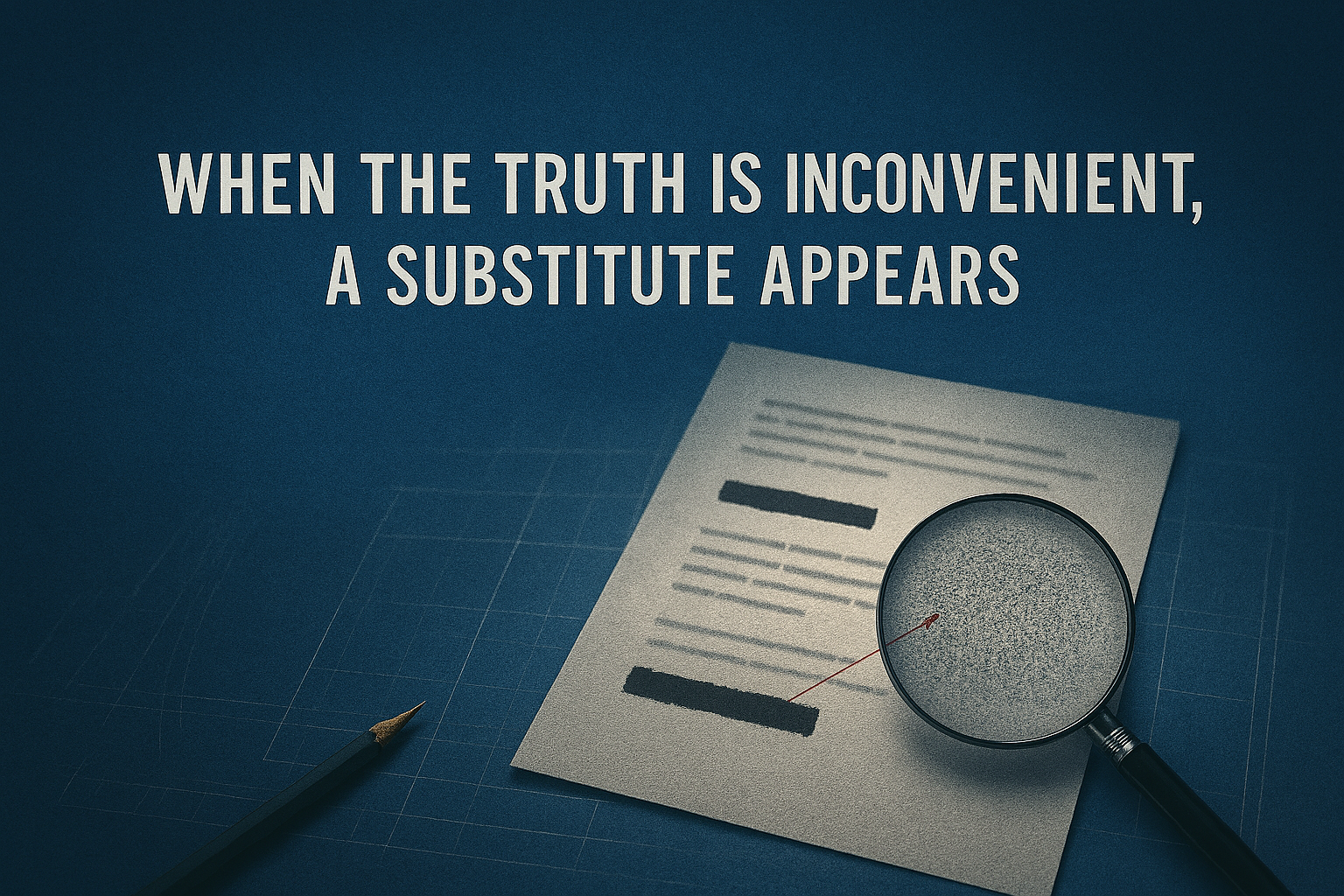
This HERO image establishes the investigative blueprint for the entire series.
The deep forensic blue background evokes a lab table under examination, grounding the viewer in the emotional register of Clarity — the moment when distortion is named, not amplified. The centered upper‑third caption functions as the thesis: a calm, clinical statement of the pattern you’re exposing.
What to Look For
The evidence cluster on the right side is intentionally sparse: a blurred document, a single redacted line, a magnified pixelated detail, and a thin red connector. Each element signals a different layer of counterfeit behavior — concealment, substitution, distortion, and motive. The strong overhead spotlight (shining from above) is the brightest in the trilogy, reinforcing that Part I is about illumination rather than interpretation.
Why It Matters
The composition directs the eye from principle → evidence → distortion, mirroring the cognitive path you want the reader to take. Nothing in the frame is decorative; every element serves the investigative logic of the Forgery Lab motif. This image teaches the viewer how to read the series: slowly, critically, and without falling for the spectacle of the counterfeit itself.
A brief note about the post that sparked this page
How Manipulated and Deepfake Content Is Designed to Break Into Public View
Source Summary
Where the Forgery Gives Itself Away
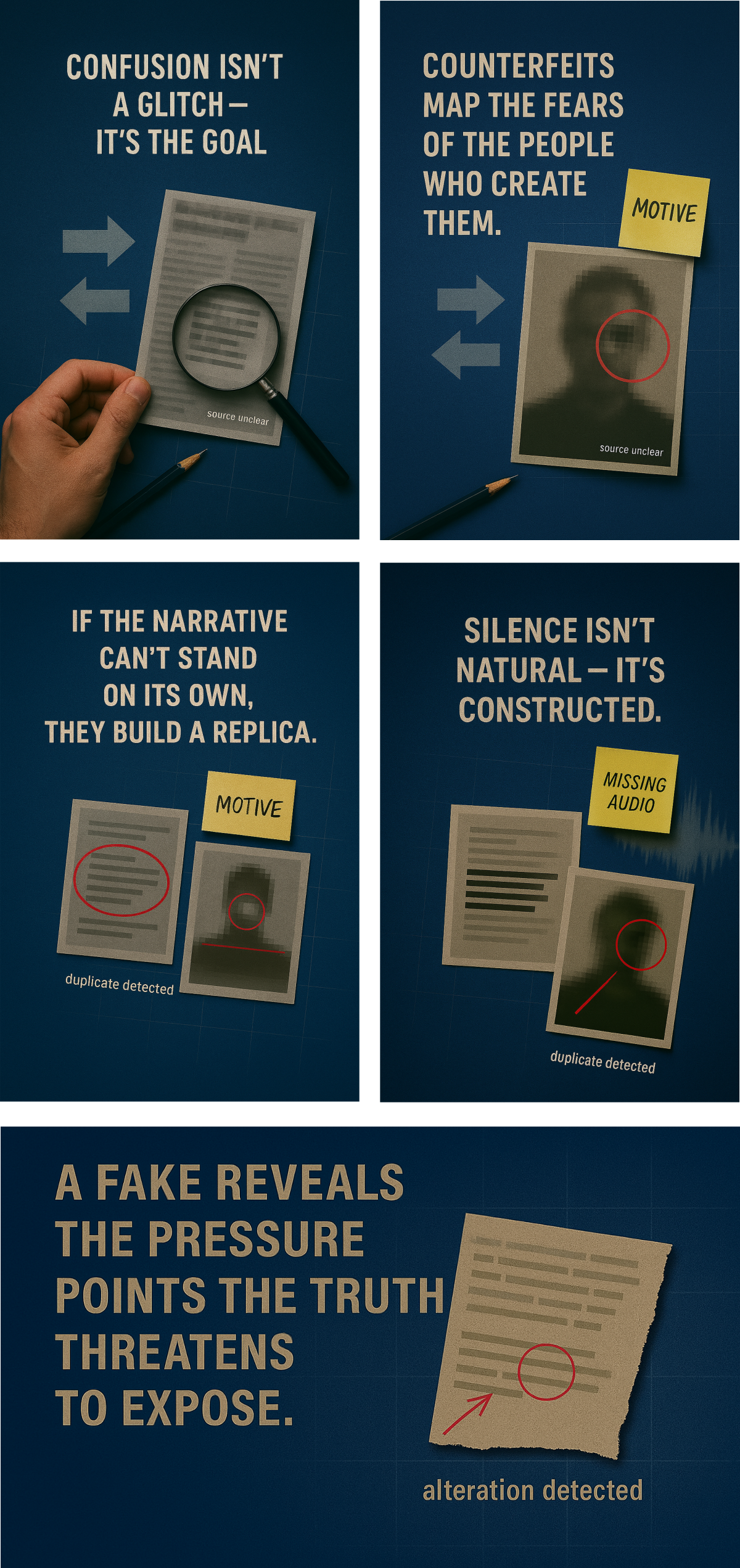
A counterfeit always tells on itself. Even when the creator’s goal is deception, the flaws they try to hide become the very clues that reveal the truth they fear. Every blurred edge, every mismatched shadow, every forced narrative beat exposes the pressure points they hoped no one would notice. The fake becomes a map — not of what happened, but of what someone needed you to believe.
In that way, the forgery becomes its own confession. It shows where the truth was too inconvenient, too threatening, or too powerful to leave untouched. It shows the lengths someone will go to distort public understanding. And it shows how easily a manipulated image can ripple through people’s emotions before anyone has a chance to question it.
But the moment the alteration is detected, the spell breaks. What was meant to mislead becomes evidence instead — evidence of the vulnerability being exploited, evidence of the civic harm being attempted, evidence of the truth trying to push its way back into the light. The fake reveals the very thing it was designed to bury.
Explore the Trilogy:
- Part I — What Counterfeits Reveal
- Part II — The Age of Manufactured Reality
- Part III — Seeing Through the Noise
Author’s Note
This trilogy was written to help readers navigate a world where distortion has become routine
and clarity feels increasingly rare. My intention is that these pages offer a steady place to
return to whenever the noise rises or the mirrors close in. We protect our shared reality by
learning to see clearly — and by refusing to surrender that skill to anyone. Clarity isn’t loud.
It’s steady. And steadiness is its own form of strength.