The Lineage of Unquiet Women
The world she inherits was shaped by women who refused to be made small, and a father who listened. Their courage is not a myth she studies but a lineage she stands inside — a long, unbroken line of women who challenged the terms written for them and men who learned to unlearn what they were taught. She does not walk into history empty‑handed. She walks forward carrying the space they carved, the truth they named, and the refusal they passed down like a birthright.

This page draws from Women’s History Month (For My Daughter) by Robert L. Arnold, published March 15, 2025, in which Arnold reflects on the world his daughter is inheriting and the lineage of women who shaped his understanding of strength, writing, “I want to give her the lineage of women who refused to be ruled by the small imaginations of small men,” a declaration that anchors this page’s motif of inheritance, unquiet women, and generational refusal to shrink; for those who want to hear the source in Robert’s own voice, the full video is available here: Watch on YouTube.
“She inherits a lineage that refuses to shrink.”

Design Notes
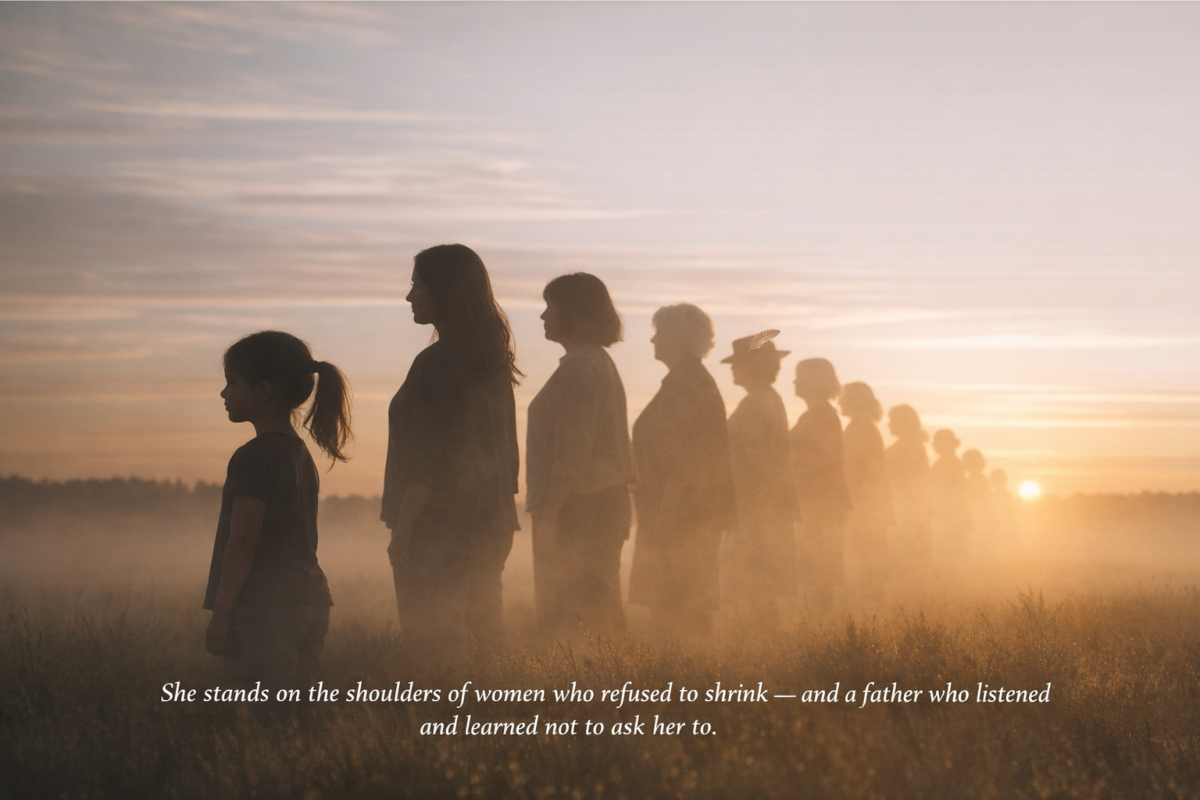
Why This Image This image was chosen to visually embody the emotional and civic truth of the Pull Quote: “Our daughter’s legacy is a lineage that refuses to shrink.” The silhouette of the young girl at the front of the line is not a portrait — it’s a symbol. She is not alone. She is not performing strength. She is simply upright, present, and carried by the women behind her. The diagonal line of silhouettes across generations creates a visual arc of inheritance, refusal, and quiet continuity. Symbolic Function Each woman in the line represents a generation that refused to be made small. Their faces are not shown — because this is not about individual identity or heroism. It’s about posture, presence, and legacy. The girl at the front is the inheritor, not the culmination. The feather added to the fifth woman’s hat is a subtle cue: femininity without fragility. The mist and horizon suggest that the lineage stretches beyond what can be seen — past and future. Civic Meaning This image declares that the daughter’s strength is not innate — it is inherited. She walks forward not because she was taught to be strong, but because she was never asked to shrink. The father’s evolution is included in the caption, not the image — reinforcing that his role is supportive, not central. The civic message is clear: the future is shaped by those who refuse to diminish others. Why It Opens the Page This image is the emotional and architectural doorway. It sets the tone: reverent, unshrinking, lineage-aware. It prepares the reader to enter a page that honors refusal, inheritance, and the quiet revolution of evolved fatherhood. It does not demand attention — it earns it.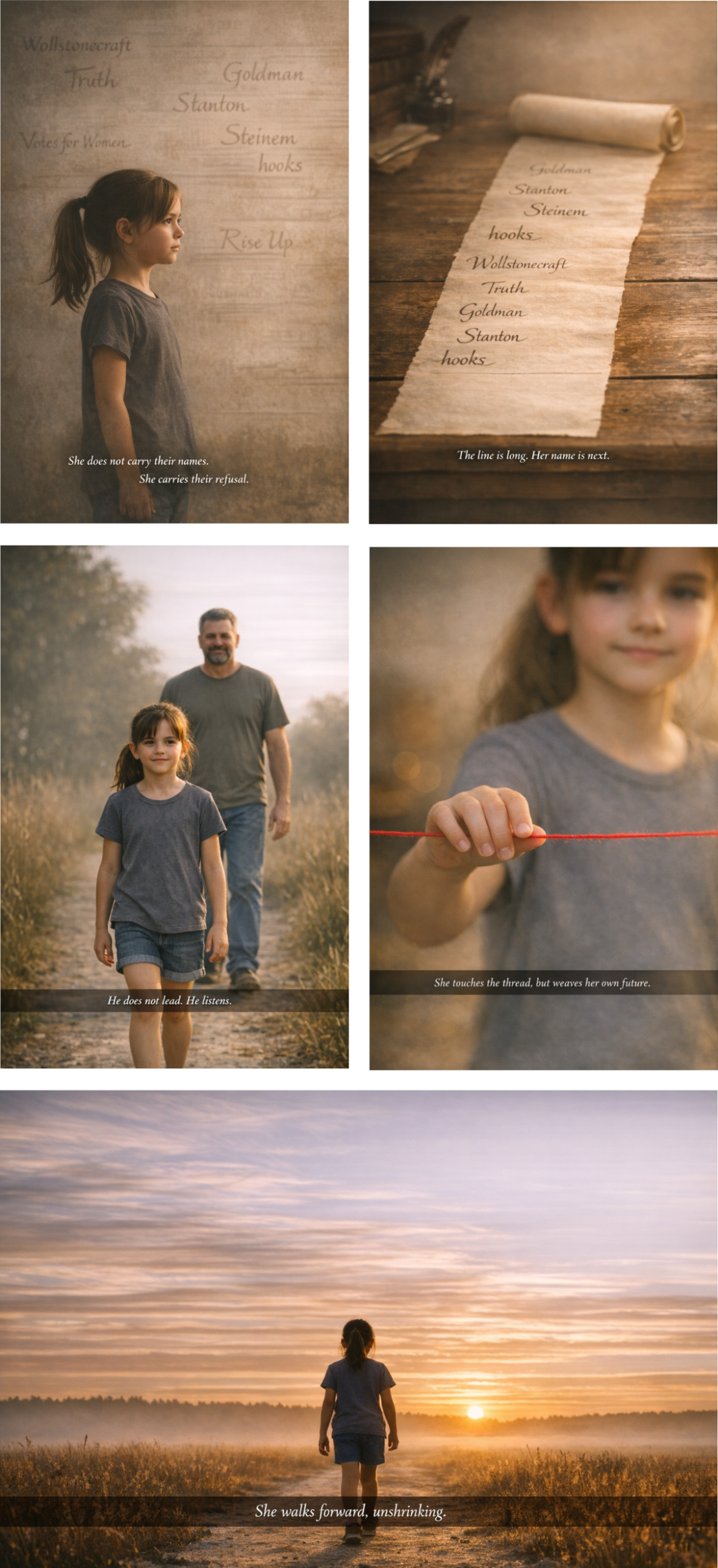
Details This is what it looks like when a lineage refuses to shrink.
When Community Becomes Structure Robert Arnold’s reflection begins with a father’s fear — not of strong women, but of the weak men who feel threatened by them. He names the strange mathematics his daughter will one day encounter: brilliance dismissed as loudness, autonomy mistaken for arrogance, dignity questioned as if it must be earned. He admits that he has been shaped by a culture that teaches boys to dominate before it teaches them to understand, and he speaks plainly about the lifelong work of unlearning. That work, he says, has been taught to him by women who refused to be small so that fragile men could feel tall. He widens the lens to the civic landscape his daughter will inherit — a landscape shaped by men who chip away at rights, autonomy, and dignity in an attempt to protect their own fragility. He names the insecurity wrapped in scripture, patriotism, and tradition, and he acknowledges that every woman he has ever loved carries stories of dismissal, harassment, and punishment for daring to exist at full scale. His fear is not abstract. It is rooted in the lived experiences of women who have told him the truth about the world he had not been taught to see From there, he turns to lineage. He places his daughter in a line that stretches across centuries — Wollstonecraft, Truth, Goldman, Stanton, Steinem, hooks, Zonneveld — women who refused to accept the terms written for them by men afraid of their power. He rejects the idea of raising a polite daughter or a quiet one. Instead, he names her inheritance: a tradition of women who challenged domination, rewrote democracy, and insisted that freedom means nothing if it does not belong to women as well. He closes with a blessing disguised as a charge. His daughter was never meant to be agreeable, never meant to be small, never meant to apologize for her voice. She was meant to be powerful — powerful enough that injustice feels the ground shake when she stands. Powerful enough that the comfortable lies of the powerful begin to crack when she speaks. The future, he says, does not belong to the men who tried to control women. It belongs to the women who refused to be controlled.This is what it looks like when a lineage refuses to shrink.
Move the Unshrinkable Line Forward.