The Power They Teach Children Is the Power We Forget as Adults
We don’t lose our power all at once. It slips away in small, ordinary moments — the kind we’re taught not to notice. Somewhere between childhood and adulthood, the world convinces us that agency is something we outgrow, when in truth, it’s something we’re conditioned to forget. But the power we learned first — the power to choose, to act, to intervene — never disappears. It waits for us to remember it.

In her Facebook video reflection, educator and commentator Joanna Johnson (Unlearn16) highlights a series of Disney park interactions that show how intentionally the company teaches children what agency feels like — from characters who hug for as long as the child chooses, to cast members who sign with Deaf guests, to a five‑year‑old dressed as Rey Skywalker stopping the First Order with a single raised hand. Posted in 2025, Johnson describes these moments as “psychologically formative,” giving children a lived sense of dignity, safety, and personal power long before they have the vocabulary for it. Her framing sits squarely in The Work of Repair, reminding us that the emotional architecture of agency is built early, reinforced through compassion, and carried into adulthood whether we recognize it or not. Source: Joanna Johnson (Unlearn16), Facebook video, December 14, 2025. Watch the video: Here “That is going to be a psychological, formative moment she carries for the rest of her life.”

Design Notes
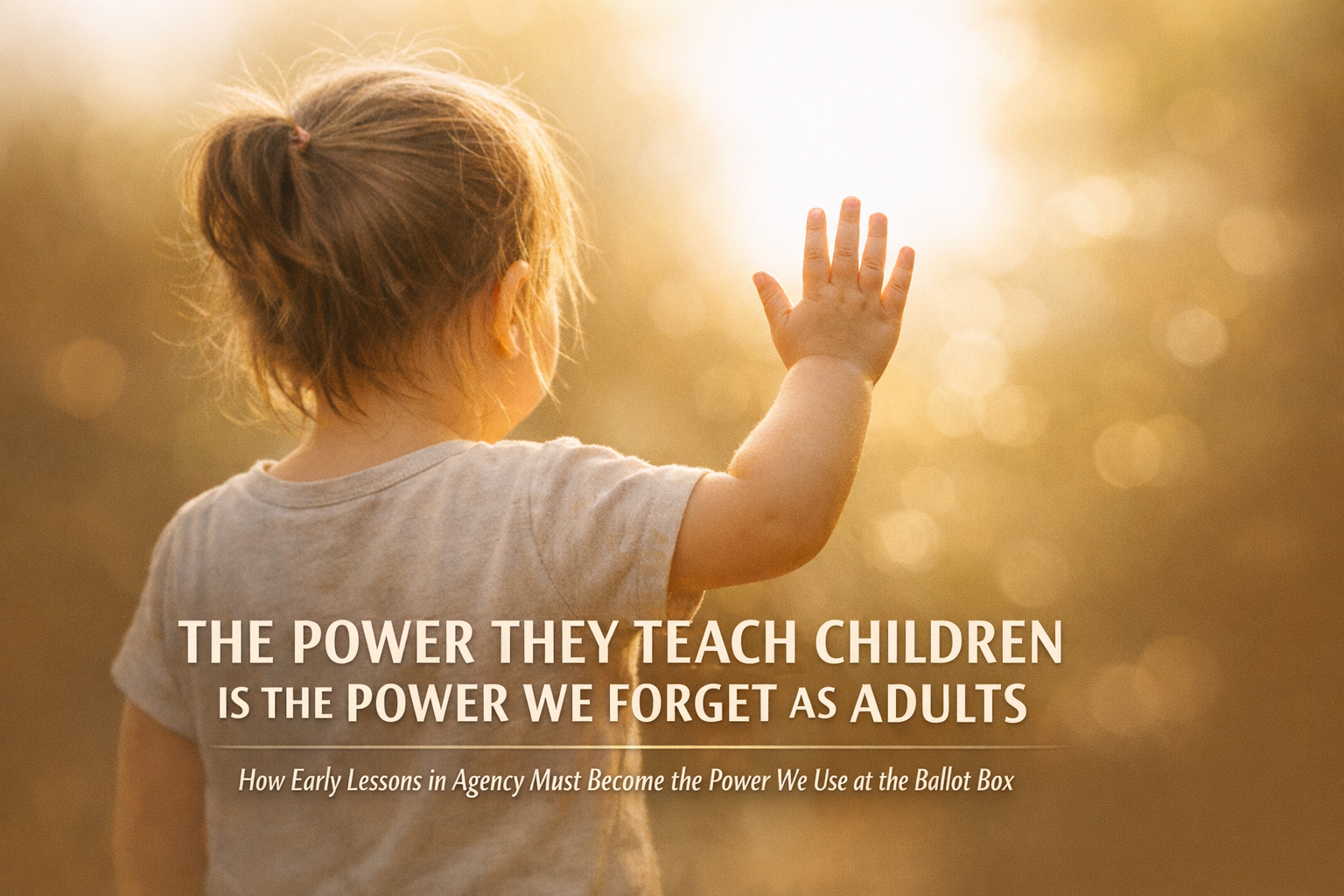
Why this image This image captures the exact moment where childhood agency first sparks: a small hand reaching toward light, possibility, and something just beyond immediate understanding. It’s not about a specific child or a specific story — it’s about the universal posture of early power. The soft glow, the upward reach, and the unguarded curiosity all signal the beginning of a lifelong relationship with capability. This is the emotional origin point the page is built on. Symbolic function The raised hand functions as both a gesture of discovery and a gesture of declaration. It is the earliest version of “I can,” long before language or civic vocabulary enters the picture. The warm light symbolizes the world reflecting back affirmation — the moment a child learns that their actions matter. The blurred background reinforces that the environment is secondary; the agency is internal. This image becomes the motif’s anchor: the first power we ever feel is the one we later abandon. .Civic meaning The page argues that the power children naturally express — confidence, curiosity, self‑directed action — is the same power adults must reclaim to participate meaningfully in democracy. This image makes that argument visible. The child’s gesture mirrors the adult gesture of raising a hand to vote, to speak, to intervene, to stop harm, to choose a direction. It reminds the reader that civic power is not something learned late in life; it is something remembered. The HERO image reframes voting not as a bureaucratic task, but as the adult continuation of a childhood truth: your actions shape the world. Why it opens the page This image opens the page because it returns the reader to the beginning — before cynicism, before overwhelm, before the noise of adulthood. It establishes the emotional baseline the rest of the page will build from: the purity of early agency. By starting here, the page invites the reader to reconnect with a power they once held effortlessly. It sets the tone for the entire narrative arc: from childhood instinct → to adult amnesia → to civic reclamation. The HERO image is the doorway back to the part of ourselves democracy needs most.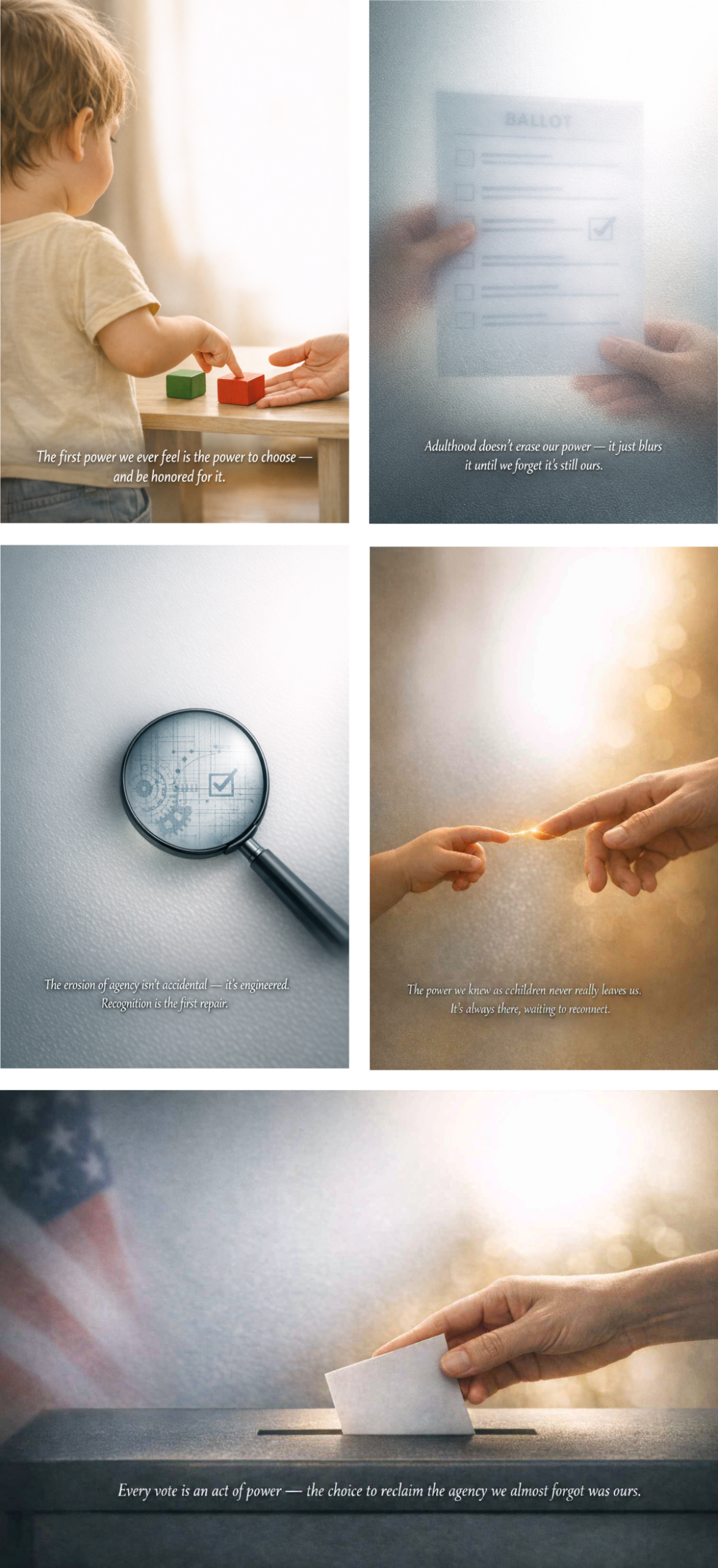
Details — There’s a quiet truth beneath all of this.
Where the Power Begins Children learn power long before they learn the word for it. They learn it in the moments when adults let them lead — when a character waits for them to finish a hug, when a princess kneels to their height, when a five‑year‑old raises her hand at Kylo Ren and the world rearranges itself around her courage. These moments teach a truth that becomes foundational: your actions matter, and the world responds to you. It’s not fantasy. It’s early agency, delivered in a form children can understand. How Adulthood Interrupts It But somewhere between childhood and adulthood, that agency gets interrupted. Not erased — interrupted. The world begins teaching a different lesson: that power belongs to institutions, to experts, to people who “know better,” to systems that feel too large to influence. Adults are trained to shrink, to defer, to believe that the levers of change are too far away or too complicated to reach. The power they once felt instinctively becomes something they assume they’ve outgrown, when in reality, it was taken from them by design. The Body Remembers First And yet, the original lesson never disappears. It sits dormant, waiting for a moment that feels safe enough to surface again. That’s why the Disney videos hit so hard — they remind adults of a truth they once lived inside: that confidence is not naïve, that agency is not imaginary, and that the world can shift because of a single gesture. The emotional reaction isn’t nostalgia. It’s recognition. It’s the body remembering something the mind forgot. Reclaiming the Original Lesson The work of adulthood — and the work of democracy — is not to learn power from scratch. It’s to reclaim the power we were taught before we had language for it. The power to raise a hand. The power to intervene. The power to choose a direction. The power to stop the First Order, whatever form it takes in the real world. Childhood teaches the muscle. Adulthood decides whether we use it.
Reclaim the Power You Were Taught to Forget. It’s What Democracy Needs Now.