No Calvary. Just Courage.
The ground didn’t suddenly change — we finally started paying attention to the people who’ve been tending it all along.
Mississippi didn’t deliver a miracle; it revealed a truth this country keeps trying to ignore: communities rise when they are seen, invested in, and taken seriously. This page names that shift and refuses to let the old narratives stand unchallenged.

In “On Blessed Hearts and Better Ones,” Robert Arnold reflects on recent electoral shifts in Mississippi and the broader South, describing community‑driven organizing efforts and long‑standing regional dynamics. The video discusses local engagement, historical context, and the conditions that shaped the outcome. You may watch the video HERE:
“They built their own momentum without the cavalry. No national spotlight, no deep‑pocketed campaign machinery.”

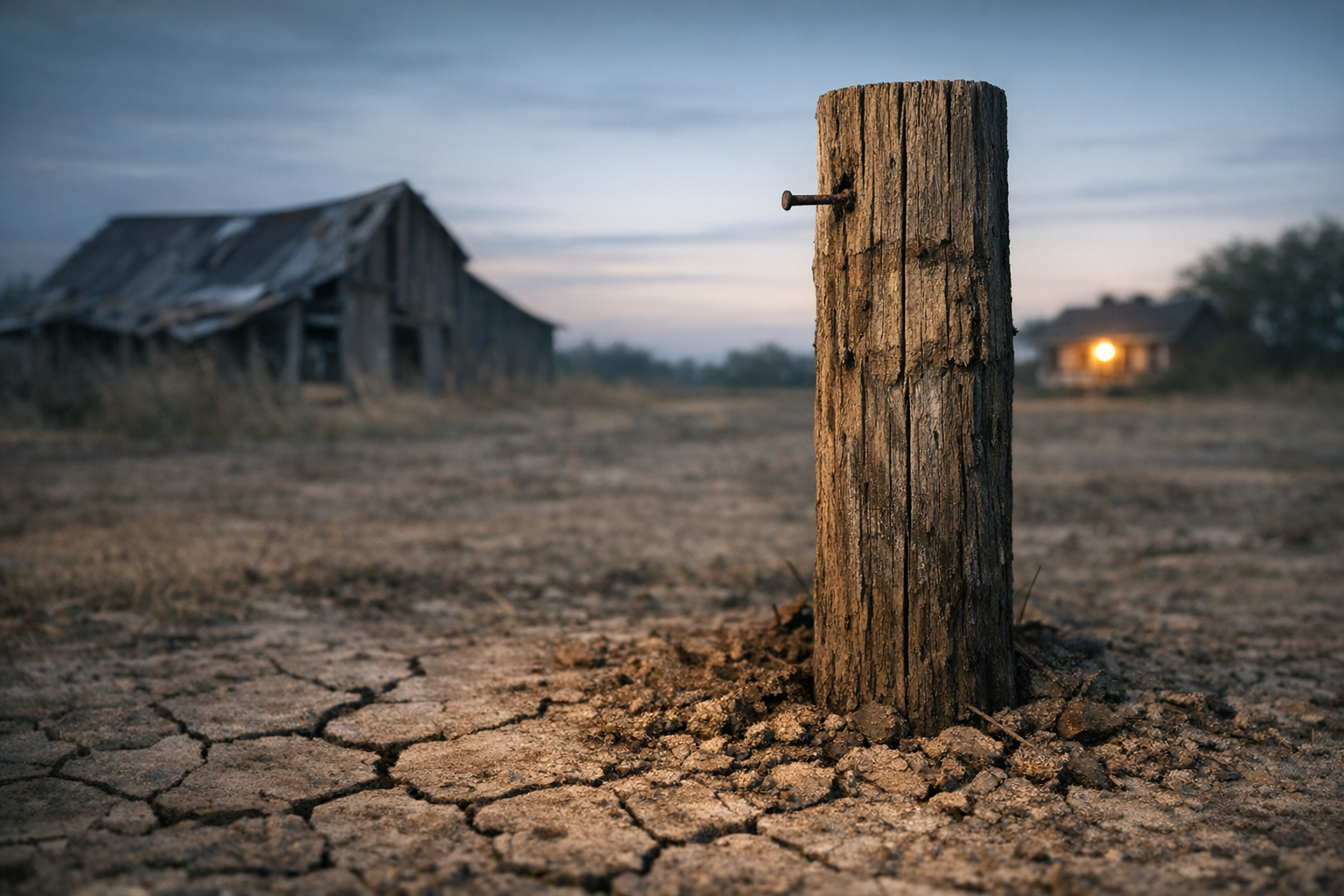
Why This Image Looks the Way It Does
The image centers on a single wooden post standing in cracked soil to express structural endurance under strain. The leaning barn and the distant porch light are placed to show surrounding instability without overshadowing the upright form in the foreground. Every element is chosen to reflect conditions that are stressed but still holding, consistent with the motif’s focus on resilience in the face of collapse.
What to Look For
Notice the nail embedded in the post and the faint impressions where a sign once hung — subtle indicators of past weight and ongoing purpose. The barn’s sagging roof contrasts with the post’s upright stance, while the porch light introduces a small but persistent point of steadiness in the distance. The cracked soil grounds the entire scene in visible pressure.
Why It Matters
This composition highlights the quiet strength required to remain standing when the structures around you are faltering. The image reinforces the page’s central theme: courage is not the absence of strain but the decision to hold firm within it. The visual cues prepare the viewer for the narrative that follows, anchoring the emotional architecture of the page
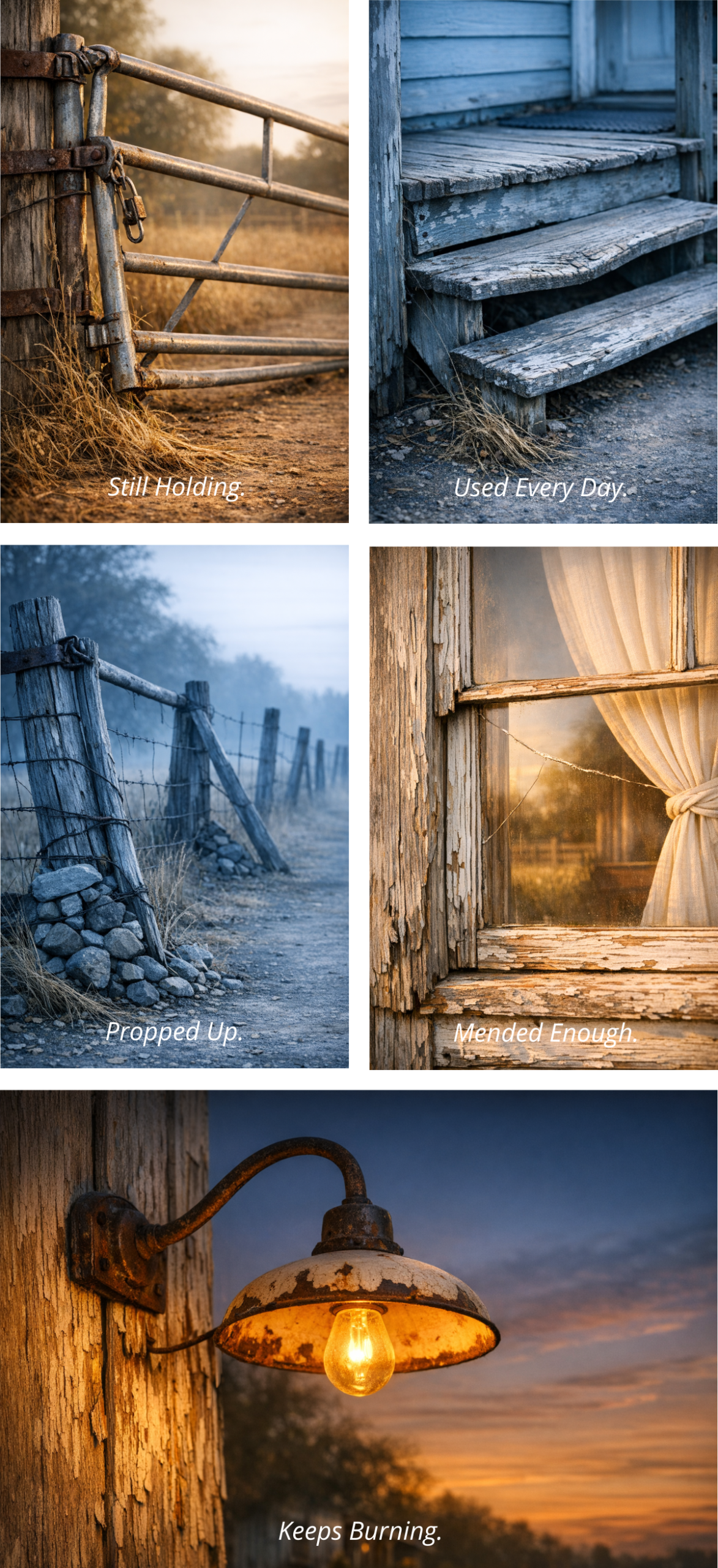
Origin Vignette — The Ranch Years
Before the civic pages and the careful grids, there was a ranch — a place where the world was
measured not in deadlines but in chores, sunlight, and the sound of hooves. I was twelve when
I first stood on a gate like the one in Still Holding, testing its strength and my own.
By thirteen, I was driving the Jeep across the pasture, learning the geometry of motion and trust.
The mornings smelled of hay and soap; the afternoons of dust and diesel. I learned the rhythm
of milking, the patience of feeding pigs, the strange tenderness of repair — how a bent hinge or
cracked frame could still hold if you cared enough to mend it.
And somewhere between the fences and the fields, I met Ralph — my first love, my first proof
that even in hard work, there’s room for wonder.
Those years taught me what endurance looks like: not perfection, but persistence. Every image
in this series — the gate, the steps, the fence, the window, the light — carries that lesson
forward. They are the architecture of care, built from the same hands that once steadied a Jeep
on uneven ground and learned that love, like a fence line, sometimes leans but never quite falls.
A brief note about the post that sparked this page
Details
Why This Post Matters
This post matters because Mississippi just proved something the rest of the country keeps forgetting:
the South is not silent, and it is not waiting for permission. What happened there wasn’t a miracle,
of new voters or a sudden shift in demographics — it was the people who’ve been here all along
deciding they were done being dismissed. Done being written off. Done being told their voices
don’t count.
This moment is a reminder that the ground is already fertile. The organizers are already working.
The communities are already awake. What’s been missing isn’t will — it’s investment, belief, and
the basic respect of being taken seriously.
Mississippi cracked the myth of inevitability. It showed that hope isn’t imported from the coasts;
it grows in the dirt, in the sweat, in the stubborn grace of people who have never stopped trying
to make this place better. This post honors that truth. It names the shift. It calls out the
institutions that still don’t see it. And it stands with the people who are doing the work anyway.
Because the South isn’t lost. It’s rising. And this time, it’s rising on its own terms.
Rise From Where You Stand.