Actions Beget Responses: When the Republic Speaks Back
Power never moves alone; it always reveals something about the intent behind it. In a constitutional republic, every public act, every statement, every decision casts a shadow that the law is obligated to examine. Authority may speak loudly, but its shadow speaks truthfully — and that truth becomes part of what the Republic must interpret. The Opening Strike sets the tone by reminding readers that the Republic’s mechanisms are not passive observers; they are active interpreters of what power reveals.
When leaders act, they do more than govern — they reveal motives. Sometimes that motive is clear and principled. At other times, it is obscured, wrapped in rhetoric, or disguised behind urgency or emotion. But regardless of how it appears, intent is never invisible. It becomes part of the constitutional record, part of the judiciary’s responsibility, part of the Republic’s duty to read. This page begins by acknowledging that power’s shadow is not metaphorical; it is evidentiary.
The Opening Strike also frames the reader’s role. Citizens often assume that only laws or policies matter, but the Republic’s design says otherwise. Courts routinely examine the meaning behind public statements, the context surrounding decisions, and the intent that animates authority. This is not political theater — it is constitutional practice. By understanding this, readers gain a clearer view of how accountability actually functions in a free society.
Finally, this Opening Strike prepares the reader for the page’s central lesson: the Republic is not merely watching power — it is responding to it. The judiciary, equal protection, and constitutional guardrails activate when intent touches the rights of the people. The Republic sees what power reveals, and it must examine what intent hides behind authority. This is the foundation upon which the rest of the page stands.

The foundation for this page rests on long‑standing constitutional principles that define how the Republic responds when those in power act or speak in ways that implicate equal protection. Across generations, judicial opinions have reaffirmed that public statements by government officials are not merely political theater; they can serve as evidence of intent when courts evaluate whether constitutional boundaries have been crossed. This understanding appears consistently in rulings that examine discriminatory motive, selective enforcement, or unequal treatment under the law. The judiciary’s responsibility is not passive — it is triggered when authority signals intent that touches protected rights.
Legal scholarship and constitutional commentary further reinforce this dynamic. Analysts routinely note that the judiciary serves as a structural counterweight, designed to activate when executive or legislative behavior raises questions about fairness or equal protection. These sources emphasize that the Republic’s design anticipates moments when rhetoric becomes relevant to legal scrutiny. When leaders speak publicly about groups, policies, or enforcement priorities, those statements can become part of the factual landscape courts must consider. The Republic’s mechanisms are built to interpret not only actions, but the meaning behind them.
Historical patterns also inform this page’s premise. Across different eras, courts have examined how official statements illuminate the intent behind governmental decisions. Whether evaluating civil rights disputes, immigration policies, or enforcement practices, the judiciary has repeatedly acknowledged that public rhetoric can reveal motive. These precedents demonstrate that accountability is not an abstract ideal — it is a recurring feature of constitutional governance. When power reveals its intentions, the Republic responds through structured, principled review.
In the end, the through‑line in these sources is unmistakable: authority never operates in a vacuum, and its choices inevitably ripple outward into the Republic it serves. Each example reinforces the same civic truth — that power carries obligations, that intent matters, and that the Republic retains both the right and the responsibility to evaluate how authority is used. It is this evaluative function that keeps equal protection anchored as a non‑negotiable guardrail and ensures that power’s shadow is always examined — and, when necessary, is expected to be held to account.
Source Material: Original Article
“Every action casts a shadow — and the law reads it.”

Design Notes
Why This Image
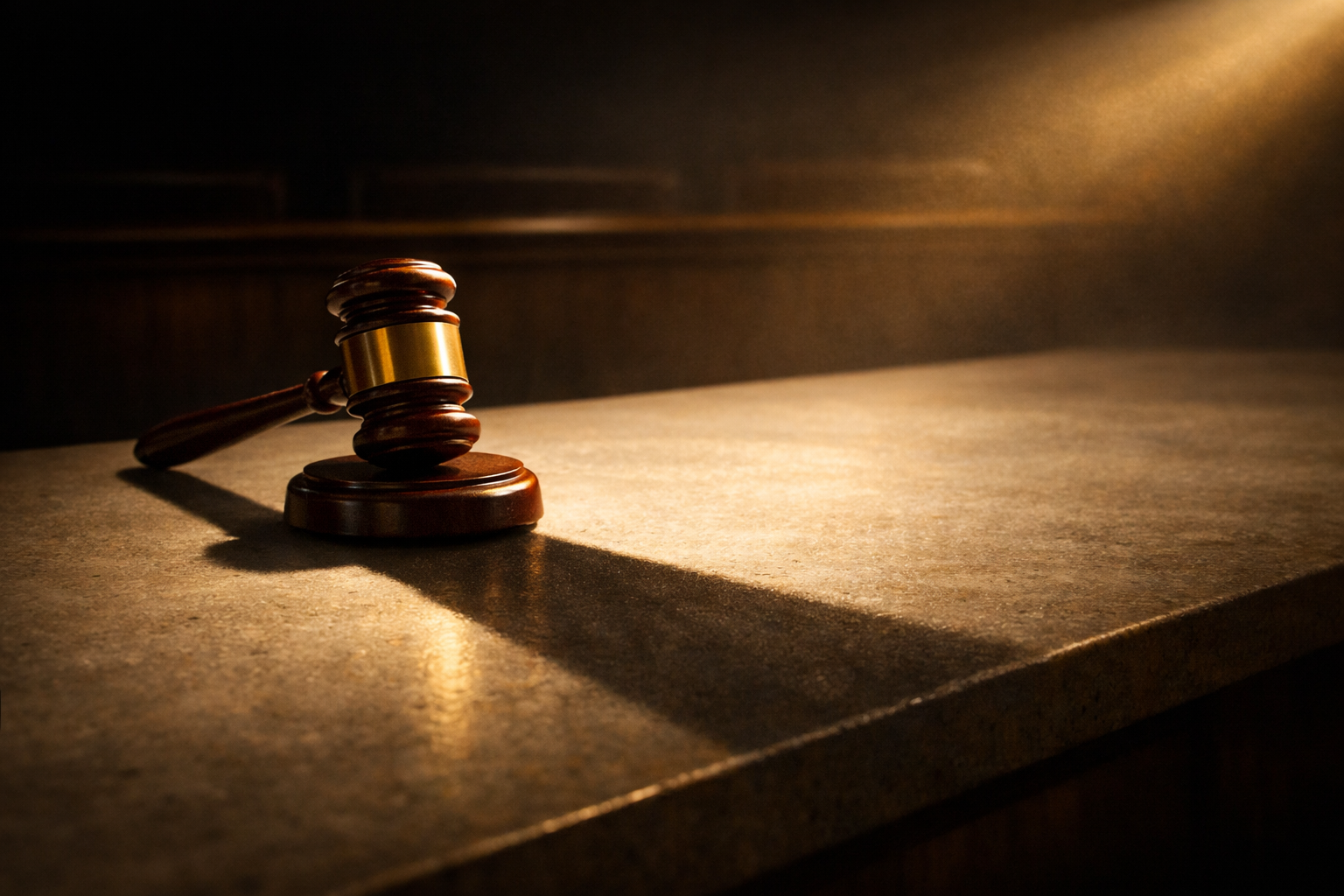
The HERO image was chosen because it visually embodies the page’s thesis: actions beget responses. The upright gavel represents authority in motion — the act of power. The long shadow stretching across the bench is the Republic’s answer, the visible consequence of that authority. The composition is simple, deliberate, and constitutional in tone, allowing the viewer to feel the weight of accountability without distraction.
Symbolic Function
The shadow is not merely a visual effect; it is the motif’s central metaphor. It symbolizes the trace every act of power leaves behind — the evidence, the intent, the constitutional echo that the judiciary must examine. The light source, rendered in Republic Gold, represents the Republic’s scrutiny — principled, illuminating, and nonpartisan. The bench itself anchors the image in institutional stability, reminding viewers that the Republic’s mechanisms are enduring.
Civic Meaning
This image teaches that authority is never isolated. In a constitutional republic, every exercise of power generates a visible consequence that the law must interpret. The gavel’s shadow is the Republic’s mirror — a reflection of accountability. It reminds citizens that equal protection and judicial review are not abstract ideals but active, living principles that respond whenever power reveals intent.
Why It Opens the Page
The HERO image opens the page because it visually declares the page’s central lesson before a single word is read. It sets the emotional and intellectual tone: solemn, constitutional, and self‑correcting. The viewer immediately understands that this page is about the Republic’s duty to see what power reveals — and that the shadow itself is the story.
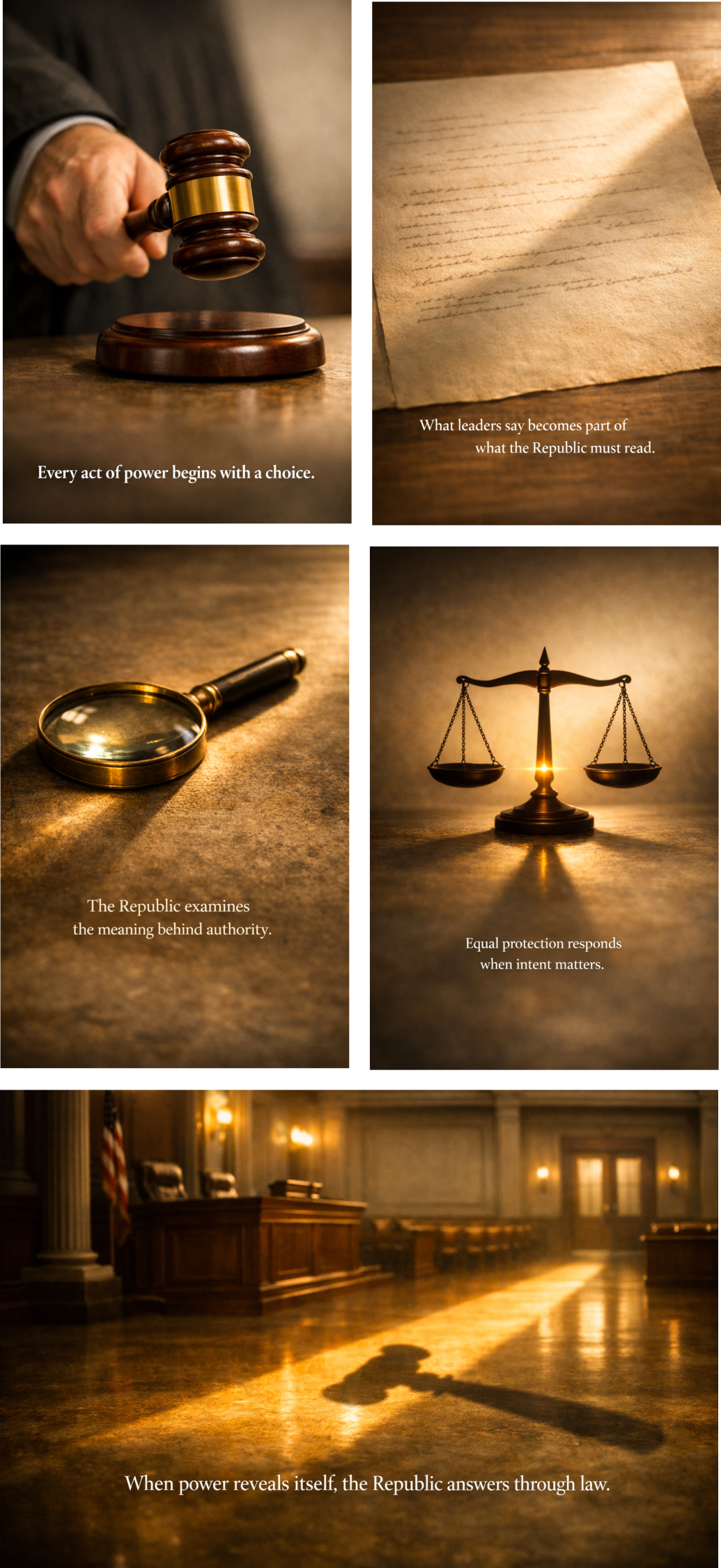
Sometimes, the moment that matters most is the one where the Republic decides how to respond.
Why This Post Matters
The Republic is built on the idea that power must always be accountable to something larger than itself. This page matters because it reminds readers that authority is not a free‑floating force; it exists within a constitutional structure designed to interpret, evaluate, and respond to the intent behind public actions and statements. When leaders reveal their motives — intentionally or unintentionally — those revelations become part of the constitutional landscape the judiciary is obligated to examine.
This matters because equal protection is not a passive principle. It activates when intent touches protected rights, when rhetoric signals discriminatory motive, or when public statements illuminate the reasoning behind governmental decisions. The Republic’s design anticipates these moments. It expects the judiciary to read the shadow cast by authority and determine whether it aligns with constitutional boundaries. This page teaches that scrutiny is not optional — it is structural.
It also matters because citizens often underestimate how deeply public statements can influence judicial review. Many assume that only formal policies or enacted laws carry weight, but history shows that courts routinely consider the meaning behind words spoken by those in power. This page helps readers understand that intent is not invisible; it becomes part of the record, part of the evidence, part of the Republic’s duty to interpret.
Finally, this post matters because it reinforces a core civic truth: the Republic speaks back. It responds through law, through precedent, through equal protection, and through the judiciary’s obligation to examine what power reveals. The shadow cast by authority is not a metaphor alone — it is a constitutional reality. And understanding that reality strengthens the public’s grasp of how accountability works in a free society.
Who examines what intent hides behind authority? The Republic must.
It is the Republic’s duty to see what power reveals.