The Line That Should Never Be Crossed: Retaliation Against Protected Speech
Power doesn’t always announce itself when it decides to cross a line; sometimes it simply shifts its weight and waits to see if anyone notices. That first movement is small, almost polite, wrapped in the language of exceptions, necessities, or temporary measures. But beneath that soft veneer is the beginning of something predatory, the moment power decides it can wound without consequence. This is the point where retaliation stops being hypothetical and becomes intentional.
I call this moment the Opening Strike — the first retaliatory act that reveals how far power is willing to go when it believes the target is too small, too isolated, or too unprotected to fight back. The Opening Strike is not designed to be dramatic. It is designed to be deniable. It is the quiet test of whether anyone will object when power harms someone for speaking, and whether the boundary meant to restrain that harm still carries any force.
What makes the Opening Strike dangerous is not its size; it’s its direction. Once power discovers that a constitutional line can be crossed without consequence, the next breach becomes easier, then easier still. The fracture widens. The justification grows. The exception becomes precedent. The First Amendment doesn’t collapse in a single moment — it erodes through a series of small retaliatory acts aimed at people who were never meant to carry the burden of defending constitutional norms in the first place, nor alone.
The Opening Strike is the civic warning shot — not because it is loud, but because it is quiet. It tells us exactly how power behaves when it thinks no one is watching. It shows us the first mark left by retaliation, the first crack in restraint, the first sign that liberty is being tested at its weakest point. And once that mark exists, it becomes part of the record — a breach that cannot be ignored.

Source Summary
Amanda created a satirical video criticizing Vice President Vance, using humor, exaggeration, and political commentary to highlight concerns about his conduct and influence within the administration. The satire also referenced the broader administration, but Vance was the central figure. Her video was a lawful political expression, fully protected under the First Amendment.
Shortly after the video circulated online, Amanda attended a public event where the president and vice president were present. During the event, a Secret Service agent approached her and made a pointed remark referencing her satire: “We know where you stand.” The comment was tied directly to her criticism of Vance and was not part of any security protocol. This interaction is a key moment because it suggests that federal authority was used to single out a citizen based on her political expression.
Amanda later filed a lawsuit arguing that the government retaliated against her for protected speech. Her claim asserts that the Secret Service’s conduct constituted viewpoint-based retaliation — a violation of the First Amendment. The constitutional principle at issue is clear: government actors cannot intimidate, threaten, or penalize citizens for expressing political views, including satire directed at high-ranking officials.
The case raises broader concerns about the misuse of government authority and the chilling effect such actions can have on political expression. When officials respond to criticism with intimidation, it can deter citizens from speaking freely. The lawsuit underscores the importance of maintaining strict boundaries between legitimate security functions and actions that target individuals based on their speech, especially when the speech involves criticism of powerful public figures.
Source Material: Cats on a couch V Just Dance Vance – video
“The test is whether government officials may use the authority of the state to reward friends and punish critics.”

Design Notes
Why This Image
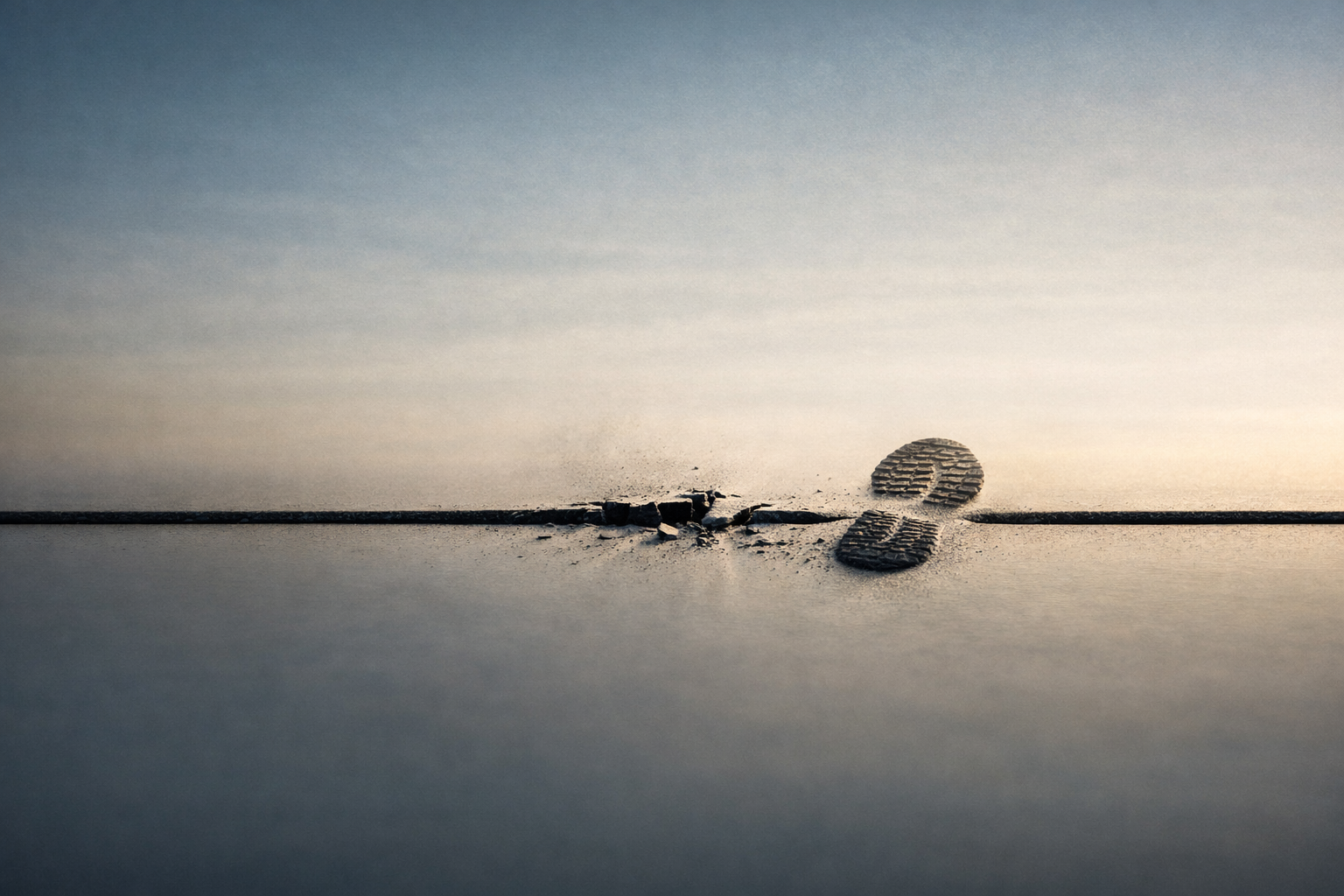
The HERO depicts a single horizontal boundary line fractured at one point, with a lone footprint resting just beyond the break. This image was chosen because it visually distills the entire constitutional question of the page: a line that should not be crossed, and the moment someone chooses to cross it. The simplicity of the composition ensures that the viewer immediately understands the gravity of the breach without distraction or narrative clutter.
Symbolic Function
The unbroken line represents constitutional limits — the boundaries that protect speech, restrain power, and define the rule of law. The fracture symbolizes the act of retaliation: a misuse of authority that breaks what should remain intact. The footprint is the human element — the deliberate step over the boundary. It is not a path, not a trail, not a walk. It is a single decisive act. The image freezes the exact moment of overreach, making the breach itself the focal point.
Civic Meaning
This HERO communicates that constitutional erosion does not begin with dramatic collapse; it begins with one breach, one exception, one moment when someone in power steps over a line meant to restrain them. The image reinforces the page’s central warning: retaliation against protected speech is not merely improper — it is a constitutional violation that leaves a mark. The footprint shows that the breach is human‑made, intentional, and consequential. It is the visual embodiment of the civic truth that liberty erodes one exception at a time.
Why It Opens the Page
The HERO sets the tone for the entire Civic Page by presenting the core danger before a single word is read. It frames the reader’s understanding: this is a story about a boundary crossed. By opening with the breach, the page signals that everything that follows — the case, the pattern, the stakes — flows from this moment. The HERO is the visual thesis of the page, anchoring the motif, the pull quote, and the narrative arc. It prepares the reader to understand that what happened to Amanda is not an isolated incident, but rather a breach of a clear constitutional line.
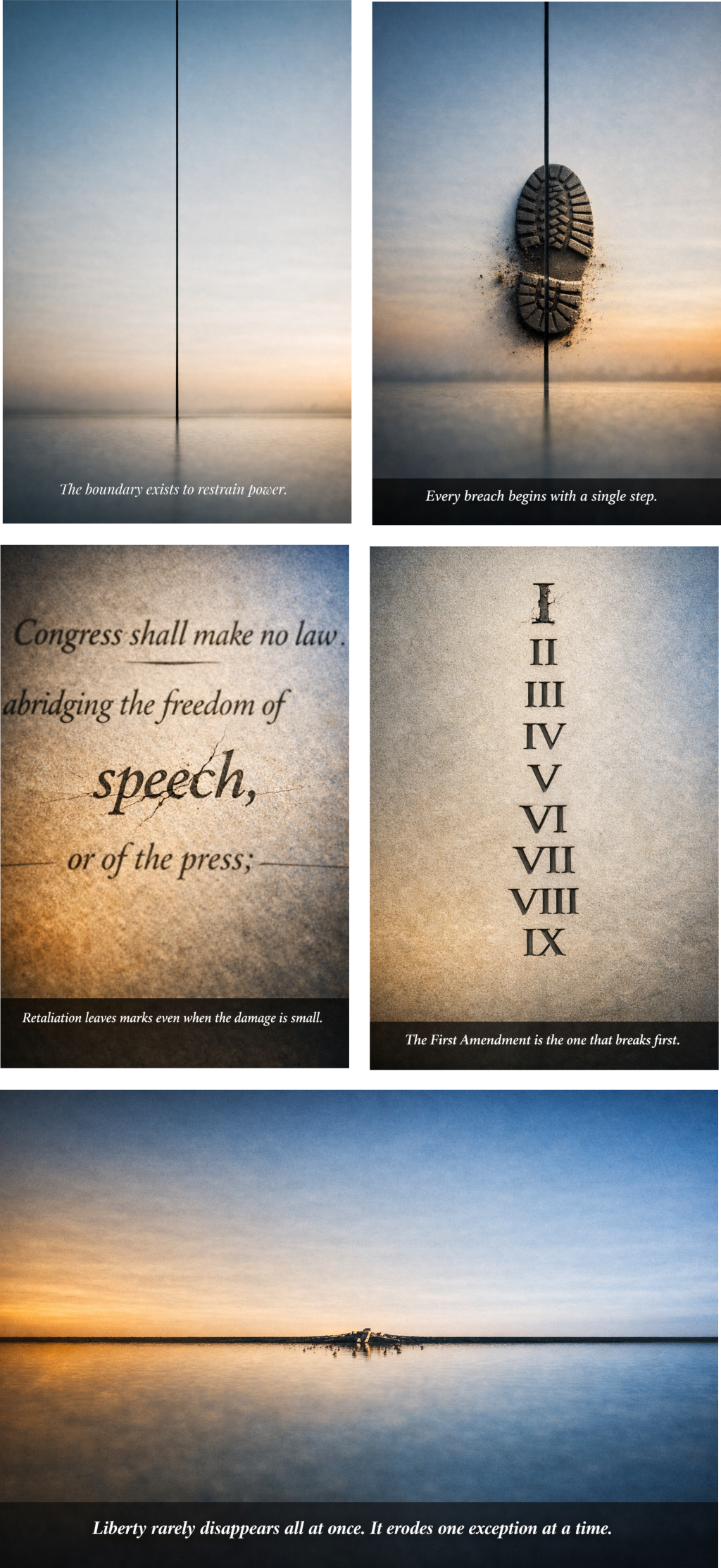
The breach begins long before the damage is visible.
Why This Post Matters
Retaliation against protected speech is not a minor misstep. It is a direct breach of the boundary that restrains power. When a government actor responds to criticism with punitive intent, the act itself becomes a warning sign — a footprint across a constitutional line that was never meant to be crossed.
The First Amendment is often described as foundational, but in practice, it is the most fragile. It breaks first because it is tested first. Retaliation rarely arrives as a dramatic event; it begins quietly, through small acts meant to discourage dissent, chill participation, or punish those who speak plainly. These early marks matter because they reveal the mindset of the actor, not just the action.
Liberty does not disappear all at once. It erodes through exceptions, justifications, and “only this time” rationalizations. Each breach, even when small, normalizes the next. This post matters because it documents the pattern — the shift from governance grounded in restraint to governance shaped by reaction.
By naming the breach, we reinforce the boundary. By documenting the footprint, we preserve the record. Civic clarity is not commentary; it is a public service. Discernment is not criticism; it is a safeguard. This post exists to ensure that the erosion is visible before it becomes irreversible.
Human‑made governance requires human‑made vigilance. The act of witnessing, recording, and calling out retaliation is not optional — it is part of the democratic duty we share. This post stands as one more mark in the ledger of accountability, ensuring that the line remains visible even when others attempt to step across it.
Liberty endures when breaches are seen, recorded, and refused.
Every breach leaves a mark that cannot be ignored.