
The Civic Dictionary
A voter‑ready guide to clarity, patterns, and civic distortion.
Why This Matters
This dictionary is designed to help you recognize common distortion patterns, stay grounded when information feels noisy or confusing, and make clearer,
more confident decisions in civic life. It’s not about telling you what to think; it’s about giving you language and structure so you can see what’s happening and decide for yourself.
SECTION I — Opening Frame: Why This Dictionary Exists
Every election season brings noise, confusion, and a flood of information that isn’t always what it appears to be. Some of it is accidental. Some of it is intentional. All of it affects how people think, react, and vote.
This dictionary exists to give readers a shared language for recognizing the patterns behind that noise.
These terms aren’t about candidates or parties. They’re about behavior, tactics, and distortion structures that show up across history, across institutions, and across modern communication channels. When people can name a pattern, they can see it faster. When they can see it faster, they can stay grounded. And when they stay grounded, they make clearer decisions — including at the ballot box.
This is a practical tool. It’s meant to be used in real time, especially during the final stretch before an election, when distortion spikes and clarity becomes essential. You don’t need to memorize anything. You don’t need to study. You just need to recognize what you’re looking at.
If you understand the pattern, you understand the moment.
II. Motif Family Introductions
The nine distortion engines of modern civic behavior — explained with down‑home clarity and a little friendly wit.
Understanding Cluster Motifs vs. Standalone Motifs
Motifs in this dictionary come in two forms: Cluster Motifs and Standalone Motifs. Both describe patterns of civic distortion, but they function differently.
Cluster Motifs are families of related distortions. They contain multiple terms because the distortion shows up in several recognizable ways. Story, Canyon, Porch, Spotlight, and Neighbor motifs each include a cluster of terms that share a common behavioral pattern.
Standalone Motifs represent distortions that don’t branch into multiple forms. They stand alone because the distortion is singular, direct, and doesn’t split into sub‑patterns. Ripple, Fog, Tilt, and Echo motifs fall into this category — each one captures a specific type of civic distortion that doesn’t require multiple variations.
Cluster Motifs help readers see the range of distortions within a theme. Standalone Motifs help readers recognize a distortion that is simple, clear, and self‑contained.
Cluster Motifs contain multiple terms, so they use the word “Cluster.” Standalone Motifs contain only one term, so they use only the motif name without “Cluster.”
And once you see these patterns, you’ll start spotting them faster than gossip travels at a church potluck.
III. The Dictionary Terms
Each term follows this structure: TERM NAME, Definition, Poli‑Sci Counterpart, Example.
StoryCluster — Narrative Distortions
Story motifs describe what happens when narratives bend, stretch, fog, or drift. These distortions arise from the way people tell stories — how they frame events, interpret motives, or retell information with missing pieces, added color, or emotional tilt. Story distortions often feel harmless, but they can quietly reshape how communities understand issues, people, and events. When a story shifts, even slightly, the meaning shifts with it.
If you’ve ever watched a tale grow bigger every time it’s told — like a fish that mysteriously gains a pound with each retelling — you already know how StoryCluster works.

StoryCluster — Narrative Distortions
StoryStretch Spiral
Definition: When a narrative expands beyond the original facts, gaining extra details, assumptions, or emotional color as it spreads.
Poli‑Sci Counterpart: Narrative inflation; framing distortion.
Example: A simple disagreement becomes “a long‑running feud” once folks retell it enough times to add their own seasoning.
StoryFog Drift
Definition: When unclear or incomplete storytelling leads people to fill in the blanks with assumptions, creating drift away from what actually happened.
Poli‑Sci Counterpart: Ambiguity bias.
Example: Someone hears half a story and fills in the rest as if they’re frosting a cake — generously and inaccurately.
StoryShadow Misread
Definition: When a person interprets a story through their own fears, biases, or past experiences, casting a “shadow” over the meaning.
Poli‑Sci Counterpart: Projection; interpretive bias.
Example: A neutral comment feels hostile because it reminds someone of a past mess they never quite cleaned up.
StoryRipple Misfire
Definition: When a story spreads quickly but inaccurately, causing reactions based on misinterpretation rather than fact.
Poli‑Sci Counterpart: Information cascade error.
Example: A misunderstood text message gets passed around faster than a rumor at a family reunion.
StoryTrail Drift
Definition: When a story changes slightly each time it’s retold, creating a trail of small distortions that add up to a major misread.
Poli‑Sci Counterpart: Telephone effect; iterative distortion.
Example: By the fifth retelling, the original event has been stretched, folded, and baked into something entirely new.
StorySnatching
Definition: When someone takes another person’s story and reframes it to serve their own narrative, agenda, or emotional needs.
Poli‑Sci Counterpart: Narrative appropriation; reframing manipulation.
Example: A personal moment gets repurposed like leftover casserole — suddenly it’s part of someone else’s argument.
StoryTumble
Definition: When multiple small narrative distortions pile up, causing the story to collapse into confusion, exaggeration, or emotional overrun.
Poli‑Sci Counterpart: Cognitive overload; narrative collapse.
Example: A simple event becomes a full‑blown saga because everyone added their own dramatic flair.
CanyonCluster — Amplification & Exaggeration
Canyon motifs capture distortions that grow louder, bigger, and more dramatic as they echo through groups, media, or social spaces. These patterns exaggerate emotion, escalate conflict, and amplify misunderstandings. Canyon distortions often begin small but expand rapidly, creating a sense of urgency or threat that may not match reality. When something echoes in a canyon, it rarely returns in its original form.
This is where a molehill becomes a mountain — and then someone paints a warning sign on the mountain and calls the neighbors.

CanyonCluster — Amplification & Exaggeration
CanyonEcho Amplification
Definition: When a claim, emotion, or misunderstanding grows louder and more extreme as it bounces through a group.
Poli‑Sci Counterpart: Echo‑chamber amplification.
Example: A minor concern becomes “a community crisis” after enough people repeat it with raised eyebrows.
CanyonFog Misread
Definition: When dramatic framing or emotional escalation makes people misread the original situation.
Poli‑Sci Counterpart: Affect bias; threat inflation.
Example: A tense conversation gets retold like it was a showdown fit for a movie trailer.
CanyonTilt Drift
Definition: When repeated dramatic framing nudges perception in one direction.
Poli‑Sci Counterpart: Framing bias; emotional drift.
Example: Hearing only the dramatic version makes the calm version sound like someone’s trying to hide something.
CanyonShadow Expansion
Definition: When a small issue casts a large “shadow” because dramatic retelling exaggerates its importance.
Poli‑Sci Counterpart: Catastrophizing; issue magnification.
Example: One mistake becomes “a pattern of failure” after enough retellings with heavy sighs.
CanyonRipple Misread
Definition: When an amplified misunderstanding spreads quickly.
Poli‑Sci Counterpart: Social contagion; misinformation spread.
Example: People react to a rumor like it’s breaking news, even though nobody checked the source.
CanyonTrail Drift
Definition: When each retelling adds a little more drama, creating a trail of escalating distortions.
Poli‑Sci Counterpart: Iterative exaggeration.
Example: By the time the story reaches the tenth person, it’s grown more twists than a daytime soap.
PorchCluster — Everyday Misreads & Assumptions
Porch motifs represent the small, familiar distortions that happen in everyday interactions — the casual misreads, quick assumptions, and interpersonal fog that shape how neighbors interpret each other. These distortions are subtle but powerful, influencing trust, communication, and community cohesion. Porch distortions often arise from incomplete information, habitual assumptions, or emotional overrun in ordinary moments.
If you’ve ever waved at someone who didn’t wave back and spent the next hour wondering what you did wrong — welcome to PorchCluster, friend.

PorchCluster — Everyday Misreads & Assumptions
PorchRipple Misread
Definition: When a small misunderstanding spreads through casual conversation, causing people to react to a misread rather than the original moment.
Poli‑Sci Counterpart: Social inference error; informal misinformation spread.
Example: A neighbor misreads a tone, mentions it to someone else, and suddenly half the block has an opinion.
PorchShadow Drift
Definition: When someone interprets an everyday interaction through their own emotional residue or past experiences, casting a “shadow” over what was actually meant.
Poli‑Sci Counterpart: Attribution bias; emotional projection.
Example: A neutral comment feels dismissive because it hits the same nerve as something from last year.
PorchFog Misalignment
Definition: When unclear communication or missing context causes two people to walk away with different interpretations of the same moment.
Poli‑Sci Counterpart: Ambiguity misalignment; communication gap.
Example: A short text gets read as irritation when the sender was just juggling three things at once.
PorchTilt Expansion
Definition: When a small personal bias nudges someone’s interpretation of an everyday interaction, causing the meaning to expand beyond what actually happened.
Poli‑Sci Counterpart: Cognitive tilt; interpretive drift.
Example: A quick glance gets interpreted as judgment because someone was already feeling self‑conscious.
PorchSpark Misread
Definition: When a tiny moment — a glance, a pause, a tone — sparks an outsized emotional interpretation that doesn’t match the intention.
Poli‑Sci Counterpart: Micro‑cue misinterpretation; affective priming.
Example: Someone assumes irritation because a reply came with a sigh — never mind the allergies.
PorchTrail Drift
Definition: When a small misunderstanding gets retold casually, picking up slight distortions each time until the final version barely resembles the original interaction.
Poli‑Sci Counterpart: Informal narrative drift; interpersonal telephone effect.
Example: A simple scheduling mix‑up becomes “they’re always unreliable” after a few porch‑side retellings.
SpotlightCluster — Attention‑Driven Distortions
Spotlight motifs describe distortions caused by visibility, charisma, loudness, or attention‑seeking behavior. When someone or something is placed under a spotlight, perception shifts — details glow brighter, flaws fade, and emotional reactions intensify. Spotlight distortions can elevate minor issues, magnify personalities, or skew judgment simply because something is seen more, heard more, or talked about more.
It’s the civic version of stepping on stage — suddenly everything looks bigger, brighter, and twice as dramatic.

SpotlightCluster — Attention‑Driven Distortions
SpotlightEcho Drift
Definition: When repeated attention causes a claim or emotion to drift from its original meaning, simply because it keeps getting echoed in visible spaces.
Poli‑Sci Counterpart: Availability heuristic; echo‑driven perception drift.
Example: A minor comment becomes “the main issue” because it keeps getting repeated like it’s headline material.
SpotlightFog Expansion
Definition: When intense attention creates confusion or exaggeration, making people misread the situation because the spotlight itself distorts the details.
Poli‑Sci Counterpart: Spotlight effect; salience distortion.
Example: A small mistake feels huge because everyone suddenly has something to say about it.
SpotlightShadow Drift
Definition: When visibility causes people to interpret motives or meaning through a distorted lens, casting a “shadow” over the person or issue being spotlighted.
Poli‑Sci Counterpart: Attribution bias; reputational distortion.
Example: Someone’s neutral action gets read as strategic simply because people are paying extra attention.
SpotlightTilt Misread
Definition: When attention nudges perception in one direction, causing people to interpret events through a skewed lens simply because the spotlight is pointed there.
Poli‑Sci Counterpart: Framing bias; salience tilt.
Example: A routine decision looks suspicious because it happened under bright lights and loud opinions.
SpotlightRipple Misalignment
Definition: When reactions spread outward from a highly visible moment, causing people to respond emotionally to the spotlight rather than the actual event.
Poli‑Sci Counterpart: Social contagion; attention‑driven misalignment.
Example: People react strongly to a clip they saw online without knowing the ten minutes that came before it.
SpotlightGlare Drift
Definition: When intense visibility creates a “glare” that blinds people to nuance, making the situation appear more extreme, dramatic, or urgent than it is.
Poli‑Sci Counterpart: Salience glare; perceptual exaggeration.
Example: A simple disagreement looks like a major conflict because it’s happening in front of an audience.
NeighborCluster — Community Perception Distortions
Neighbor motifs capture the distortions that arise from interpersonal interpretation — how people read each other’s actions, motives, tone, or silence. These patterns often involve projection, assumption, or emotional filtering. Neighbor distortions spread quickly through communities, shaping group behavior, alliances, and misunderstandings. When we misread a neighbor, we often misread the community around them.
This is the motif where one raised eyebrow can start a whole neighborhood mystery.

NeighborCluster — Community Perception Distortions
NeighborRipple Misread
Definition: When a small interpersonal misunderstanding spreads through a community, causing reactions based on the misread rather than the original moment.
Poli‑Sci Counterpart: Social inference error; informal misinformation spread.
Example: One person misreads a tone, mentions it to a friend, and suddenly everyone “heard” the wrong version.
NeighborShadow Drift
Definition: When someone interprets another person’s actions through their own emotional residue or past experiences, casting a “shadow” over the interaction.
Poli‑Sci Counterpart: Projection; attribution bias.
Example: A neighbor’s quietness gets interpreted as disapproval because it resembles a past conflict.
NeighborFog Misalignment
Definition: When unclear communication or missing context causes two people to walk away with mismatched interpretations of the same interaction.
Poli‑Sci Counterpart: Ambiguity misalignment; communication gap.
Example: A short reply gets read as irritation when it was simply rushed.
NeighborGlance Drift
Definition: When a brief moment — a glance, a pause, a gesture — gets interpreted with more meaning than intended, causing perception to drift away from reality.
Poli‑Sci Counterpart: Micro‑cue misinterpretation; affective priming.
Example: Someone assumes judgment because a neighbor looked away mid‑conversation — probably at a squirrel.
NeighborSpark Expansion
Definition: When a tiny interpersonal moment sparks an outsized emotional interpretation, expanding far beyond what the original action meant.
Poli‑Sci Counterpart: Emotional amplification; affective overread.
Example: A delayed wave becomes “they’re upset with me” after one emotional spark and a long afternoon.
NeighborTilt Drift
Definition: When personal bias nudges someone’s interpretation of another person’s behavior, causing a subtle but persistent drift in how they read that person.
Poli‑Sci Counterpart: Cognitive tilt; interpretive bias.
Example: Someone assumes negative intent because they’ve already formed a tilted impression — and haven’t checked it since.
Ripple — Reaction & Spread Distortions
Ripple motifs represent the distortions that occur when reactions spread outward from a single moment. These patterns show how one misunderstanding, one emotional surge, or one misread can jump from person to person, gaining speed or intensity. Ripple distortions are about movement — how civic confusion travels, multiplies, or shifts as it spreads.
Think of it like dropping a pebble in a pond — except the pond is social media and the pebble is a half‑read headline.

Ripple — Reaction & Spread Distortions
RippleBlind Citizenship
Definition: When people react quickly to civic information without pausing to verify, reflect, or understand the context, causing decisions to be driven by momentum rather than clarity.
Poli‑Sci Counterpart: Reactive citizenship; impulsive political behavior.
Example: Someone shares a dramatic post immediately without checking whether it’s accurate — faster than you can say “Wait a second.”
RippleJump Reaction
Definition: When a person leaps to a strong emotional or civic reaction based on a small cue, causing the response to “jump” ahead of the facts.
Poli‑Sci Counterpart: Affective jump; premature conclusion bias.
Example: A headline triggers outrage before the full article is read — or even opened.
Fog — Confusion & Ambiguity Distortions
Fog motifs describe distortions rooted in uncertainty, vagueness, or missing information. Fog doesn’t change the facts — it simply makes them harder to see. These patterns create hesitation, misinterpretation, and emotional overrun because people fill in the blanks with assumptions or fear. Fog distortions thrive when clarity is absent, and speculation takes its place.
Fog is that moment when you squint at a text message and think, “Now what in the world did they mean by THAT?”

Fog — Confusion & Ambiguity Distortions
FogMisread Drift
Definition: When unclear information, missing context, or vague communication causes people to fill in the blanks with assumptions, leading their understanding to drift away from what’s actually true.
Poli‑Sci Counterpart: Ambiguity bias; uncertainty distortion.
Example: A vague statement gets interpreted as a warning simply because the details are missing — and imagination fills the gaps.
Tilt — Skew & Drift Distortions
Tilt motifs capture distortions that occur when perception leans in one direction — not dramatically, but noticeably. Tilt is subtle: a small skew, a slight drift, a gentle shift in interpretation. These distortions often come from personal bias, emotional residue, or prior experiences that nudge understanding off‑center. Tilt distortions are quiet but persistent, shaping how people interpret civic information without realizing it.
It’s the civic version of wearing one high heel and one flat — you’ll still get where you’re going, but you’ll lean the whole way there.

Tilt — Skew & Drift Distortions
TiltDrift Misread
Definition: When perception leans slightly in one direction because of personal bias, emotional residue, or past experience, causing a subtle misread that feels natural but isn’t accurate.
Poli‑Sci Counterpart: Cognitive bias; interpretive skew.
Example: Someone assumes negative intent because their perception is already leaning that way — like a picture frame that’s just a little crooked.
Echo — Repetition & Reinforcement Distortions
Echo motifs represent distortions created through repetition — when ideas, claims, or emotions bounce around until they feel true simply because they’re repeated. Echo distortions reinforce existing beliefs, amplify misunderstandings, and create a sense of consensus that may not exist. When something echoes long enough, it becomes familiar — and familiarity can feel like truth.
If you’ve ever heard something so many times you started believing it — even though you knew better — that’s Echo doing its thing.

Echo — Repetition & Reinforcement Distortions
EchoReinforce Loop
Definition: When an idea, claim, or emotion gains power simply because it keeps getting repeated, creating a loop where familiarity starts to feel like truth.
Poli‑Sci Counterpart: Illusory truth effect; repetition bias.
Example: A claim feels credible after hearing it many times — even though nobody remembers where it started.
IV. How to Use This Dictionary
Your guide to reading, recognizing, and applying the motifs — with a little friendly wit to keep things easy on the brain.
1. What This Dictionary Is Designed to Do
This dictionary helps readers recognize the subtle distortions that shape modern civic behavior — the narrative bends, emotional amplifications, interpersonal misreads, and attention‑driven shifts that influence how people understand events, issues, and each other.
It is not a list of “bad behaviors.” It is a pattern map — a way to see the mechanics behind confusion,
conflict, and civic fog.
Think of it like turning on the porch light: the critters don’t disappear, but at least you can see what’s skittering around.
2. How the Motifs Work
Each motif represents a type of distortion engine. Some motifs contain multiple related terms (Cluster Motifs).
Others stand alone with a single, precise distortion (Standalone Motifs).
Readers should think of motifs as categories, not judgments. They describe how a distortion behaves, not why
someone used it.
It’s not about calling people out — it’s about calling patterns out, gently and clearly.
3. How the Terms Work
Each term follows a consistent structure:
- TERM NAME — the distortion’s shorthand label
- Definition — what the distortion does
- Poli‑Sci Counterpart — the academic or behavioral equivalent
- Example — a simple, real‑world illustration
This format keeps every term recognizable, teachable, easy to apply, and easy to spot in real civic life.
If you can read a recipe card, you can read this dictionary.
4. How to Read a Cluster Motif
Cluster Motifs contain multiple terms because the distortion shows up in several recognizable ways. Readers should scan the whole cluster to understand the full range of distortions inside that motif family.
For example: StoryCluster shows how narratives stretch, drift, fog, or tumble. CanyonCluster shows how emotion or drama amplifies as it echoes. PorchCluster shows how everyday interactions get misread or over‑interpreted.
It’s like looking at all the shades of the same paint color — you need the whole strip to see the full picture.
5. How to Read a Standalone Motif
Standalone Motifs contain one term because the distortion is singular and doesn’t branch. Ripple, Fog, Tilt, and Echo each represent a distortion that is simple, direct, self‑contained, and instantly recognizable.
Readers should treat Standalone Motifs as precision tools — one term, one distortion, one clean definition.
Sometimes the simplest tools do the most work — like a good broom or a well‑timed “hold on now.”
6. How to Apply the Dictionary in Real Life
Readers can use this dictionary to:
- Identify distortions in conversations, media, and civic spaces
- Understand why misunderstandings spread
- Recognize emotional or narrative drift
- Reduce confusion in community interactions
- Improve clarity in civic discussions
- Teach others how to spot manipulation patterns
- Strengthen their ability to interpret information accurately
This dictionary is not about calling people out. It’s about calling patterns out — gently, clearly, and
without shame.
Because most confusion isn’t malicious — it’s just human.
7. How This Dictionary Supports Civic Clarity
When readers understand the motifs, they gain better emotional grounding, stronger interpretive skills, clearer communication, healthier community interactions, and more resilient civic behavior.
The dictionary becomes a tool for clarity, not a weapon.
It’s here to help folks talk to each other without needing a referee.
SECTION V — Visual Motif Map
The Visual Motif Map shows how the nine motifs relate to one another — which ones cluster,
which ones stand alone, and how they interact to shape the patterns we see in everyday civic life.
It is designed to give readers a quick, intuitive overview of the “landscape” behind the dictionary.
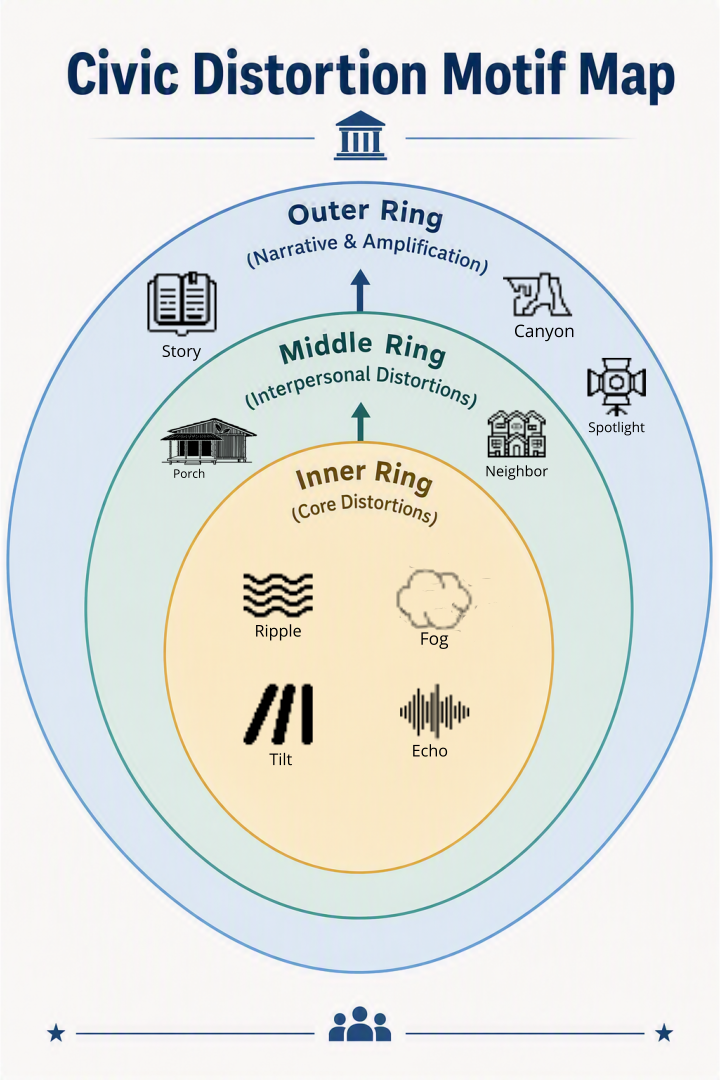
How to Read This Map
The map is organized to make the relationships between motifs easy to see at a glance:
- Cluster Motifs: Motifs that share a common behavioral theme are grouped together in clusters.
- Standalone Motifs: Motifs that operate independently sit outside the clusters.
- Color Coding: Each motif uses its own color palette to reflect its emotional or behavioral “temperature.”
- Proximity: Motifs placed closer together share conceptual similarities or often appear together in real life.
- Connections: Any lines or arrows (if present) suggest influence, flow, or interaction between motifs.
Cluster Motifs
The cluster motifs represent groups of patterns that tend to show up together or share a common root:
- StoryCluster:
Motifs rooted in narrative, framing, and the stories people tell to explain, justify, or reshape reality. - CanyonCluster:
Motifs shaped by distance, separation, or disconnect — emotional, social, or informational gaps between people. - PorchCluster:
Motifs centered on openness, welcome, and relational exchange — the spaces where conversation and connection happen. - SpotlightCluster:
Motifs focused on attention, visibility, and exposure — who is seen, how they are seen, and what gets highlighted. - NeighborCluster:
Motifs grounded in proximity, familiarity, and everyday interaction — the patterns that show up in our shared spaces.
Standalone Motifs
The standalone motifs sit outside the clusters because they can appear in many different contexts without belonging
to a single behavioral “neighborhood”:
- Ripple:
A single action or decision that sends effects outward, often in ways that reach far beyond the original moment. - Fog:
Uncertainty, confusion, or obscured truth — situations where clarity is missing and people struggle to see what’s real. - Tilt:
Imbalance, distortion, or skew — when the scales are subtly (or not so subtly) tipped in one direction. - Echo:
Repetition, reinforcement, or amplification — patterns that grow stronger as they are repeated or reflected back.
Together, these motifs form the landscape of the dictionary. The Visual Motif Map helps readers see how individual terms fit into a larger pattern, making the dictionary easier to navigate and the motifs easier to recognize and apply in real life.
SECTION VII — Closing Frame: How to Use This Dictionary During Election Season
You don’t need to read this dictionary straight through. You don’t need to master every term. You only need to use it the way it was designed: as a reference, a grounding tool, and a quick stabilizer when something feels off.
Here’s how to use it during the final weeks before voting:
- When a headline feels exaggerated, check the pattern.
- When a claim seems too perfect, too dramatic, or too urgent, check the pattern.
- When a conversation online feels engineered to provoke you, check the pattern.
- When you feel overwhelmed, confused, or pulled in ten directions, check the pattern.
The goal isn’t to tell you what to think. The goal is to help you stay steady while you think.
Distortion thrives in confusion. Clarity is its antidote. And clarity is what gets people to the polls.
This dictionary is one piece of a larger effort: helping voters stay confident, informed, and grounded enough to participate. Use it as often as you need. Share it with people who might benefit from it. And remember — the most powerful thing you can bring to an election is your ability to recognize what’s real.
Stay steady. Stay grounded. And vote.
Return to: Home Page
Visit: The Full Archive
Go to: The Glossary