A Nation Soaked in Gasoline
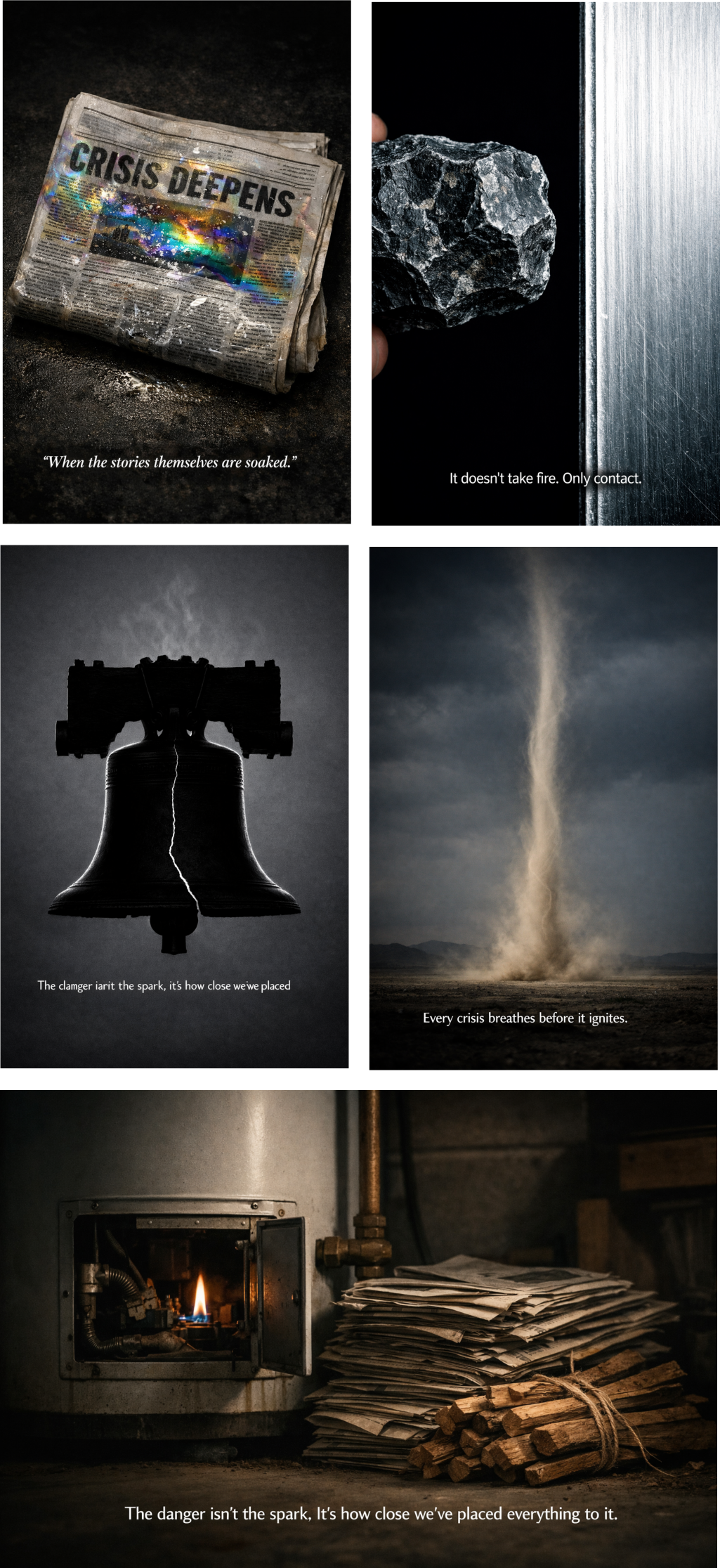
We talk a lot about the fires in American politics, but far less about the conditions that make them possible. The truth is simple and uncomfortable: nothing ignites on its own. Something has to be saturated. Something has to grind. Something has to heat. Something has to feed the air. And something has to sit too close to the spark. We are not a nation on the verge of spontaneous combustion. We are a nation living inside the perfect environment for ignition.
The danger isn’t the flame itself — it’s how easily the flame can appear. We’ve grown accustomed to a political and media ecosystem that keeps us flammable: overloaded with distortion, primed for conflict, and conditioned to react before we understand. These aren’t accidents. They’re the predictable outcomes of systems designed to reward heat over clarity, friction over truth, and proximity over safety.
A healthy democracy can withstand disagreement. What it cannot withstand is a constant state of pre-ignition — a country so saturated, so heated, and so oxygen-rich with outrage that the smallest spark becomes a national event. When everything is flammable, everything becomes a threat.
This page is not about the fire. It’s about the environment we’ve allowed to surround us. Because if we want a different future, we have to stop staring at the flames and start dismantling the conditions that make them inevitable.

Robert Arnold’s video essay, The Fire Next Time (May 15, 2026), examines the United States through the lens of James Baldwin’s warning that “God gave Noah the rainbow sign, no more water, the fire next time.” Arnold argues that the country has repeatedly ignored the moral and structural warnings embedded in its own history. His analysis frames the present moment as the consequence of accumulated injustice rather than an unexpected crisis.
Drawing on Baldwin, bell hooks, and Toni Morrison, Arnold traces a lineage of racial violence, political denial, and the erosion of civic trust. He emphasizes that the danger facing the nation is not sudden but engineered through decades of policy choices and cultural avoidance. The video positions humiliation, not chaos, as the true accelerant beneath democratic decline.
Arnold also critiques the role of white moderation and performative progressivism in sustaining the conditions that allow injustice to deepen. In this context, white moderation refers to opposing overt harm while prioritizing comfort or civility over confronting structural inequity, and performative progressivism describes the use of progressive language without a willingness to support or enact meaningful change. Arnold argues that these patterns function as oxygen in the fire triangle, feeding the conditions that make civic combustion possible.
The video concludes that the nation is approaching a point where people no longer believe reform is possible within existing structures. Arnold warns that “the flood was mercy; the fire is what happens when mercy is mocked for too long,” underscoring the motif of accumulated accelerants. The full video can be viewed at: [link].
“Every diluted vote, every censored history lesson, every smirking politician waving flags while stripping away representation is another match struck against a nation already soaked in gasoline.”

Design Notes
Why This Image
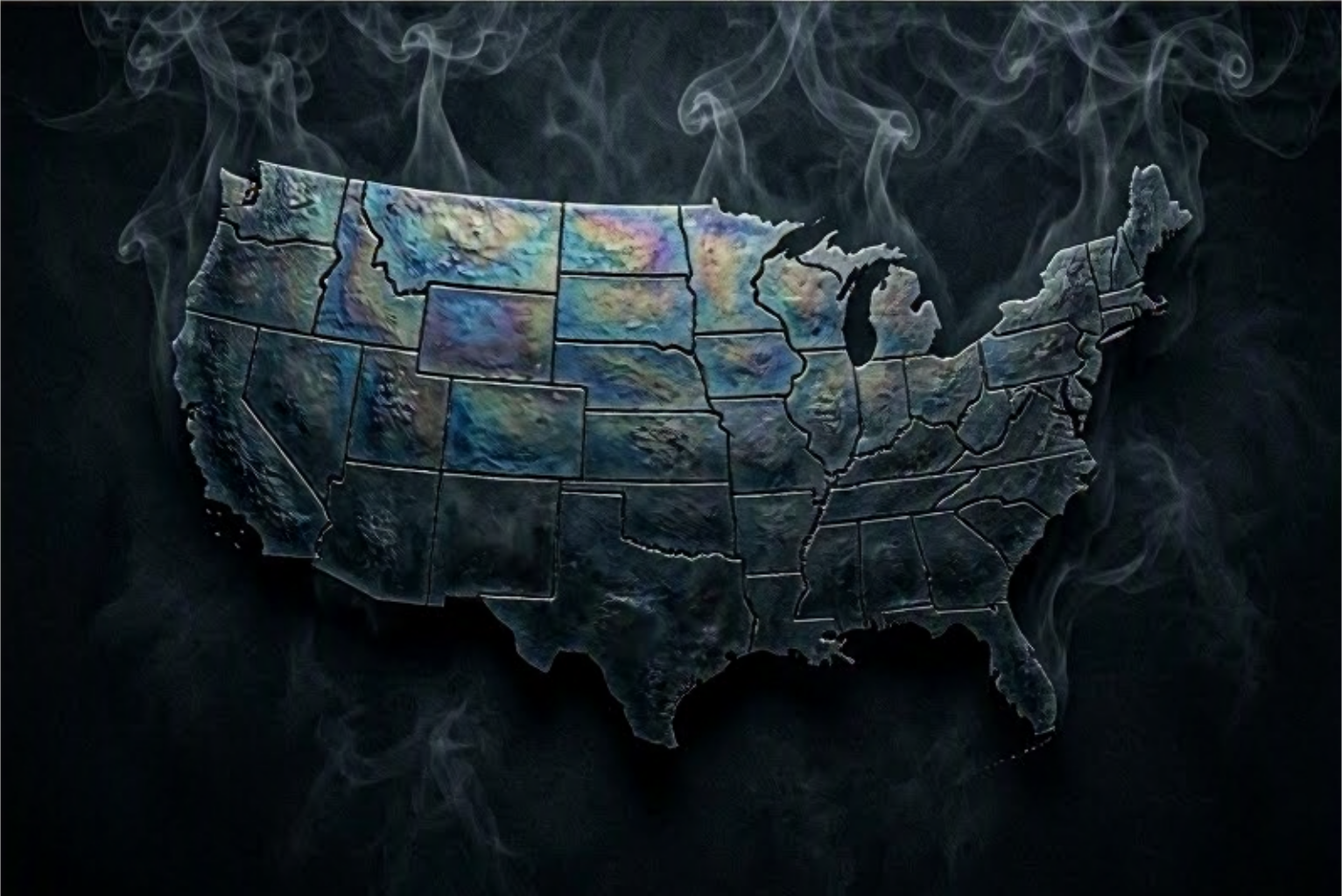
The nation appears suspended in darkness, its shape unmistakable yet stripped of context, as if lifted out of its own reality. The gasoline sheen across its surface introduces an unstable beauty — a quiet warning disguised as iridescence. This is not a map meant for orientation; it is a portrait of a country caught in a volatile pause.
Symbolic Function
The thin tendrils of smoke rising from the edges signal a perimeter under stress, a boundary where heat has already touched. Nothing is actively burning, yet everything suggests the conditions for ignition are already present. The image functions as a visual metaphor for a nation saturated with accelerants — political, social, informational — needing only the smallest spark.
Civic Meaning
The sheen and smoke together articulate the civic moment: a country coated in flammable narratives, conspiracies, resentments, and manufactured grievances. The danger is not in a single flame but in the saturation itself — the way volatility has seeped into the national grain. The image captures the truth that instability is no longer hypothetical; it is ambient.
Why It Opens the Page
This HERO sets the emotional register for the entire piece. It tells the reader, before a single word is read, that the story ahead is about conditions, not catastrophes — about the quiet, cumulative choices that leave a nation soaked and waiting. The suspended map invites the reader to confront the precariousness of the moment and understand the stakes before moving into the argument.
Before we can change the conditions, we name the reality they reveal.
Why This Post Matters
When a nation feels volatile, it’s easy to focus on the flames. We point to the latest outrage, the loudest headline, the most visible explosion of conflict. But fire never begins with the blaze. It begins with the conditions that make ignition possible.
We are living in a moment where information is saturated with distortion, where friction is engineered for profit, where heat is generated faster than we can cool it, where oxygen is pumped into every grievance, and where proximity to the spark is treated as entertainment. None of these conditions alone creates a fire. But together, they create a country that feels one bad moment away from something we can’t take back.
This matters because civic health isn’t measured by how loudly we argue — it’s measured by how easily we ignite. A stable democracy can absorb disagreement. A brittle one can’t. And right now, the brittleness is showing. Not because Americans are inherently divided, but because the systems shaping our information, our attention, and our emotional bandwidth are designed to keep us flammable.
Naming the conditions is the first step in neutralizing them. When we understand what’s saturating us, what’s grinding against us, what’s heating us, what’s feeding the air around us, and what’s sitting too close to the spark, we regain agency. We stop reacting to the fire and start addressing the environmental conditions that allow it to spread.
This post matters because the country isn’t doomed — but it is combustible. And the difference between those two realities is whether we choose to see the danger before the match is struck.
Because a nation that understands its conditions can change its trajectory.
Nothing burns by accident.