Codified Suspicion
When Paperwork Becomes a Weapon
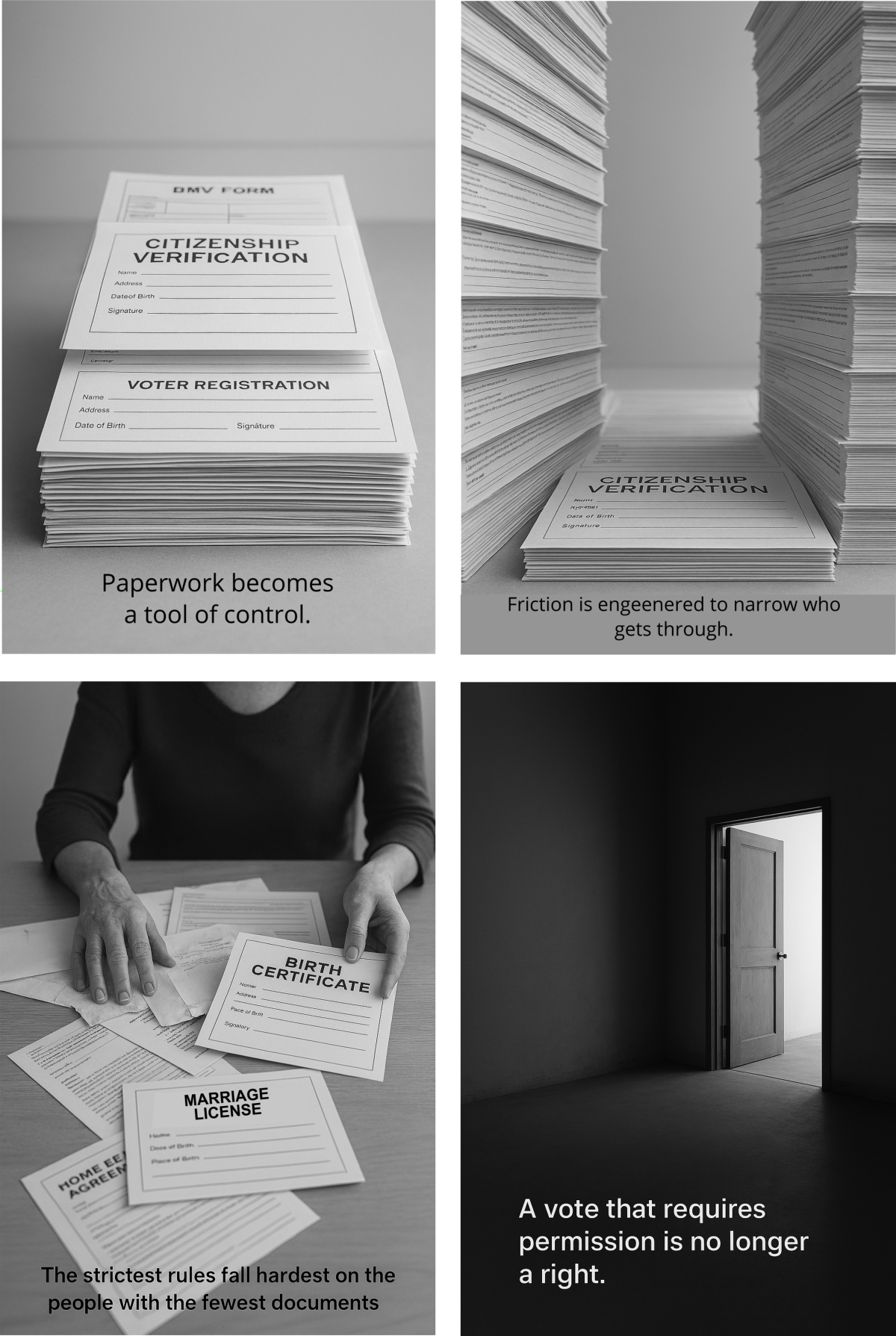
Paperwork is supposed to record a right, not regulate it. But when the system treats documents as proof of worthiness, the process becomes the barrier. What looks like routine administration becomes a quiet sorting mechanism, narrowing who gets to vote and who doesn’t, long before a ballot is ever cast.

This video examines the SAVE Act as a bureaucratic weapon that narrows the electorate under the guise of “integrity.” Through historical memory, lived experience, and civic analysis, it exposes how paperwork, documentation demands, and administrative fear function as modern tools of voter suppression. The piece argues that when a government adds friction without overwhelming evidence of fraud, it is not protecting democracy — it is deciding whose voice is expendable.
“When the state demands proof instead of trust, citizens become applicants.

Design Notes
Why This Image
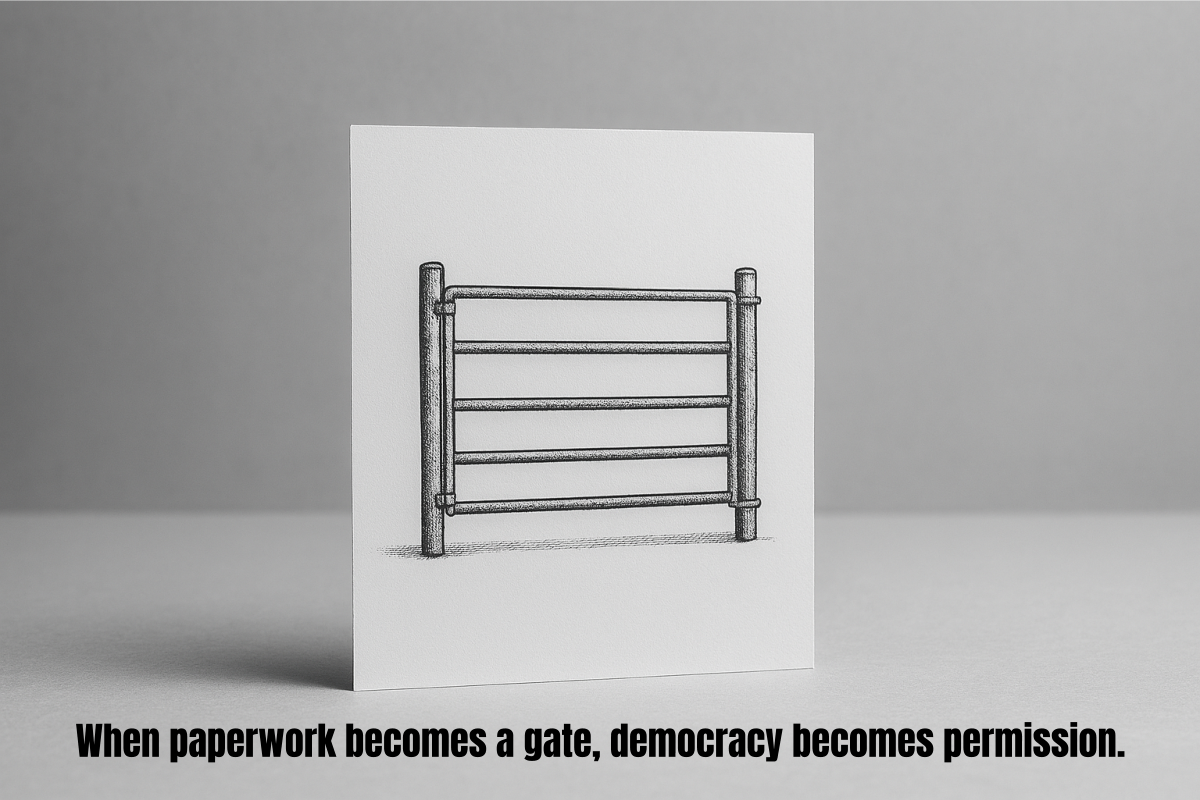
This HERO image is designed with intentional symbolism to support the civic argument of this page. Each visual element — color, light, texture, and object placement — reflects the emotional and structural themes explored below
What to Look For
• Symbolic elements that represent power, absence, protection, fracture, or dignity
• Lighting and contrast that signal emotional tone
• Textures and surfaces that echo civic decay or resilience
• Objects chosen for metaphor rather than literal depiction
Why It Matters
The HERO image sets the emotional and conceptual frame for the entire page. Understanding its design deepens the reader’s ability to recognize civic patterns, decode visual rhetoric, and see how power operates in the world around them.
For readers who wish to delve deeper, the distilled source summary is provided below.
Source Summary
The video argues that the SAVE Act is framed as a matter of “integrity,” but that word is used as a veneer to mask a deeper instinct: suspicion. Instead of trusting citizens, the bill demands proof at every turn — proof of identity, proof of belonging, proof of worthiness. What looks like a neutral administrative update becomes a system that sorts people into those who can easily produce documents and those who cannot. The speaker connects this to a long American pattern: when power feels threatened, it tightens the rules around those least able to meet them.
Drawing on historical voices like Emma Goldman, James Baldwin, and Hunter S. Thompson, the video situates the SAVE Act within a lineage of bureaucratic control. Goldman understood the state’s impulse to categorize and exclude; Baldwin would ask who bears the weight of these new requirements; Thompson warned that authoritarianism often arrives not with tanks but with forms, copies, and clerks afraid of being sued. The video emphasizes that fear trickles downward — from Washington to county offices — until the safest answer becomes “no,” and every “no” falls hardest on those already living closest to the edge.
The speaker highlights the real-world consequences: the grandmother searching for a mismatched birth certificate, the naturalized citizen who never imagined they’d have to prove their oath again, the renter without a tidy folder of documents, the working-class voter relying on a gas station copier. These are the people who feel the friction first. Meanwhile, the affluent glide through untouched, buffered by time, stability, and legal support. The bill does not address a proven threat; instead, it constructs new barriers around a right that is supposed to be foundational.
Ultimately, the video argues that the SAVE Act is not about preventing fraud — a problem for which there is no overwhelming evidence — but about narrowing the electorate. It reframes voting as a conditional privilege rather than a guaranteed right. By demanding paperwork instead of trust, the bill transforms citizens into applicants and democracy into a gated system. The speaker warns that if we accept this shift quietly, we become complicit in the slow burial of the very thing we claim to cherish.
Power always tightens the rules for those least able to meet them.