The Quiet Cost of Telling the Truth
There is a moment — small, almost invisible — when you realize the truth you carry will not land gently. You feel the shift before you speak it: the tightening in the room, the unspoken expectation that you will smooth things over, the quiet pressure to protect someone else’s comfort at the expense of your own clarity. Most people never notice that moment because they’ve learned to step around it. But for those who choose to tell the truth anyway, that moment becomes the threshold where everything changes.
The cost doesn’t announce itself with drama. It shows up in subtle ways people pull back when your honesty disrupts the narrative they were invested in. It appears in the recalibration of relationships, in the invitations that stop arriving, in the conversations that suddenly feel more careful around you. Telling the truth doesn’t just reveal what is real — it reveals who is willing to stand in the reality of truth with you. That revelation is often quiet, but it is rarely painless.
And yet, the deeper cost is internal. It’s the emotional labor of holding your ground when others would prefer that you soften the edges. It’s the fatigue of being the one who names what others avoid. It’s in the loneliness that can follow clarity, especially in spaces where silence has been the currency of belonging. Truth-telling asks you to choose alignment over approval, and that choice reshapes you in ways that are both steadying and isolating.
Still, there is a reason people keep choosing it. Because beneath the discomfort, beneath the social friction, beneath the quiet losses, there is a deeper freedom that only honesty can unlock. The cost is real — but so is the integrity that emerges when you refuse to betray what you know. This page begins there: at the threshold where truth meets consequence, and where the courage to speak becomes its own kind of clarity.

On May 18, 2026, writer and creator Robert Arnold released a video message titled “To My Friends That Are Exhausted.” In this piece, Arnold speaks directly to people who publicly engage in truth-telling, civic education, organizing, and documentation. He outlines the unique form of exhaustion that arises from staying informed, responding to ongoing events, and carrying the emotional weight of public engagement. The transcript captures his description of the constant vigilance required to track developments, verify information, and communicate responsibly in a rapidly shifting environment.
Arnold also details the private strain that accompanies public visibility. He notes that while audiences see polished content, they rarely see the emotional and physical toll behind it — including stress, panic, disrupted relationships, and the pressure to remain accurate and present. He emphasizes the isolation experienced by many creators and organizers who work across time zones, rely on digital communication, and often support others while managing their own fears and fatigue.
In the video, Arnold highlights the unseen labor that sustains civic engagement: late-night research, repeated fact-checking, emotional support for strangers, and the ongoing effort to remain informed and compassionate. He stresses that this work is meaningful even when it feels insufficient. And that exhaustion is not evidence of failure but of sustained commitment. His remarks underscore the ongoing nature of civic participation, noting that there is no clear endpoint or moment of resolution.
The transcript concludes with Arnold’s affirmation that the efforts of these individuals have a real impact. He asserts that people are “breathing easier,” “still believing in tomorrow,” and “not giving up” because of the work done by exhausted truth tellers. His message serves as recognition of their contributions and a reminder that their continued presence matters, even when the broader challenges remain unresolved.
“Behind almost every voice helping carry people through this moment is a human being who is carrying an unbearable amount themselves.”


Design Notes
Why This Image
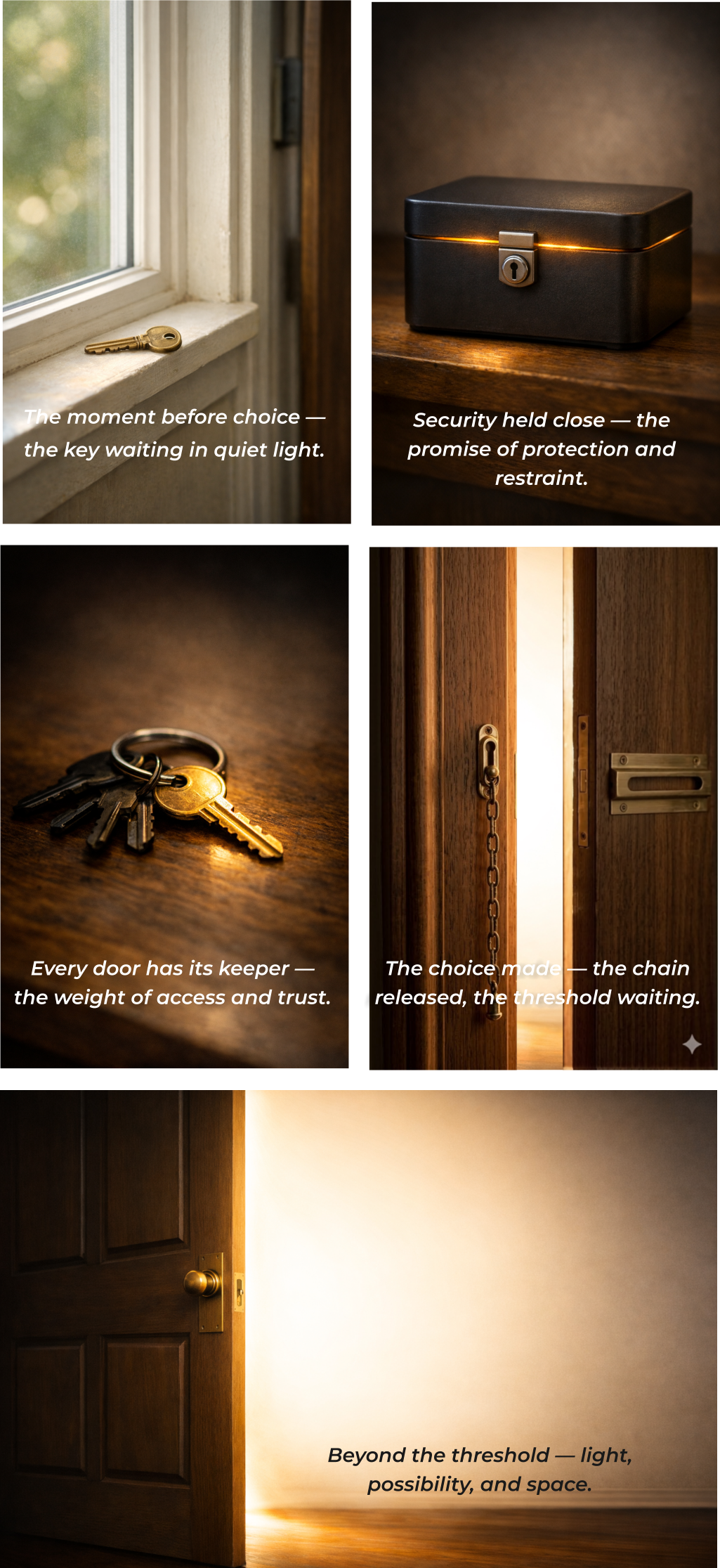
This image captures the instant before action — the quiet readiness that defines civic agency. The key is already in the lock, poised to turn, symbolizing the moment when awareness becomes participation. The warm light from the keyhole represents the power that’s waiting to be released when people choose to engage. It’s not dramatic; it’s deliberate. The image holds its breath, inviting the viewer to do the same before stepping forward.
Symbolic Function
The key embodies personal agency — the ability to unlock change. The lock represents the systems and barriers that hold power in place. Together, they form a relationship of potential: nothing opens until someone acts. The glow from the keyhole reminds us that the light of democracy doesn’t appear on its own; it’s activated by choice. The composition’s stillness reinforces the idea that readiness itself is a civic act.
Civic Meaning
In a time when disengagement is widespread, this image reframes participation as the turning of a key — small, intentional, and transformative. It reminds the reader that democracy isn’t self-executing; it depends on people who are willing to unlock its mechanisms. The light spilling from the keyhole symbolizes the shared illumination that follows when individuals act together.
Why It Opens the Page
This HERO sets the emotional tone of the page: calm, focused, and ready. It invites the reader into a moment of pause before movement — the same rhythm your civic reflections follow. By opening with the image of a key waiting to turn, the page begins with agency rather than urgency. It prepares the reader for the Opening Strike and establishes the page’s central progression: recognize → ready → unlock → act.
When we choose to remember, we choose to hold the line together.
Why This Post Matters
Telling the truth is rarely a dramatic act. More often, it is a quiet decision made in the space between what you know and what others want you to pretend not to see. The cost begins there — in the moment you choose clarity over comfort. It shows up in the subtle recoil when your honesty disrupts someone’s preferred version of events, in the way conversations shift when you refuse to participate in the unspoken agreements that keep everything smooth on the surface. Truth-telling doesn’t just reveal facts; it reveals fault lines.
The deeper cost comes from the social gravity that pulls people toward whatever feels easiest. We say we value honesty, but we reward compliance. We praise transparency, but we gravitate toward narratives that protect our illusions. When you speak plainly in a culture that relies on soft focus framing, you become the disruption — not because you are wrong, but because you refuse to maintain the silence that keeps everyone else comfortable. That tension accumulates quietly: in strained relationships, in the emotional labor of holding your ground, in the loneliness that sometimes follows clarity.
And yet, the quiet cost is also where the quiet strength lives. Each time you choose truth over convenience, you reinforce your own integrity. You make it harder for manipulation to take root. You create a small, steady pocket of reality in a world that often prefers fog. The cost is real — but so is the gain: a clearer voice, a steadier spine, a life aligned with what you know rather than what others demand you perform. Truth-telling becomes not just an act of courage, but an act of self-preservation.
This page names that reality. It acknowledges the emotional architecture of choosing honesty in a culture that often punishes it. It honors the people who speak plainly even when the room tilts away from them. And it affirms a simple, steady truth: the cost of telling the truth is real — but so is the freedom that follows.
Honesty may unsettle the room, but it steadies you in ways silence never will.
Truth is heavy. Carry it with intention.