WHAT LEADERSHIP REFUSED TO CONFRONT: Proximity and Silence in the Epstein Era
We confront what they chose to ignore.
Series Page · USA Protect Your Vote Inspired by:
Robert Arnold — YouTube.com/@Defiance13
Source Video:
“On His Pattern of Judgement” December 29, 2025
I. Opening Strike
There are moments in a nation’s history when the failure is not hidden, complicated, or ambiguous — it is simply refused. The Epstein era is one of those moments. For years, leaders across parties, administrations, and institutions were confronted with warning signs that were visible, persistent, and impossible to mistake. Some stood too close to the rot and pretended not to see it. Others stood far away and convinced themselves that silence was neutrality. But leadership is neither proximity nor distance. Leadership is discernment. It is the ability — and the obligation — to recognize exploitation when it unfolds in your orbit and to act before the vulnerable are harmed again. In the Epstein era, too many in power chose comfort over confrontation, and that choice is its own indictment.
This page draws from Robert Arnold’s December 29, 2025 video,
“On His Pattern of Judgement.”
You can watch the full video here:
Watch on YouTube.

“Proximity and silence are different failures, but both are refusals.”
II. The Distinction That Matters
In every era of public reckoning, there comes a point when a nation must remember the difference between what can be proven in court and what must be recognized in plain sight. Allegations require evidence. Documentation requires verification. A courtroom requires certainty. But leadership requires something else entirely — judgment. Discernment. The ability to recognize danger before it becomes irreversible, and exploitation before it becomes a case file. The Epstein era exposed a truth we have tried, again and again, to outrun: that the threshold for holding power cannot be reduced to the absence of a conviction. A president is not entrusted with authority because they have avoided indictment. They are entrusted because they can see what others refuse to see, and act when others hesitate. When leaders collapse those standards into a single binary — guilty or not guilty — they are not defending justice. They are defending convenience. And convenience has never protected a single survivor.

Design Notes
The HERO image uses a closed door with light leaking around the edges because the page centers on avoidance, proximity, and the refusal to act. The door is the threshold leadership would not cross — the barrier between what they knew and what they chose not to confront. The warm light beneath the door represents the truth they avoided, the evidence they sidestepped, and the moral clarity they refused to claim. The institutional texture of the wall — concrete, stone, or archival paper — reinforces the systemic nature of the failure. This is not a depiction of the harm; it is a depiction of the silence that enabled it.
What to Look ForThe brick red door anchors the frame with a sense of authority and institutional weight. Its placement on the left side creates visual tension, as though the viewer has arrived at the moment just before accountability should have begun. The cracked concrete wall introduces subtle distress, echoing the motif language across your Civic Pages: institutions under strain, truth pressing outward. The soft gold or muted white light leaking from beneath the door is the emotional pivot — a quiet insistence that the truth was always present, always visible, and always ignored. The caption “THE THRESHOLD THEY REFUSED TO CROSS” appears on the wall itself, making the indictment part of the architecture.
Why It MattersThis HERO image prepares the reader for the page’s central argument: leadership was not confused, overwhelmed, or uninformed — they were proximate, aware, and silent. The closed door symbolizes the deliberate choice to avoid confrontation, while the leaking light exposes the truth they refused to face. By pairing institutional textures with a simple, declarative visual metaphor, the image becomes both evidence and accusation. It teaches the viewer how to read the Civic Page: not as a story of ignorance, but as a story of refusal. Nothing in the composition is decorative; every element reinforces the motif of proximity without courage.

III. The Proximity Problem
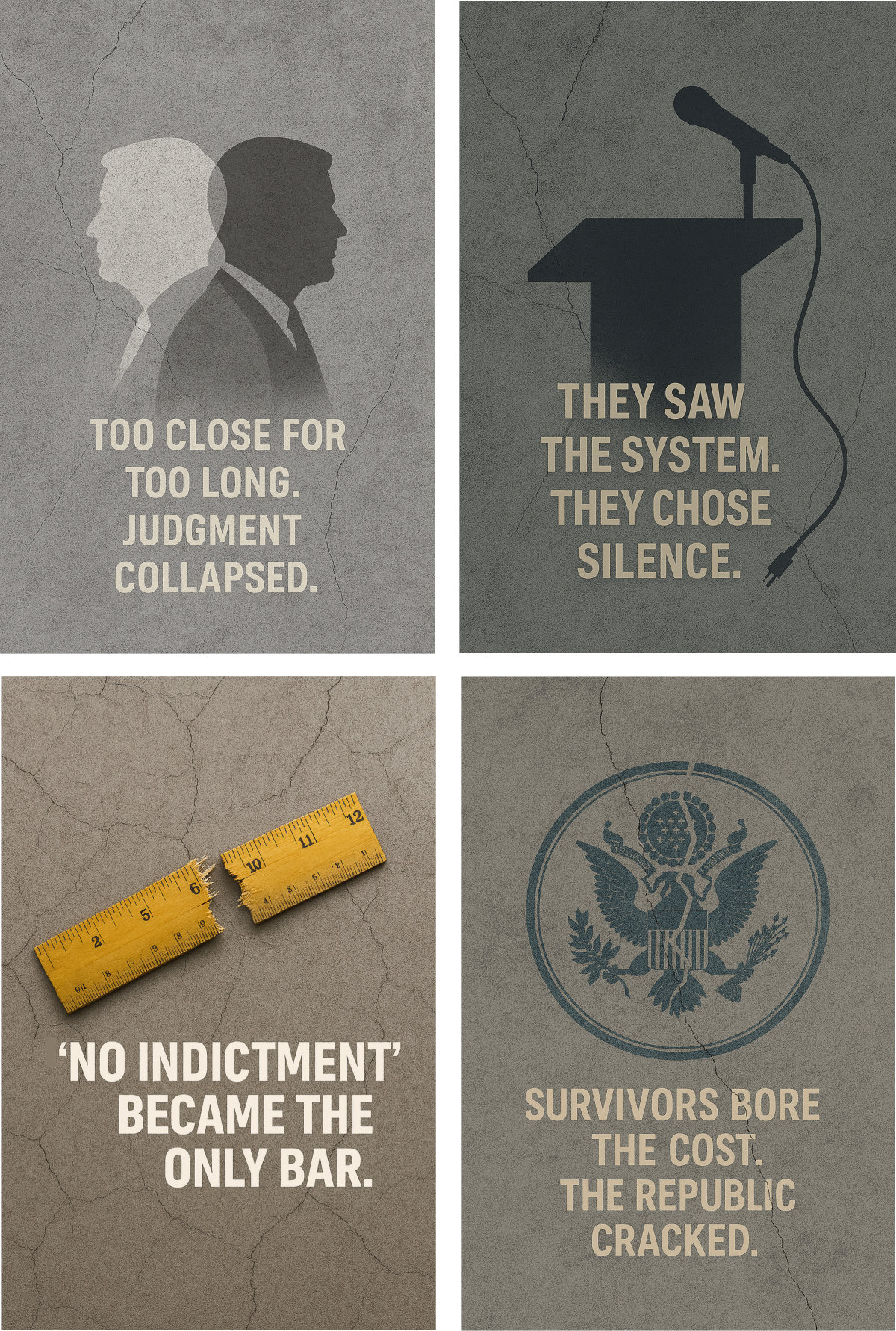
Leadership failure in the Epstein era did not take a single form. It split along two equally damning paths. On one side were those who stood too close for too long — men who shared rooms, flights, favors, and social circles with a predator whose warning signs were visible long before the public ever saw a case file. Proximity is not guilt, but it is judgment. It reveals what a leader notices, what they tolerate, and what they choose to excuse when power is in the room. A decade of overlap is not coincidence. It is discernment collapsing in slow motion. On the other side were those who stood far away and convinced themselves that distance was virtue. They inherited a system already warped by secrecy, already shaped by years of avoidance, and still chose not to confront the rot directly. Survivors waited. Institutions stalled. Files gathered dust. Silence became the default posture of power — not because the truth was unclear, but because confronting it would demand courage, transparency, and political risk. Passivity is not neutrality. It is a decision with consequences. Proximity and silence are different failures, but they converge on the same outcome: a leadership class that protected its own comfort more reliably than it protected the vulnerable. One failure is intimacy with corruption. The other is indifference to it. Both are refusals at their core — refusals to confront exploitation when it mattered most.
IV. The Loyalist Collapse
Every era of moral failure produces its own chorus of excuses, and the Epstein era is no different. The most predictable defense arrives like muscle memory: there was no conviction, therefore there is no problem. It is a shield built on technicalities, wielded by those who would rather debate legal thresholds than confront moral ones. But leadership is not a courtroom, and the public is not a jury bound by rules of evidence. A nation does not entrust power to someone simply because they have avoided prosecution. It entrusts power to those capable of recognizing danger before it becomes irreversible. The loyalist defense collapses under its own weight because it cannot answer the simplest civic question: What does it say about a leader when exploitation unfolds in their orbit, and they do nothing? If someone stood close to a man surrounded by visible warning signs of exploitation and never recognized them, that is a failure of judgment. If someone inherited a system shaped by secrecy and still chose not to confront it, that is a failure of courage. One failure is proximity. The other is silence. Both are refusals. Both are incompatible with the responsibilities of high office. Survivors have watched these defenses play out for decades — the minimization, the deflection, the insistence that unless a crime can be proven beyond a reasonable doubt, no one in power bears responsibility. But responsibility is not a verdict. It is a standard. And when leaders refuse to confront exploitation, when they hide behind legalistic shields or political convenience, they are not defending justice. They are defending themselves. The cost of that refusal has been paid by the vulnerable, again and again, while those in power perfected the art of looking away.
A Failure Written in Avoidance
They had every opportunity to act and declined each one. The damage that followed was not accidental but predictable. This reflection marks the breach they hoped would be forgotten.
Read the Summary
On His Pattern of Judgement
Summary of the December 29, 2025, Video by Robert Arnold.
The video examines a moment when the country is forced to confront not a verdict or a single revelation, but a pattern — one that becomes undeniable when viewed in full. The recent release of tens of thousands of documents related to the Epstein investigation created a chaotic transparency dump: verified material mixed with unverified claims, rumors, dead ends, and fragments logged out of investigative obligation. Arnold stresses that allegations are not guilt, documentation is not proof, and inclusion in a file is not an indictment. That distinction matters because it separates justice from hysteria.
But he argues that another distinction matters just as much: the difference between legal innocence and fitness for the presidency. Those standards were never meant to be the same. Even if every unproven allegation is discarded, the remaining record still reveals something deeply troubling — a long-term pattern of proximity, association, and personal connection between Donald Trump and Jeffrey Epstein, extending across years when warning signs were visible to anyone willing to see them.
Arnold notes that Epstein did not emerge “out of nowhere” in 2008. His behavior, his company, and the presence of young girls in his orbit were visible long before formal charges. Despite this, the record shows that Trump maintained social and personal ties with Epstein over a significant period. Newly released documents strengthen earlier indications that travel between them was more extensive than previously acknowledged. A single flight proves nothing, Arnold says — but repeated proximity over years proves judgment.
He addresses the familiar defense that proximity is not guilt, that there was no conviction, no prosecution. While those points may be true, Arnold argues they are insufficient because the presidency is not a jury box — it is a trust. The office demands discernment, moral awareness, and the ability to recognize danger and exploitation in one’s immediate orbit. At some point, probability matters. Patterns matter. Duration matters. No one is that unlucky, and if someone is truly that oblivious, they fail the most basic threshold of leadership.
Arnold outlines the unavoidable dilemma:
- If Trump knew and tolerated Epstein’s behavior, he is disqualified.
- If he didn’t know and failed to notice, he is disqualified.
There is no third option that preserves a claim to the office.
He criticizes the insistence that all standards collapse into a binary of guilt or innocence, calling that framing an abdication of responsibility. It demands that character, judgment, and moral awareness become optional so long as a technical defense exists. The presidency, he argues, was never meant to be awarded to the most legally insulated person in the room, but to someone capable of recognizing corruption and acting accordingly.
The documents released by the Department of Justice do not prove criminal guilt, and claiming otherwise is reckless. But they do prove something else that should matter to a functioning republic: that the bar for acceptable judgment has been lowered so far that proximity to trafficking circles can be dismissed with talking points. They show that duration no longer triggers moral reckoning and that loyalty has replaced judgment.
Arnold concludes that a nation that confuses “not convicted” with “qualified” has forgotten what leadership is supposed to be. We do not need a verdict to say this was unacceptable. We do not need certainty of guilt to recognize catastrophic judgment. Stripped of speculation and rage, the record reveals a judgment threshold far below what the presidency demands. And if leaders are now too afraid of their own loyalists to defend the standards of the office, then the problem is no longer one man — it is all of them.
WHAT LEADERSHIP REFUSED TO CONFRONT: