When Power Stops Respecting Limits
When power stops respecting its limits, a democracy enters dangerous territory. The shift is quiet at first — a boundary ignored here, a norm dismissed there — but the meaning is unmistakable. A republic cannot survive the moment when authority begins to treat its constraints as optional. That is the threshold where a self-governing nation shifts to become something else, and where the people must decide whether the structure holds or fractures.

This Civic Page is based on Robert Arnold’s April 28, 2026, video analysis, On the Existential Threat, in which he examines how democratic systems weaken when political power stops operating within constitutional boundaries. Arnold argues that the stability of a republic depends on the alignment between authority, restraint, and the limits designed to prevent concentrated power from reshaping government according to impulse rather than law. Drawing on historical examples and the structure of the American system, he outlines how the erosion of these limits creates conditions that shift a nation away from representative governance and toward a model defined by unilateral decision‑making. His analysis focuses on the relationship between power, accountability, and the constitutional architecture intended to preserve democratic function.
“A government that stops respecting its limits stops being a republic.”


Design Notes
Why This Image
The fractured column presents a single, unmistakable truth: power that once appeared immovable is already failing under its own weight. The close framing forces the viewer to confront the damage directly, without distraction or narrative escape routes. The light falling across the break isolates the wound, making the fracture the subject rather than the architecture. This image was chosen because it communicates the thesis of the page in one glance — the moment when strength stops being strength.
Symbolic Function
Columns are the visual shorthand for institutions, legitimacy, and the promise of stability. A crack in a column is never just a crack; it is a breach in the story a society tells itself about permanence. Here, the diagonal fracture interrupts the vertical fluting — a symbolic interruption of order, continuity, and the expectation that power will hold. The darkened negative space beside it amplifies the sense of imbalance, suggesting that the failure is not isolated but spreading.
Civic Meaning
The image speaks to the civic moment when power exceeds its limits and begins to erode the very structures meant to contain it. A cracked column is a warning: unchecked authority doesn’t simply distort democracy — it weakens the load bearing supports that keep it standing. The fracture becomes a civic metaphor for the consequences of neglect, silence, and the normalization of overreach. It reminds the reader that collapse is not sudden; it is cumulative.
Why It Opens the Page
This image earns the opening position because it establishes the emotional and structural stakes immediately. Before a single sentence is read, the viewer understands that the page is about the moment before failure becomes irreversible. It sets the tone of quiet alarm, architectural seriousness, and moral clarity that the rest of the page builds upon. It signals to the reader: this is not about politics — this is about the integrity of the foundation itself.
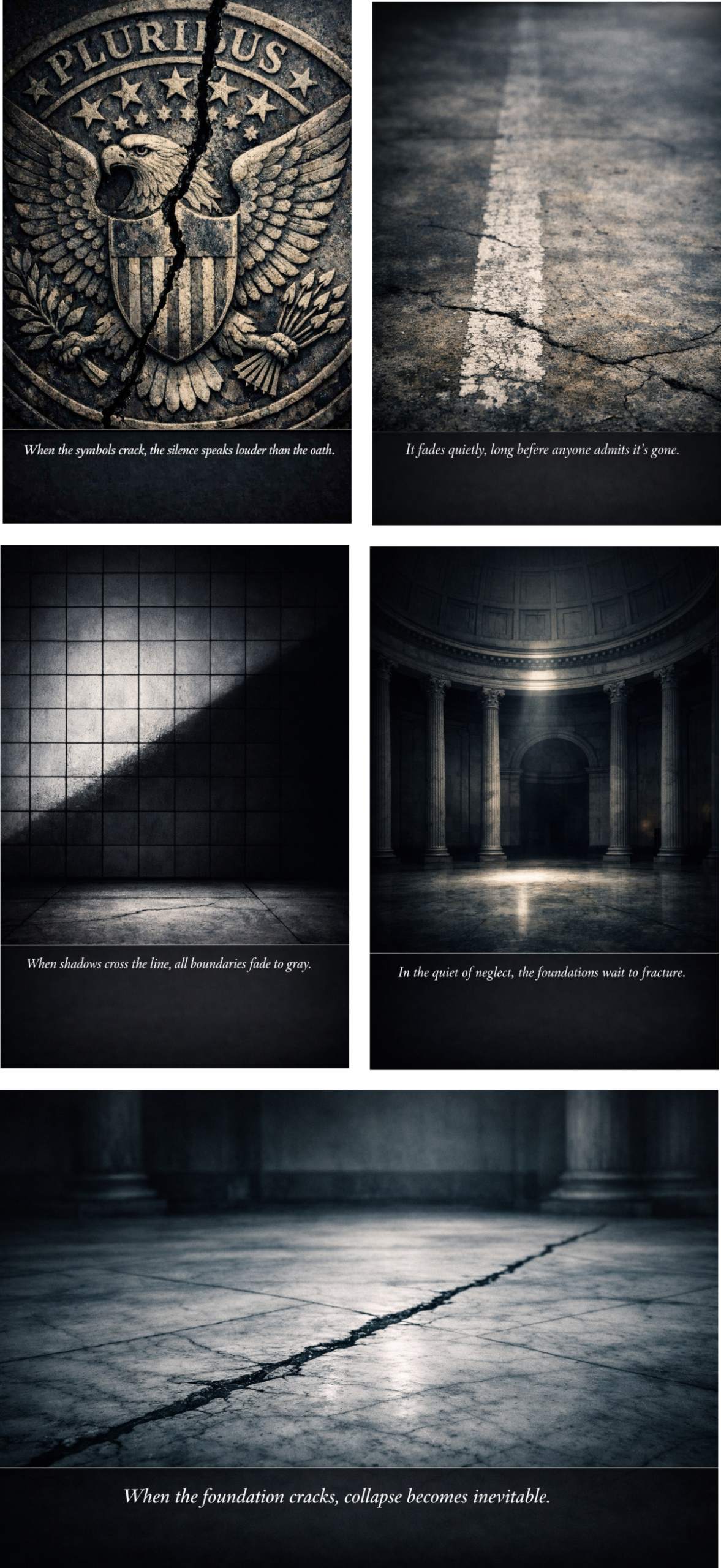
To understand the significance of this message, open the Toggle below.
Why This Post Matters
When power exceeds the boundaries meant to contain it, the first signs of damage rarely appear in headlines — they appear in the quiet shifts inside institutions, norms, and public expectations. This post matters because it identifies that early moment, the one most people sense but struggle to name. It clarifies what it means when authority stops operating within its intended limits and begins reshaping the system around its own impulses.
The page traces how democratic structures weaken long before they visibly fail. It explains how small breaches in accountability accumulate, how silence becomes complicity, and how the erosion of limits creates conditions where overreach feels normal rather than alarming. By mapping these early fractures, the post gives readers a framework for recognizing institutional stress before it becomes irreversible.
It also restores the civic vocabulary that’s needed to talk about power without collapsing into partisanship. The argument is not about personalities or political factions; it is about the architecture of democratic restraint — the guardrails, norms, and expectations that keep power from becoming self-justifying. The post makes clear that when these boundaries are ignored, the consequences are structural, not rhetorical.
Finally, this post matters because it re-centers responsibility where it belongs: with the public. Democracies do not fail because power tests its limits; they fail when people stop insisting that those limits hold. By naming the fracture, the page invites readers to step back into their role as guardians of the boundary line — the line that keeps institutions accountable and the foundation intact.
When power breaks its bounds, the fracture belongs to all of us.