The Circle That Will Not Break
The strength of a community isn’t measured by what it says, but by what it does when the ground shifts — when protections are stripped away, when institutions hesitate, and when the systems meant to safeguard people leave them exposed. These are the moments when fear spreads rapidly and truth becomes harder to hold. Minnesota reminded us what it looks like when a community refuses to let that stand: neighbors forming circles of protection that deploy faster than the noise, faster than the uncertainty, faster than the harm. In doing so, they didn’t just respond — they restored the record of what people can build together. This page begins there, with the people who refuse to let the circle break.

This page is grounded in Robert Arnold and Kris’s March 2, 2026, co voiced reflection on Minnesota’s rapid response networks — a blueprint for how ordinary people become the infrastructure when formal systems fail. This page draws from Robert Arnold’s March 2, 2026 video, “On the Importance of Community (with my friend Kris).” For those who want to hear the source in his own voice, the full video is here: Watch on Facebook. In their conversation, they describe neighbors who lock arms across language, faith, and immigration status to create circles of protection that move faster than fear. As Robert puts it, “Proximity is what turns courage into capacity.” Their story shows how community becomes a system — not through hierarchy, but through human connection — and why the first civic act is learning to neighbor as a verb.
“Growth that doesn’t translate into dignity is not strength.”

Design Notes
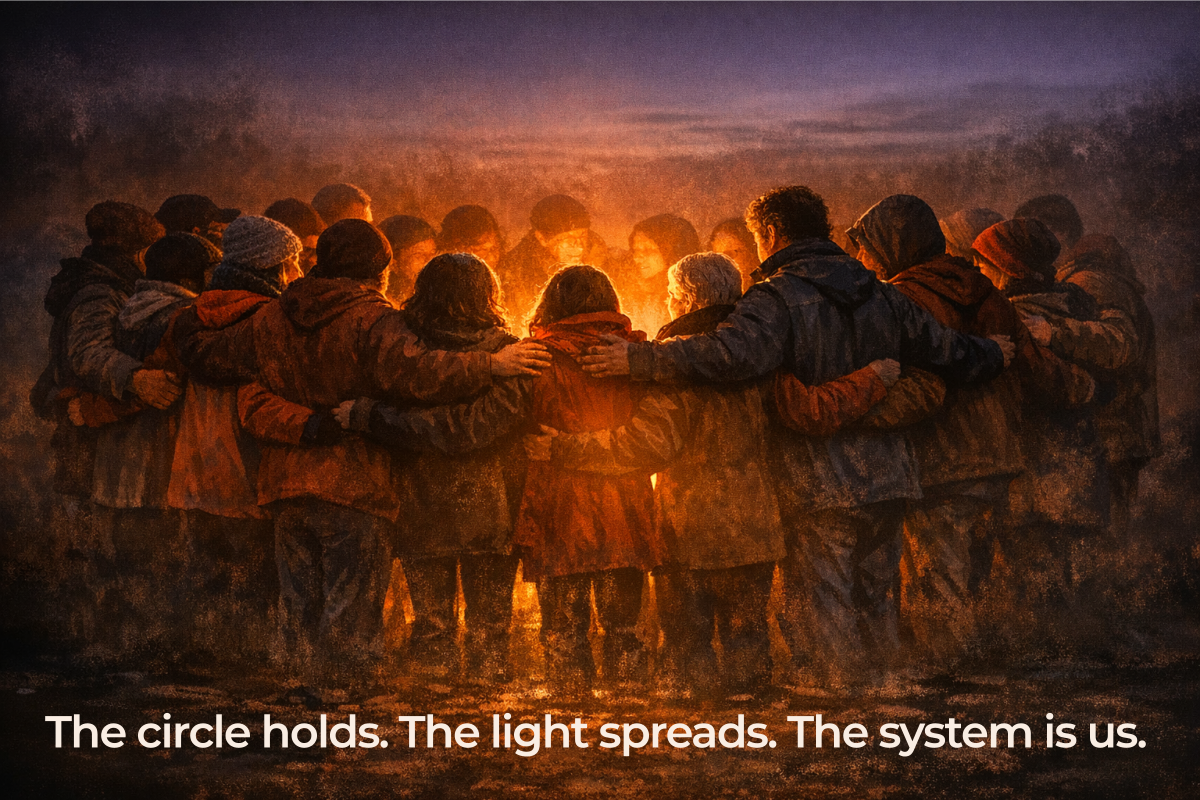
Why this image This HERO works because it captures the emotional truth of the page in a single frame: people gathered in a circle, holding each other close, illuminated by shared warmth in the dark. It’s not symbolic warmth — it’s literal firelight. It’s not metaphorical unity — it’s physical proximity. It’s not staged resilience — it’s lived, embodied, communal. Symbolic function The circle is the oldest symbol of collective protection. In this image, it becomes a living boundary — not drawn, but formed. The firelight at the center signals shared courage, shared capacity, and the kind of strength that only emerges when people stand close enough to feel one another’s presence. Civic meaning This image reframes community as infrastructure — something built, maintained, and reinforced through proximity. It argues that resilience is not an individual trait but a civic practice, and that the smallest unit of democracy is the neighbor standing beside you. Why it opens the page The HERO sets the emotional temperature for the entire page: quiet strength, shared warmth, and the undeniable power of people who choose to hold together. Before a single word is read, the reader understands the thesis — a circle that holds cannot be broken.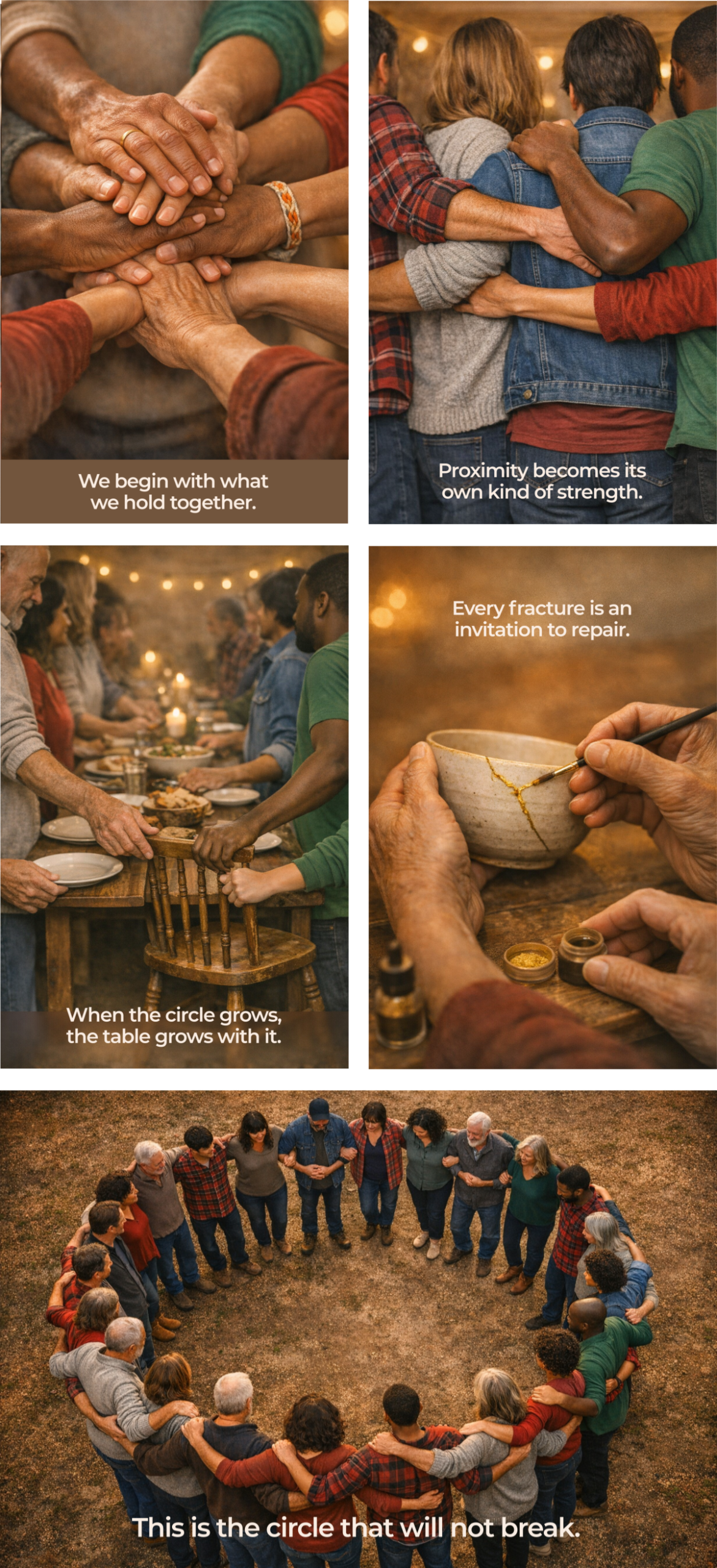
Details — In every community, there comes a moment when people become the system.
When Community Becomes Structure When Robert and Kris talk about Minnesota’s rapid response networks, they describe something both simple and profound: community stepping into its oldest role. Not as sentiment, not as nostalgia, but as structure — a living system built from proximity, trust, and the quiet understanding that safety is something we create together. Their March 2 reflection shows how clarity often emerges from the ground up, long before institutions find their footing. They describe neighbors who move faster than fear because they already know one another. Circles of protection form across language, faith, and immigration status, held together not by hierarchy but by relationship. These networks don’t wait for perfect information or official direction; they respond to what is happening in real time, guided by the shared instinct to keep one another safe. In their telling, courage is not an individual act — it is a collective capacity that grows through closeness. Robert and Kris also name the challenges of navigating misinformation, uncertainty, and the speed of crisis. They explain how communities learn to distinguish signal from noise by relying on relationships rather than rumors. When people are connected, truth moves faster. When they are isolated, fear does. Their conversation makes clear that the work of community is not only emotional — it is civic, strategic, and deeply practical.This page looks at what becomes possible when we treat community as infrastructure — not a backdrop, but a system we build and maintain together. It begins with the premise Robert names: proximity is what turns courage into capacity. And it asks what changes when we see neighboring as a verb, not a sentiment. A circle that holds becomes a force that cannot be undone.
“Growth that doesn’t translate into dignity is not strength.”
Neighbor is a Verb.