The Line That Should Never Be Crossed: Retaliation Against Protected Speech

A horizontal boundary line stretches across a landscape frame, fractured at the center. Small fragments scatter beneath the break. Just beyond the gap, a single footprint rests on the surface, symbolizing a deliberate step over a constitutional boundary.
USA Protect Your Vote banner with bold civic message and blue wave icons.

The Line That Should Never Be Crossed: Retaliation Against Protected Speech

Power doesn’t always announce itself when it decides to cross a line; sometimes it simply shifts its weight and waits to see if anyone notices. That first movement is small, almost polite, wrapped in the language of exceptions, necessities, or temporary measures. But beneath that soft veneer is the beginning of something predatory, the moment power decides it can wound without consequence. This is the point where retaliation stops being hypothetical and becomes intentional.

I call this moment the Opening Strike — the first retaliatory act that reveals how far power is willing to go when it believes the target is too small, too isolated, or too unprotected to fight back. The Opening Strike is not designed to be dramatic. It is designed to be deniable. It is the quiet test of whether anyone will object when power harms someone for speaking, and whether the boundary meant to restrain that harm still carries any force.

What makes the Opening Strike dangerous is not its size; it’s its direction. Once power discovers that a constitutional line can be crossed without consequence, the next breach becomes easier, then easier still. The fracture widens. The justification grows. The exception becomes precedent. The First Amendment doesn’t collapse in a single moment — it erodes through a series of small retaliatory acts aimed at people who were never meant to carry the burden of defending constitutional norms in the first place, nor alone.

The Opening Strike is the civic warning shot — not because it is loud, but because it is quiet. It tells us exactly how power behaves when it thinks no one is watching. It shows us the first mark left by retaliation, the first crack in restraint, the first sign that liberty is being tested at its weakest point. And once that mark exists, it becomes part of the record — a breach that cannot be ignored.

Soft, faint gray single line divider, low-contrast and gently blurred, symbolizing quiet resilience and reflection.

Source Summary

Amanda created a satirical video criticizing Vice President Vance, using humor, exaggeration, and political commentary to highlight concerns about his conduct and influence within the administration. The satire also referenced the broader administration, but Vance was the central figure. Her video was a lawful political expression, fully protected under the First Amendment.

Shortly after the video circulated online, Amanda attended a public event where the president and vice president were present. During the event, a Secret Service agent approached her and made a pointed remark referencing her satire: “We know where you stand.” The comment was tied directly to her criticism of Vance and was not part of any security protocol. This interaction is a key moment because it suggests that federal authority was used to single out a citizen based on her political expression.

Amanda later filed a lawsuit arguing that the government retaliated against her for protected speech. Her claim asserts that the Secret Service’s conduct constituted viewpoint-based retaliation — a violation of the First Amendment. The constitutional principle at issue is clear: government actors cannot intimidate, threaten, or penalize citizens for expressing political views, including satire directed at high-ranking officials.

The case raises broader concerns about the misuse of government authority and the chilling effect such actions can have on political expression. When officials respond to criticism with intimidation, it can deter citizens from speaking freely. The lawsuit underscores the importance of maintaining strict boundaries between legitimate security functions and actions that target individuals based on their speech, especially when the speech involves criticism of powerful public figures.

“The test is whether government officials may use the authority of the state to reward friends and punish critics.”


Blue wave motif flowing across the screen.


A horizontal boundary line stretches across a landscape frame, fractured at the center. Small fragments scatter beneath the break. Just beyond the gap, a single footprint rests on the surface, symbolizing a deliberate step over a constitutional boundary.


Design Notes

Why This Image
The HERO depicts a single horizontal boundary line fractured at one point, with a lone footprint resting just beyond the break. This image was chosen because it visually distills the entire constitutional question of the page: a line that should not be crossed, and the moment someone chooses to cross it. The simplicity of the composition ensures that the viewer immediately understands the gravity of the breach without distraction or narrative clutter.

Symbolic Function
The unbroken line represents constitutional limits — the boundaries that protect speech, restrain power, and define the rule of law. The fracture symbolizes the act of retaliation: a misuse of authority that breaks what should remain intact. The footprint is the human element — the deliberate step over the boundary. It is not a path, not a trail, not a walk. It is a single decisive act. The image freezes the exact moment of overreach, making the breach itself the focal point.

Civic Meaning
This HERO communicates that constitutional erosion does not begin with dramatic collapse; it begins with one breach, one exception, one moment when someone in power steps over a line meant to restrain them. The image reinforces the page’s central warning: retaliation against protected speech is not merely improper — it is a constitutional violation that leaves a mark. The footprint shows that the breach is human‑made, intentional, and consequential. It is the visual embodiment of the civic truth that liberty erodes one exception at a time.

Why It Opens the Page
The HERO sets the tone for the entire Civic Page by presenting the core danger before a single word is read. It frames the reader’s understanding: this is a story about a boundary crossed. By opening with the breach, the page signals that everything that follows — the case, the pattern, the stakes — flows from this moment. The HERO is the visual thesis of the page, anchoring the motif, the pull quote, and the narrative arc. It prepares the reader to understand that what happened to Amanda is not an isolated incident, but rather a breach of a clear constitutional line.
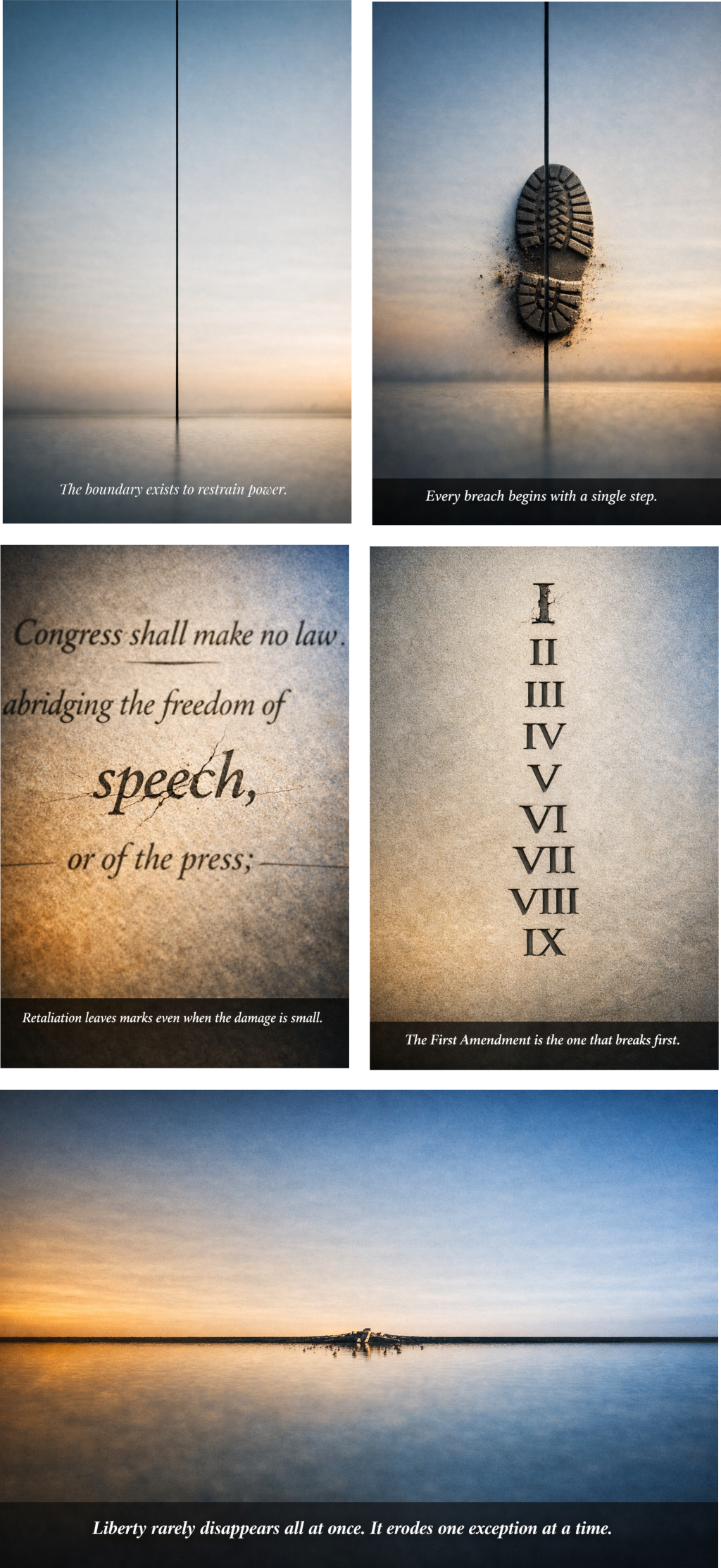
Five panel civic sequence showing how constitutional boundaries erode: the purpose of restraint, the first breach, the marks left by retaliation, the fragility of the First Amendment, and the slow, exception driven disappearance of liberty.

Blue wave motif flowing across the screen.

The breach begins long before the damage is visible.

Why This Post Matters

Retaliation against protected speech is not a minor misstep. It is a direct breach of the boundary that restrains power. When a government actor responds to criticism with punitive intent, the act itself becomes a warning sign — a footprint across a constitutional line that was never meant to be crossed.

The First Amendment is often described as foundational, but in practice, it is the most fragile. It breaks first because it is tested first. Retaliation rarely arrives as a dramatic event; it begins quietly, through small acts meant to discourage dissent, chill participation, or punish those who speak plainly. These early marks matter because they reveal the mindset of the actor, not just the action.

Liberty does not disappear all at once. It erodes through exceptions, justifications, and “only this time” rationalizations. Each breach, even when small, normalizes the next. This post matters because it documents the pattern — the shift from governance grounded in restraint to governance shaped by reaction.

By naming the breach, we reinforce the boundary. By documenting the footprint, we preserve the record. Civic clarity is not commentary; it is a public service. Discernment is not criticism; it is a safeguard. This post exists to ensure that the erosion is visible before it becomes irreversible.

Human‑made governance requires human‑made vigilance. The act of witnessing, recording, and calling out retaliation is not optional — it is part of the democratic duty we share. This post stands as one more mark in the ledger of accountability, ensuring that the line remains visible even when others attempt to step across it.

Liberty endures when breaches are seen, recorded, and refused.

Soft gray whisper line divider.

Every breach leaves a mark that cannot be ignored.
Actions Beget Responses: When the Republic Speaks Back

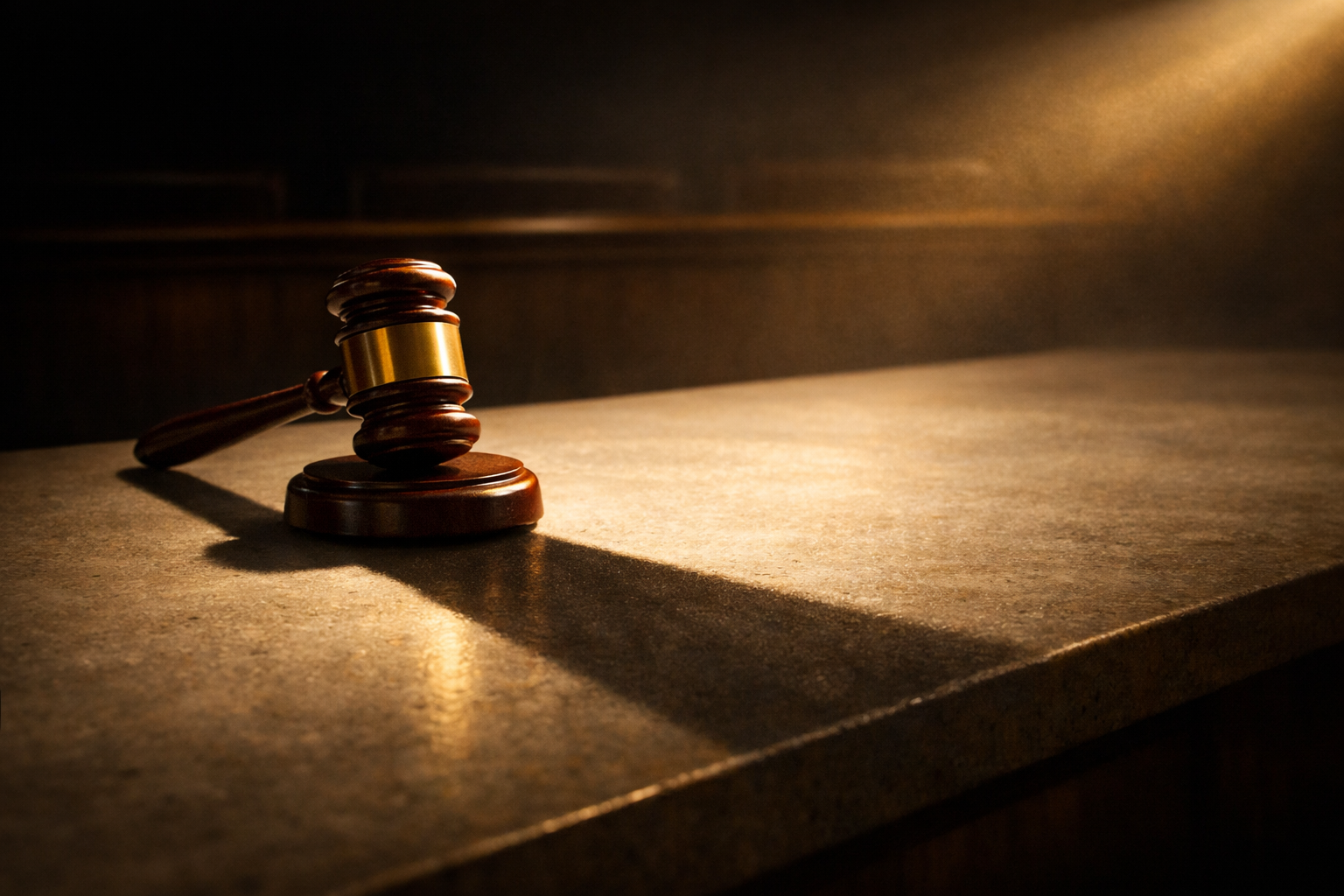
A judicial gavel stands upright on a courtroom bench, illuminated by warm directional light that casts a long shadow toward the viewer. The image symbolizes authority and accountability in a constitutional republic, where every act of power leaves a visible consequence for the law to examine.
USA Protect Your Vote banner with bold civic message and blue wave icons.

Actions Beget Responses: When the Republic Speaks Back

Power never moves alone; it always reveals something about the intent behind it. In a constitutional republic, every public act, every statement, every decision casts a shadow that the law is obligated to examine. Authority may speak loudly, but its shadow speaks truthfully — and that truth becomes part of what the Republic must interpret. The Opening Strike sets the tone by reminding readers that the Republic’s mechanisms are not passive observers; they are active interpreters of what power reveals.

When leaders act, they do more than govern — they reveal motives. Sometimes that motive is clear and principled. At other times, it is obscured, wrapped in rhetoric, or disguised behind urgency or emotion. But regardless of how it appears, intent is never invisible. It becomes part of the constitutional record, part of the judiciary’s responsibility, part of the Republic’s duty to read. This page begins by acknowledging that power’s shadow is not metaphorical; it is evidentiary.

The Opening Strike also frames the reader’s role. Citizens often assume that only laws or policies matter, but the Republic’s design says otherwise. Courts routinely examine the meaning behind public statements, the context surrounding decisions, and the intent that animates authority. This is not political theater — it is constitutional practice. By understanding this, readers gain a clearer view of how accountability actually functions in a free society.

Finally, this Opening Strike prepares the reader for the page’s central lesson: the Republic is not merely watching power — it is responding to it. The judiciary, equal protection, and constitutional guardrails activate when intent touches the rights of the people. The Republic sees what power reveals, and it must examine what intent hides behind authority. This is the foundation upon which the rest of the page stands.

Soft, faint gray single line divider, low-contrast and gently blurred, symbolizing quiet resilience and reflection.

The foundation for this page rests on long‑standing constitutional principles that define how the Republic responds when those in power act or speak in ways that implicate equal protection. Across generations, judicial opinions have reaffirmed that public statements by government officials are not merely political theater; they can serve as evidence of intent when courts evaluate whether constitutional boundaries have been crossed. This understanding appears consistently in rulings that examine discriminatory motive, selective enforcement, or unequal treatment under the law. The judiciary’s responsibility is not passive — it is triggered when authority signals intent that touches protected rights.

Legal scholarship and constitutional commentary further reinforce this dynamic. Analysts routinely note that the judiciary serves as a structural counterweight, designed to activate when executive or legislative behavior raises questions about fairness or equal protection. These sources emphasize that the Republic’s design anticipates moments when rhetoric becomes relevant to legal scrutiny. When leaders speak publicly about groups, policies, or enforcement priorities, those statements can become part of the factual landscape courts must consider. The Republic’s mechanisms are built to interpret not only actions, but the meaning behind them.

Historical patterns also inform this page’s premise. Across different eras, courts have examined how official statements illuminate the intent behind governmental decisions. Whether evaluating civil rights disputes, immigration policies, or enforcement practices, the judiciary has repeatedly acknowledged that public rhetoric can reveal motive. These precedents demonstrate that accountability is not an abstract ideal — it is a recurring feature of constitutional governance. When power reveals its intentions, the Republic responds through structured, principled review.

In the end, the through‑line in these sources is unmistakable: authority never operates in a vacuum, and its choices inevitably ripple outward into the Republic it serves. Each example reinforces the same civic truth — that power carries obligations, that intent matters, and that the Republic retains both the right and the responsibility to evaluate how authority is used. It is this evaluative function that keeps equal protection anchored as a non‑negotiable guardrail and ensures that power’s shadow is always examined — and, when necessary, is expected to be held to account.

Blue wave motif flowing across the screen.


A judicial gavel stands upright on a courtroom bench, illuminated by warm directional light that casts a long shadow toward the viewer. The image symbolizes authority and accountability in a constitutional republic, where every act of power leaves a visible consequence for the law to examine.


Design Notes

Why This Image

The HERO image was chosen because it visually embodies the page’s thesis: actions beget responses. The upright gavel represents authority in motion — the act of power. The long shadow stretching across the bench is the Republic’s answer, the visible consequence of that authority. The composition is simple, deliberate, and constitutional in tone, allowing the viewer to feel the weight of accountability without distraction.

Symbolic Function

The shadow is not merely a visual effect; it is the motif’s central metaphor. It symbolizes the trace every act of power leaves behind — the evidence, the intent, the constitutional echo that the judiciary must examine. The light source, rendered in Republic Gold, represents the Republic’s scrutiny — principled, illuminating, and nonpartisan. The bench itself anchors the image in institutional stability, reminding viewers that the Republic’s mechanisms are enduring.

Civic Meaning

This image teaches that authority is never isolated. In a constitutional republic, every exercise of power generates a visible consequence that the law must interpret. The gavel’s shadow is the Republic’s mirror — a reflection of accountability. It reminds citizens that equal protection and judicial review are not abstract ideals but active, living principles that respond whenever power reveals intent.

Why It Opens the Page

The HERO image opens the page because it visually declares the page’s central lesson before a single word is read. It sets the emotional and intellectual tone: solemn, constitutional, and self‑correcting. The viewer immediately understands that this page is about the Republic’s duty to see what power reveals — and that the shadow itself is the story.

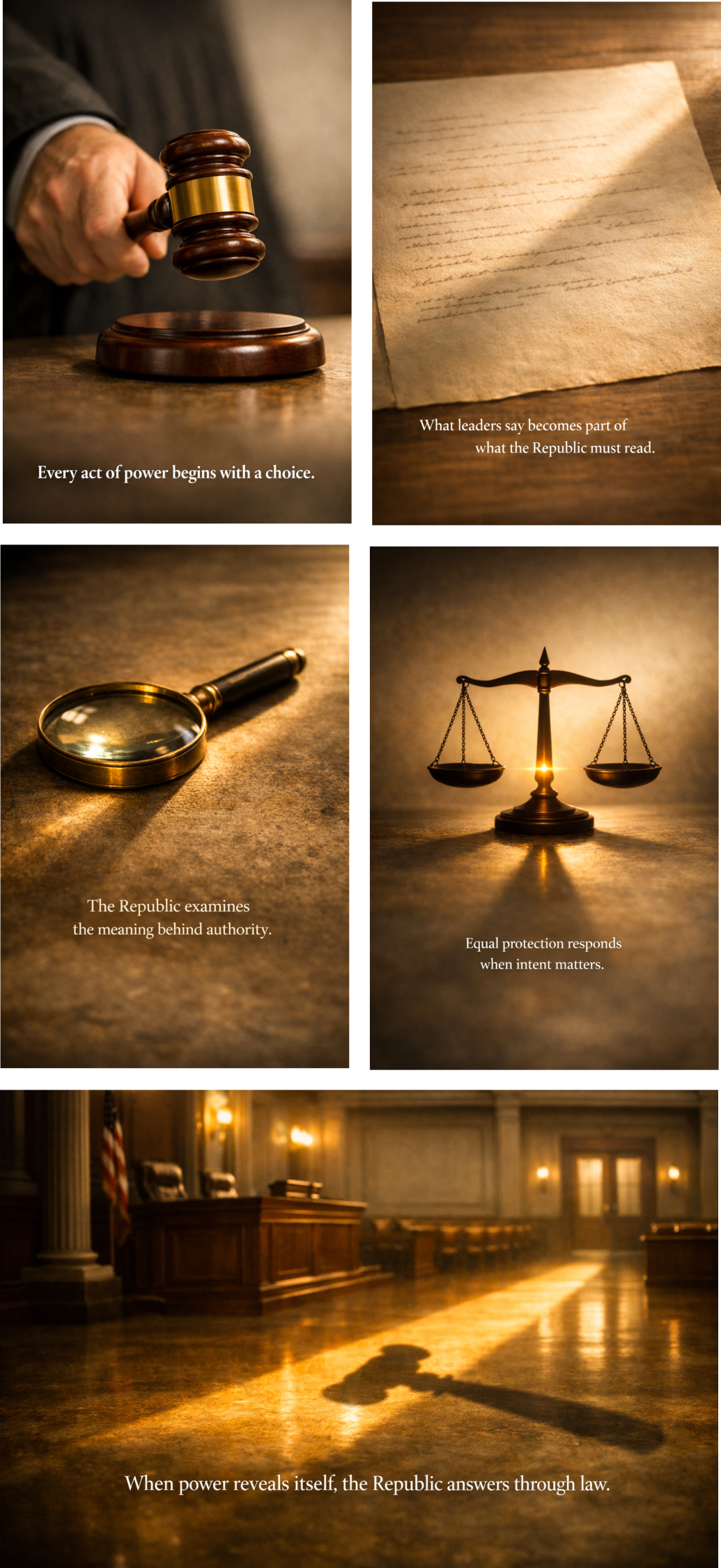
A five panel civic sequence showing a gavel’s choice, a leader’s words on parchment, the Republic examining intent, equal protection weighing justice, and a courtroom where the Republic answers through law.

Blue wave motif flowing across the screen.

Sometimes, the moment that matters most is the one where the Republic decides how to respond.

Why This Post Matters

The Republic is built on the idea that power must always be accountable to something larger than itself. This page matters because it reminds readers that authority is not a free‑floating force; it exists within a constitutional structure designed to interpret, evaluate, and respond to the intent behind public actions and statements. When leaders reveal their motives — intentionally or unintentionally — those revelations become part of the constitutional landscape the judiciary is obligated to examine.

This matters because equal protection is not a passive principle. It activates when intent touches protected rights, when rhetoric signals discriminatory motive, or when public statements illuminate the reasoning behind governmental decisions. The Republic’s design anticipates these moments. It expects the judiciary to read the shadow cast by authority and determine whether it aligns with constitutional boundaries. This page teaches that scrutiny is not optional — it is structural.

It also matters because citizens often underestimate how deeply public statements can influence judicial review. Many assume that only formal policies or enacted laws carry weight, but history shows that courts routinely consider the meaning behind words spoken by those in power. This page helps readers understand that intent is not invisible; it becomes part of the record, part of the evidence, part of the Republic’s duty to interpret.

Finally, this post matters because it reinforces a core civic truth: the Republic speaks back. It responds through law, through precedent, through equal protection, and through the judiciary’s obligation to examine what power reveals. The shadow cast by authority is not a metaphor alone — it is a constitutional reality. And understanding that reality strengthens the public’s grasp of how accountability works in a free society.

Who examines what intent hides behind authority? The Republic must.

Soft gray whisper line divider.

It is the Republic’s duty to see what power reveals.

The Weight of the Uniform

A formal military dress jacket displayed on an invisible mannequin outdoors at sunset, with the United States Capitol glowing warmly in the background. The jacket’s medals, ribbons, and insignia symbolize duty, restraint, and service under the Republic. The scene conveys constitutional fidelity and the moral weight of serving the nation’s democratic institutions.
USA Protect Your Vote banner with bold civic message and blue wave icons.

The Weight of the Uniform

When an active-duty officer steps forward in uniform, the fabric he wears becomes more than cloth — it becomes a contract. A contract with the Constitution, with the institution he serves, and with the people whose freedoms he protects. Most days, that contract is invisible. But on rare days, it becomes unbearably heavy.

Sometimes, an officer chooses to speak — not as a partisan, not as a provocateur, but as someone who believes the oath demands more of them than silence. In those moments, the uniform carries a weight that cannot be measured by regulations alone. The burden shifts from procedural compliance to moral consequence, and the distinction becomes impossible to ignore.

The consequences are never the story. The uniform is. Because when someone bound by duty breaks a rule to honor the oath beneath it, it forces us to confront a question older than the Republic itself: What does loyalty look like when conscience and regulation collide?

This page is not about politics. It is about the burden of the uniform — and the price of carrying it with integrity. It is about the unseen weight that settles on the shoulders of those who serve, and the rare moments when that weight becomes visible to the nation they protect.

Soft, faint gray single line divider, low-contrast and gently blurred, symbolizing quiet resilience and reflection.

Major Jason Watson, an active-duty Air Force officer, appeared on the steps of the U.S. Capitol wearing his service uniform and speaking publicly about the state of the nation. His remarks were not delivered as a political endorsement, nor as a partisan attack, but as a personal appeal rooted in his understanding of the oath he swore.

His presence in uniform, however, placed him in direct conflict with long standing military regulations governing political activity by service members. Federal law and Department of Defense directives strictly limit what active-duty personnel may do while in uniform, especially in public settings that could be interpreted as political. These rules exist to preserve the nonpartisan integrity of the armed forces. By speaking in uniform, Major Watson knowingly crossed a regulatory boundary designed to protect the institution he serves — a boundary he acknowledged even as he stepped forward.

Capitol Police detained him shortly after his remarks, citing violations related to unauthorized demonstration activity. His arrest was procedural, not violent, and he cooperated fully. The incident quickly drew national attention, not because of the charges themselves, but because of the symbolism of a uniformed officer choosing to speak publicly despite the consequences.

The event sparked a broader conversation about duty, conscience, and the limits placed on those who serve. It raised questions about how service members navigate the tension between institutional rules and personal conviction — and what it means when someone bound by regulation chooses to honor the deeper moral obligations of their oath.

“I knew the rules. I spoke anyway.”

Blue wave motif flowing across the screen.


A formal military dress jacket displayed on an invisible mannequin outdoors at sunset, with the United States Capitol glowing warmly in the background. The jacket’s medals, ribbons, and insignia symbolize duty, restraint, and service under the Republic. The scene conveys constitutional fidelity and the moral weight of serving the nation’s democratic institutions.


Design Notes

Why This Image

The HERO image presents the uniform without a visible wearer, transforming it from a portrait into a symbol. By placing the jacket on an invisible mannequin, the focus shifts away from any individual and toward the institutional meaning of service itself. The Capitol in the background anchors the image in the seat of democratic authority, reminding the viewer that the uniform’s legitimacy flows from the Republic — not from personal power, personality, or politics.

Symbolic Function

The uniform stands as a proxy for duty, restraint, and constitutional fidelity. Its medals and insignia represent earned responsibility, not entitlement. The absence of a visible person reinforces the idea that service is not about the individual — it is about the office, the oath, and the principles the uniform is sworn to uphold. The warm sunset light symbolizes clarity, transition, and the enduring nature of the Republic’s ideals.

Civic Meaning

This image visually asserts the foundational hierarchy of American democracy: The uniform serves the Republic — never the reverse. By placing the Capitol behind the uniform, the image communicates that military service is subordinate to civilian authority and the rule of law. It embodies the constitutional guardrails that protect the nation from authoritarian drift and affirms that the moral weight of service lies in upholding democratic institutions, not overshadowing them.

Why It Opens the Page

The HERO sets the altitude for the entire Civic Page. It establishes the tone — solemn, principled, and grounded in constitutional meaning — before the reader encounters any text. It signals that this page is not about politics, outrage, or personalities; it is about the Republic itself. By opening with this image, the page immediately frames the conversation around duty, restraint, and the civic architecture that holds the nation together.

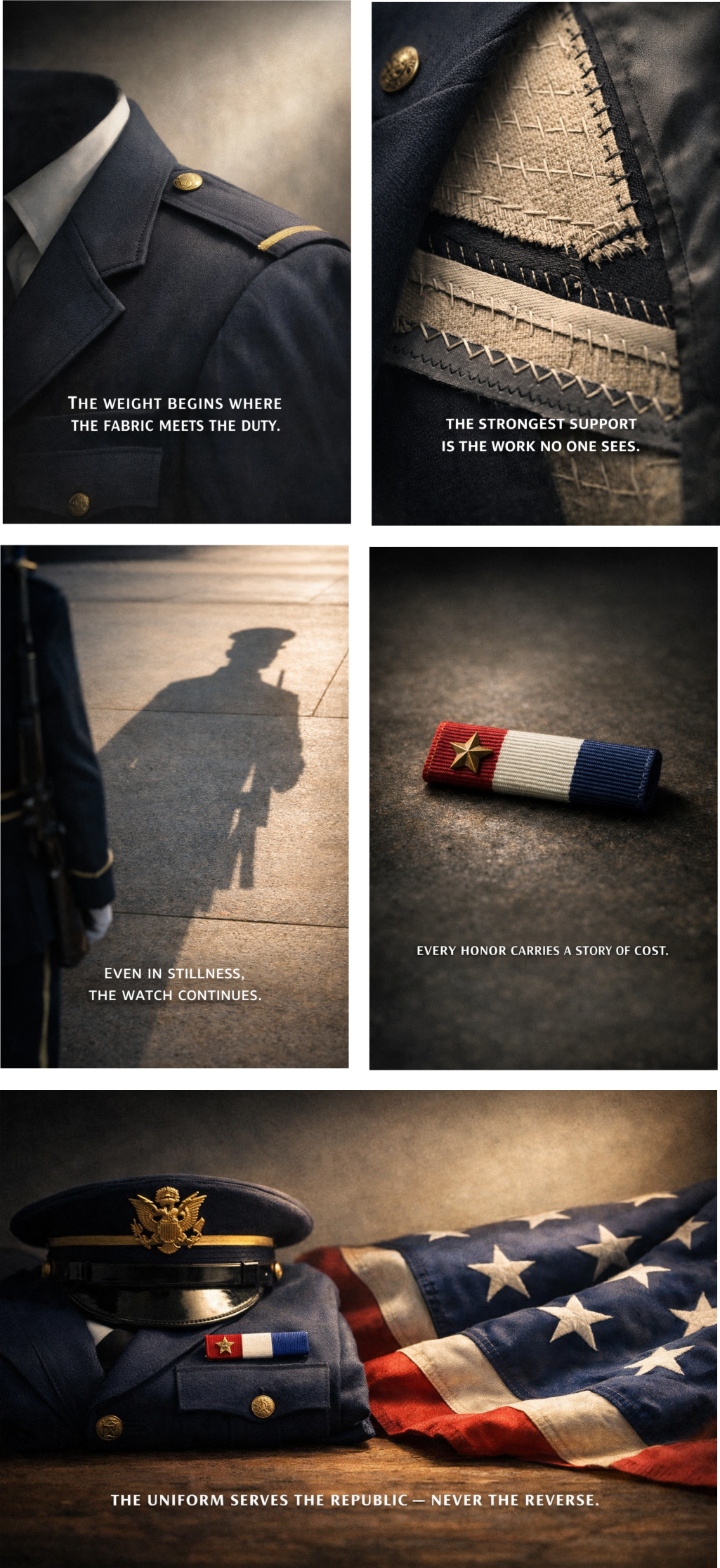
Five‑panel civic sequence showing the different facets of duty revealed through the uniform: the first surface, the underlayer, the stillness that reflects vigilance, the earned honor, and finally the full pattern of service.

Blue wave motif flowing across the screen.

Why This Post Matters

This page is about the moral architecture that holds a constitutional republic together. The images, captions, and reflections are not political commentary — they are reminders of the civic hierarchy that protects the nation from sliding into personality‑driven power. The uniform, the Capitol, the Constitution, and the quiet symbols of service all point to the same truth: duty is not about the individual who wears the uniform, but about the Republic that grants it meaning.

Each visual element on this page serves a specific symbolic role. The HERO image establishes the primacy of the Republic by placing the Capitol behind the uniform. The Grid sequence walks the reader through the emotional and constitutional burdens of service — weight, labor, vigilance, sacrifice, and finally, alignment with the Republic. Together, they form a civic narrative that restores perspective in a moment when surface‑level debates often drown out deeper principles.

This page speaks from the rule‑of‑law perspective — the altitude where service is measured not by procedural infractions but by fidelity to democratic institutions. It invites the reader to consider the constitutional hierarchy that places the Republic above the individual and the uniform beneath the law.

It reminds the reader that the weight of the uniform is not personal power — it is borrowed authority, held only in service to the Republic.

Soft gray whisper line divider.

When the rules bind the body, but the oath binds the soul, the uniform becomes heavier than law.