The Reflecting Pool Peel

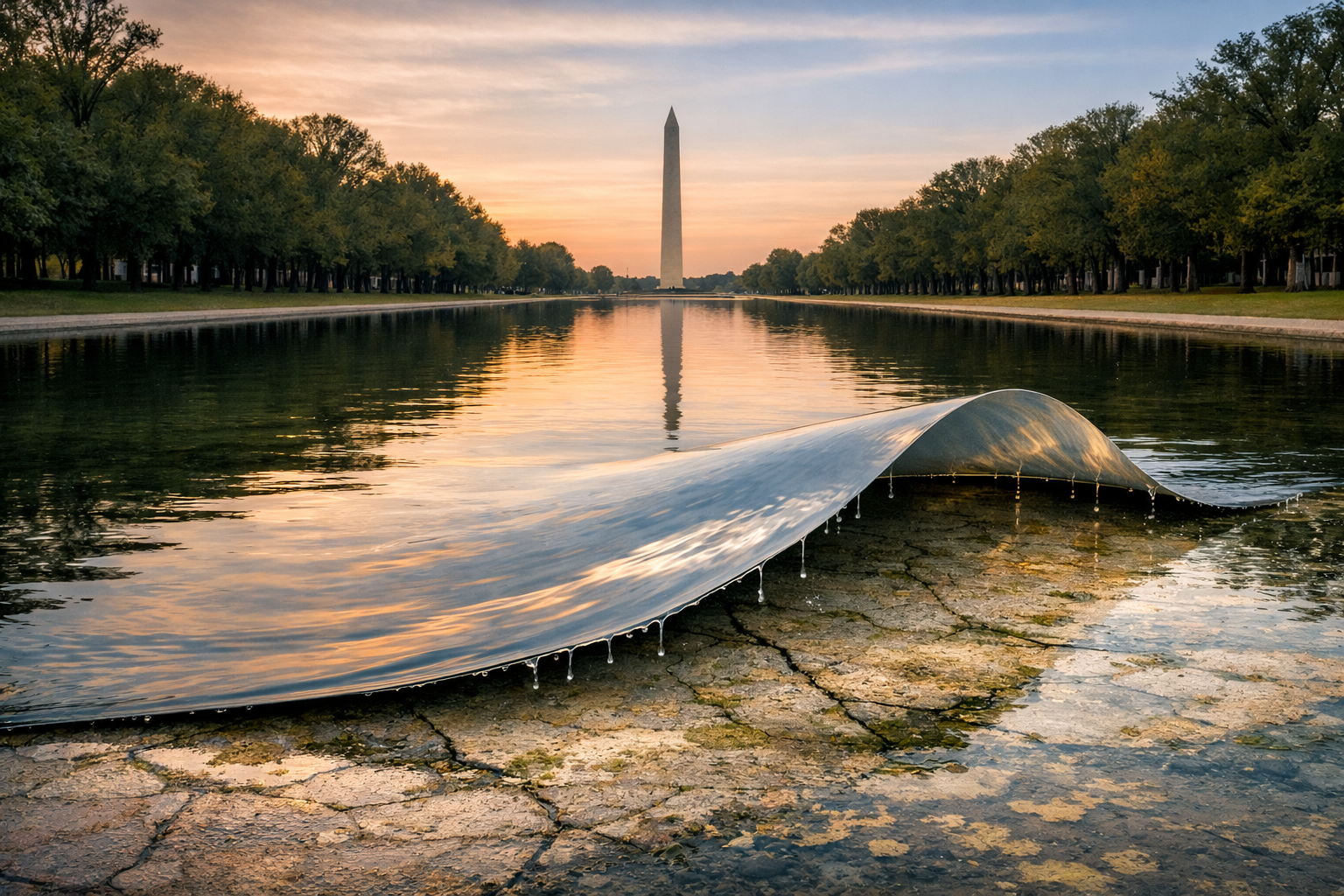
Wide horizontal view of the Reflecting Pool with several small peeled sections along the water’s surface, revealing patches of the basin beneath, with the Washington Monument centered in the distance.
USA Protect Your Vote banner with bold civic message and blue wave icons.

The Reflecting Pool Peel

The moment the surface peeled back on the Reflecting Pool, it revealed more than a maintenance issue — it exposed the quiet truth that every reflection depends on the strength of what lies beneath. The thin layer we trust to mirror our ideals lifted just enough to show the underlayer we rarely consider, reminding us that even our most iconic symbols rest on structures that require care.

The Reflecting Pool has always been a place where the nation looks at itself, a long sheet of water designed to hold our collective image. But when the surface shifted, the reflection fractured. What emerged was not a crisis, but a moment of clarity — a glimpse into the foundation that makes the reflection possible in the first place.

We often assume that what we see is what is stable. We assume the surface will hold, the image will remain intact, and the structure beneath will continue to function without our attention. But the peeled edge of the Pool disrupted that assumption. It asked us to consider the unseen work that supports the symbols we rely on, and the vigilance required to keep them sound.

The truth is simple and unavoidable: surfaces change. They weather, they thin, they lift. What matters is whether the foundation beneath them is strong enough to endure. The Reflecting Pool’s quiet reveal is a reminder that the health of our shared spaces — and the systems they represent — depends not on how they appear, but on how well they are maintained.

Soft, faint gray single line divider, low-contrast and gently blurred, symbolizing quiet resilience and reflection.

In mid‑2026, new images of the Reflecting Pool in Washington, D.C., circulated widely after sections of the surface appeared discolored, peeling, or visibly deteriorated. The National Park Service confirmed that the pool was again experiencing algae growth and surface instability, a condition that has occurred periodically due to heat, stagnant water, and organic buildup. The visual contrast between the pool’s iconic appearance and its exposed underlying surface drew immediate public attention.

Photos and videos of the peeling surface spread quickly across social media, prompting commentary, humor, and concern about the state of one of the nation’s most recognizable public landmarks. The unexpected visibility of the underlying material—normally hidden beneath the water—became a focal point of online discussion. The moment gained traction not only because of the pool’s symbolic importance, but also because the exposed surface created a striking and unusual visual.

The Reflecting Pool has required periodic draining and cleaning in the past, including a full maintenance cycle in 2024 to address algae accumulation and basin treatment. These interventions are part of the routine stewardship needed to preserve large public spaces that face environmental stress and heavy use. The 2026 resurfacing of the issue highlighted the ongoing challenges of maintaining national sites that depend on consistent funding, timely upkeep, and environmental management.

The renewed visibility of the pool’s condition drew attention to a broader pattern in which surface‑level deterioration reveals deeper questions about infrastructure resilience and public maintenance systems. When a prominent civic symbol experiences a failure that becomes publicly visible, it often prompts renewed discussion about the structures responsible for its care. The 2026 moment became one such instance, offering a clear view of the gap between appearance and underlying reality.

“The unexpected visibility of the underlying material became a focal point of public discussion.”

Blue wave motif flowing across the screen.

Wide horizontal view of the Reflecting Pool with several small peeled sections along the water’s surface, revealing patches of the basin beneath, with the Washington Monument centered in the distance.


Design Notes
Why This Image

The Reflecting Pool is shown at dawn, its calm surface peeling upward to reveal the cracked basin beneath. The composition centers the Washington  Monument, a national symbol of endurance, while the lifted water exposes the fragile infrastructure supporting that reflection. The image captures the moment when beauty and decay coexist in the same frame — a visual truth that mirrors the civic condition it represents.

The peeled surface functions as a metaphor for revelation. What appears serene and unified from a distance is, upon closer view, fractured and neglected. The upward curl of the water suggests both exposure and renewal — the act of lifting illusion to confront reality. The monument’s reflection remains visible but distorted, reminding viewers that national ideals persist even when their foundations require repair.

Civic Meaning

This image speaks to stewardship and accountability. The Reflecting Pool’s deterioration is not merely aesthetic; it symbolizes the maintenance of shared spaces and the systems that sustain them. When the surface fails, the underlying neglect becomes visible to all. The civic message is clear: transparency is not destruction — it is the first step toward restoration.

Why It Opens the Page

The HERO introduces the reader to the page’s central motif — The Peel of Truth. It invites reflection before reaction, positioning the viewer at the threshold between appearance and reality. By opening with the moment of exposure, the page establishes its tone: calm, factual, and unflinching. The peeled surface becomes the lens through which the entire Civic Page is read.
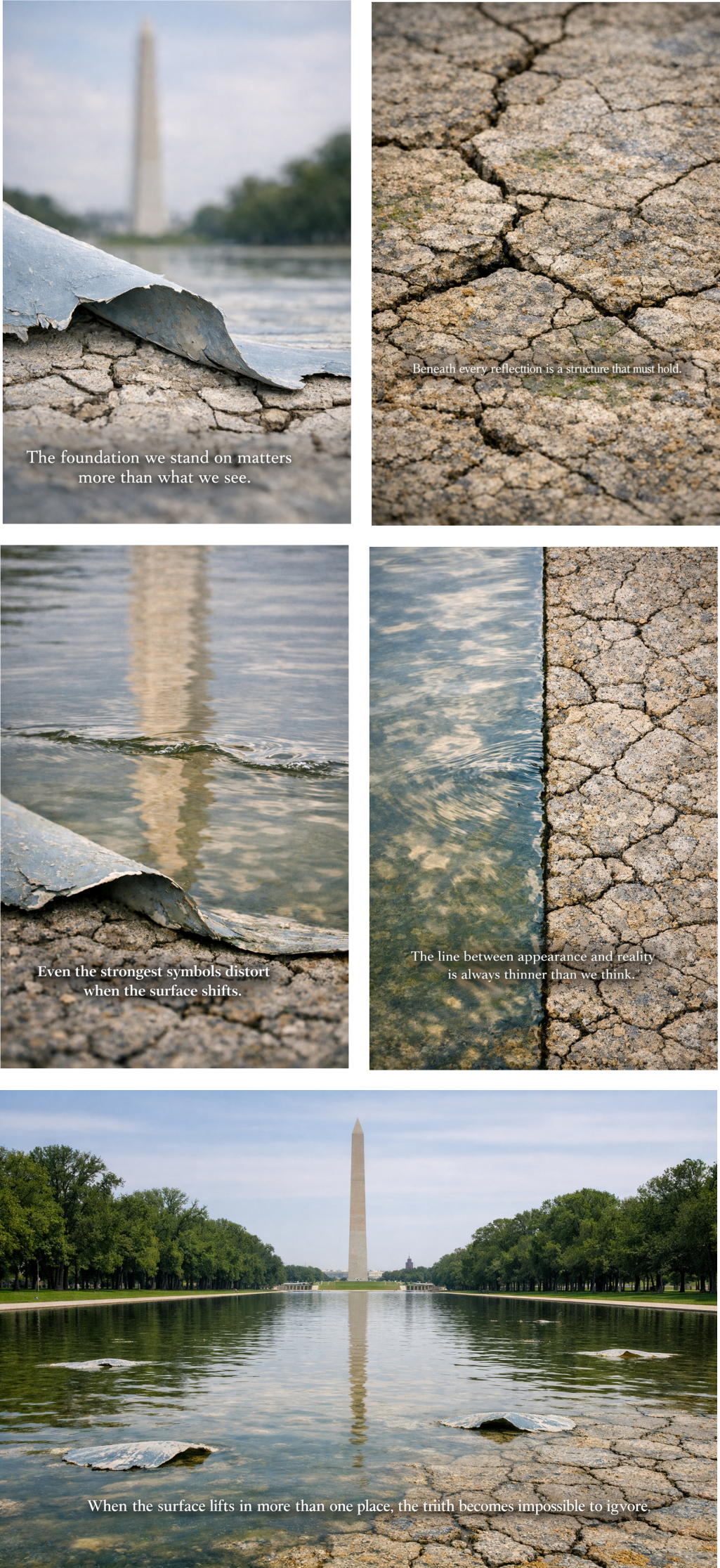
 
Five panel civic sequence showing the different facets of the surface failures that reveal truths: the first reveal, then the underlayer, the distorted reflection, the seam, and finally the full pattern emerges.
Blue wave motif flowing across the screen.

Sometimes the moment that changes the story is the one that exposes what we weren’t meant to see.

Why This Post Matters

The Reflecting Pool is one of the most photographed civic spaces in the nation, a place where symbolism and reality meet on a thin sheet of water. When that surface unexpectedly peeled back, exposing the cracked basin beneath, it became more than a maintenance issue — it became a moment of public clarity. The image of a national symbol revealing its underlayer resonated far beyond the Mall.

This moment matters because it reminds us that civic life is built on structures we rarely see. We walk past them, rely on them, and assume they will hold. But when the surface fails, the underlying condition becomes visible to everyone at once. The Reflecting Pool’s exposure was not dramatic, but it was unmistakable: a quiet reveal that asked the country to look more closely at the foundations — physical and civic — that support us.

It also matters because transparency is not a crisis — it is a beginning. When the basin was exposed, the conversation shifted from assumptions to facts. The public could see the wear, the weathering, and the need for repair. That visibility created a moment of collective understanding: stewardship requires attention, not just admiration.

Finally, this moment matters because it mirrors a broader civic truth. Our institutions, like the Reflecting Pool, are designed to reflect our highest ideals. But their ability to do so depends on the integrity of the structures beneath. When those structures weaken, the reflection distorts. Seeing the underlayer is not a failure of the system — it is an invitation to strengthen it through vigilant maintenance and structural stability.

When the surface lifts, we’re given a chance to see what needs care — and what can still be restored.

Soft gray whisper line divider.

The surface is temporary. Once it peels, the story becomes impossible to ignore.
Spurn the Spectacle. Fuel the Work.

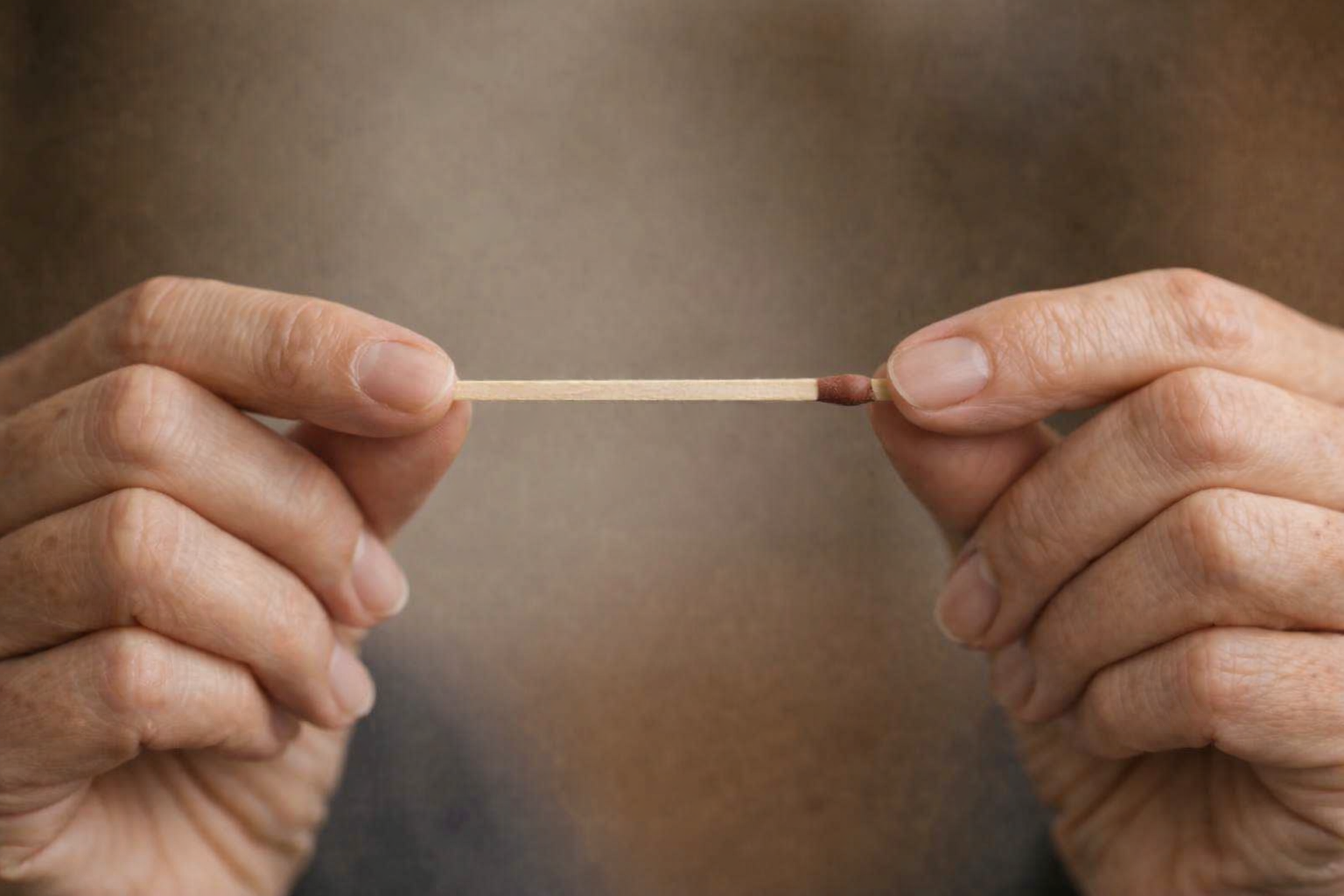
A pair of hands hold an unlit wooden match horizontally by its ends against a softly blurred neutral background. The match remains unstruck, symbolizing restraint and the power of focus.
USA Protect Your Vote banner with bold civic message and blue wave icons. Accessibility Text: A rectangular banner with the words “USA PROTECT YOUR VOTE. MAKING WAVES. NAMING NAMES. DEFENDING DEMOCRACY.” in bold blue capital letters on a white background. Below the text are three stylized blue wave icons, framed by a rough hand-drawn border.

Spurn the Spectacle. Fuel the Work.

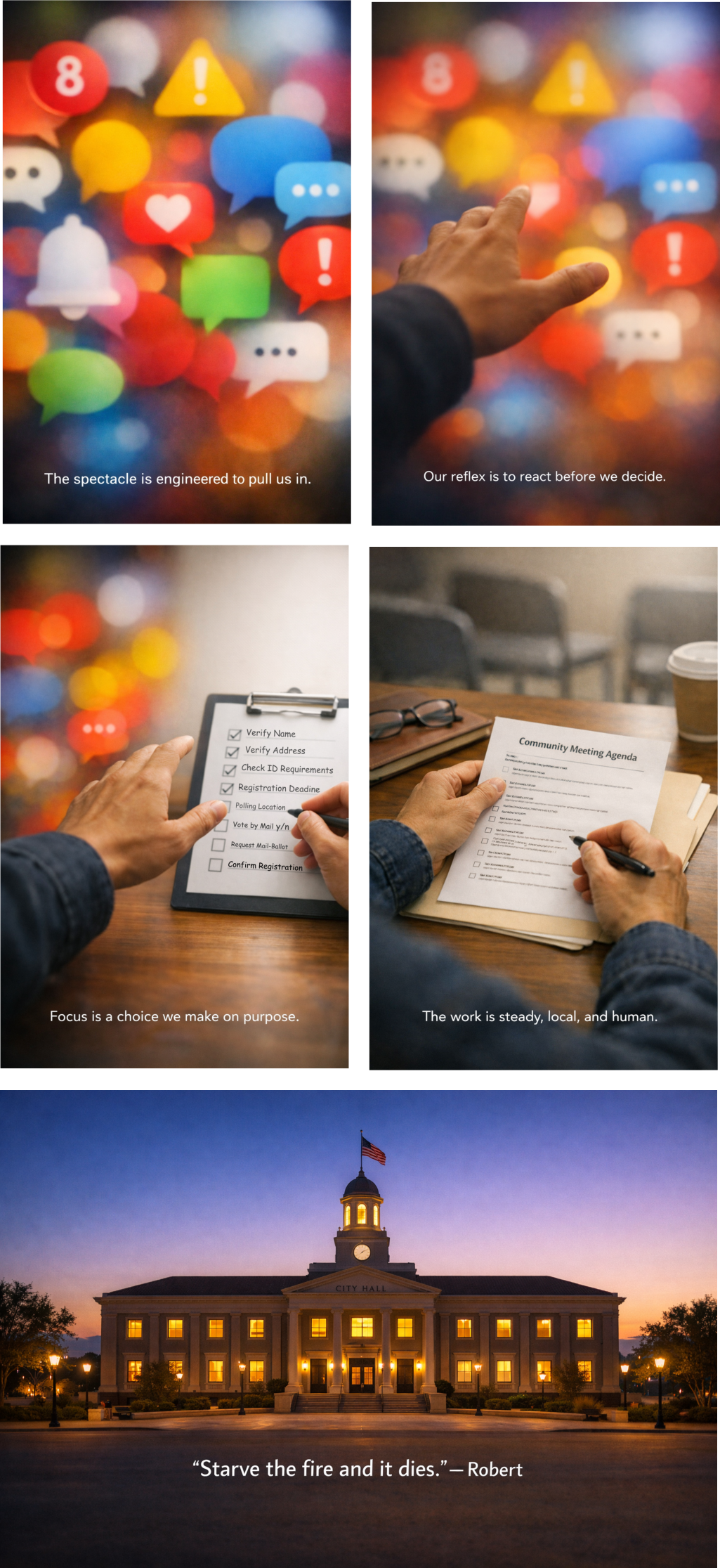
The pull is constant, and it’s designed to be. Every day, noise tries to claim our attention before we even realize we’ve given it away. But beneath the swirl, there is a steadier truth waiting for us — one that doesn’t shout, doesn’t flash, and doesn’t demand. It simply asks us to look up.

We live in a moment where distraction is not an accident; it’s an industry. Outrage is packaged, urgency is manufactured, and the spectacle is engineered to keep us reacting instead of choosing. The more chaotic the environment becomes, the easier it is for the real work — the quiet, local, human work — to slip out of view. And when that happens, the people who benefit most are the ones who prefer we stay overwhelmed and unproductive.

When we redirect it toward the places where decisions are made, where community is shaped, where democracy actually lives, we interrupt the engineered dynamic — and that interruption changes what becomes possible. The shift begins the moment we recognize that our attention is not a passive resource — it’s a form of power. When we choose where it goes, we choose what grows.

This page begins there: with the simple, deliberate act of turning away from the noise and toward the work that matters. It’s a reminder that our agency isn’t found in the spectacle — it’s found in the choices we make on purpose, in the rooms where we show up, and in the focus we refuse to surrender.

What Counts as Spectacle

    • viral outrage
    • engineered conflict
  • attention traps
  • performative politics
  • algorithmic churn
  • headline‑bait
  • platform‑driven drama
  • manufactured controversy
  • noise designed to provoke reaction instead of reflection

Blue wave motif flowing across the screen—symbol of civic vigilance, legacy protection, and unstoppable movement.


A pair of hands hold an unlit wooden match horizontally by its ends against a softly blurred neutral background.


Design Notes

Why This Image
This image presents a single unlit match held horizontally between two hands. Its simplicity is intentional. The match is familiar, ordinary, and immediately recognizable, yet the way it is held — steady, centered, and unignited — draws attention to the moment before action. The image invites the viewer to notice the pause, the choice, and the quiet control embedded in that moment.

Symbolic Function
The unlit match functions as a symbol of potential rather than outcome. It represents the capacity for ignition without depicting fire itself. By withholding flame, the image emphasizes restraint, intention, and the power of deciding where energy will or will not be directed. The horizontal orientation reinforces stability and balance, suggesting deliberation rather than spontaneous reaction.

Civic Meaning
In a civic context, the match becomes a stand‑in for attention — a resource that can fuel conflict or support constructive work depending on how it is used. The image underscores the premise that not every provocation requires engagement and that withholding attention can be an act of civic strength. It reflects the broader theme that democratic power is shaped not only by what we respond to, but by what we choose to let pass without ignition.

Why It Opens the Page
This image opens the page to establish the central tension of the piece before a single word is read. It frames the reader’s mindset around choice, focus, and agency. By beginning with a moment of deliberate non‑action, the page signals that the work ahead is about directing attention with intention rather than being pulled into reactive cycles. The image sets a calm, grounded tone that prepares the reader for the analysis that follows.

Five panel civic sequence showing the shift from digital distraction to human focus.

Blue wave motif flowing across the screen—symbol of civic vigilance, legacy protection, and unstoppable movement.

We are not powerless — but outside forces are constantly trying to pull us off course.

Why This Post Matters

Outside forces work hard to keep us distracted. Outrage cycles, viral noise, and engineered spectacle are designed to pull our attention away from the places where our choices actually matter. The goal isn’t to inform us — it’s to keep us reacting, endlessly, so we never look up long enough to notice what’s happening in the rooms where decisions are made.

Our reflex to react is deeply human. That’s why the spectacle targets it. The people who benefit from chaos don’t need us to agree with them — they just need us to stay caught in the swirl. If we’re busy responding to every manufactured fire, we’re not focusing on the steady, unglamorous work that shapes our communities.

Civic work rarely announces itself. It doesn’t trend, it doesn’t flash, and it doesn’t reward us with instant gratification. It consists of reading agendas, attending meetings, asking questions, voting in elections nobody seems to care about, and paying attention to the decisions that quietly shape our daily lives. This is the work that actually moves power.

When we choose to redirect our attention — deliberately, consistently — we weaken the spectacle’s grip. We reclaim our agency. We remind ourselves that democracy isn’t sustained by noise; it’s sustained by participation. And participation begins with focus.

When we redirect our attention, we redirect our power.

Soft, faint gray single line divider, low-contrast and gently blurred, symbolizing quiet resilience and reflection. Accessibility: Symbolizes quiet resilience, reflection, and gentle healing.

Reclaiming Our Focus.

A Nation Soaked in Gasoline

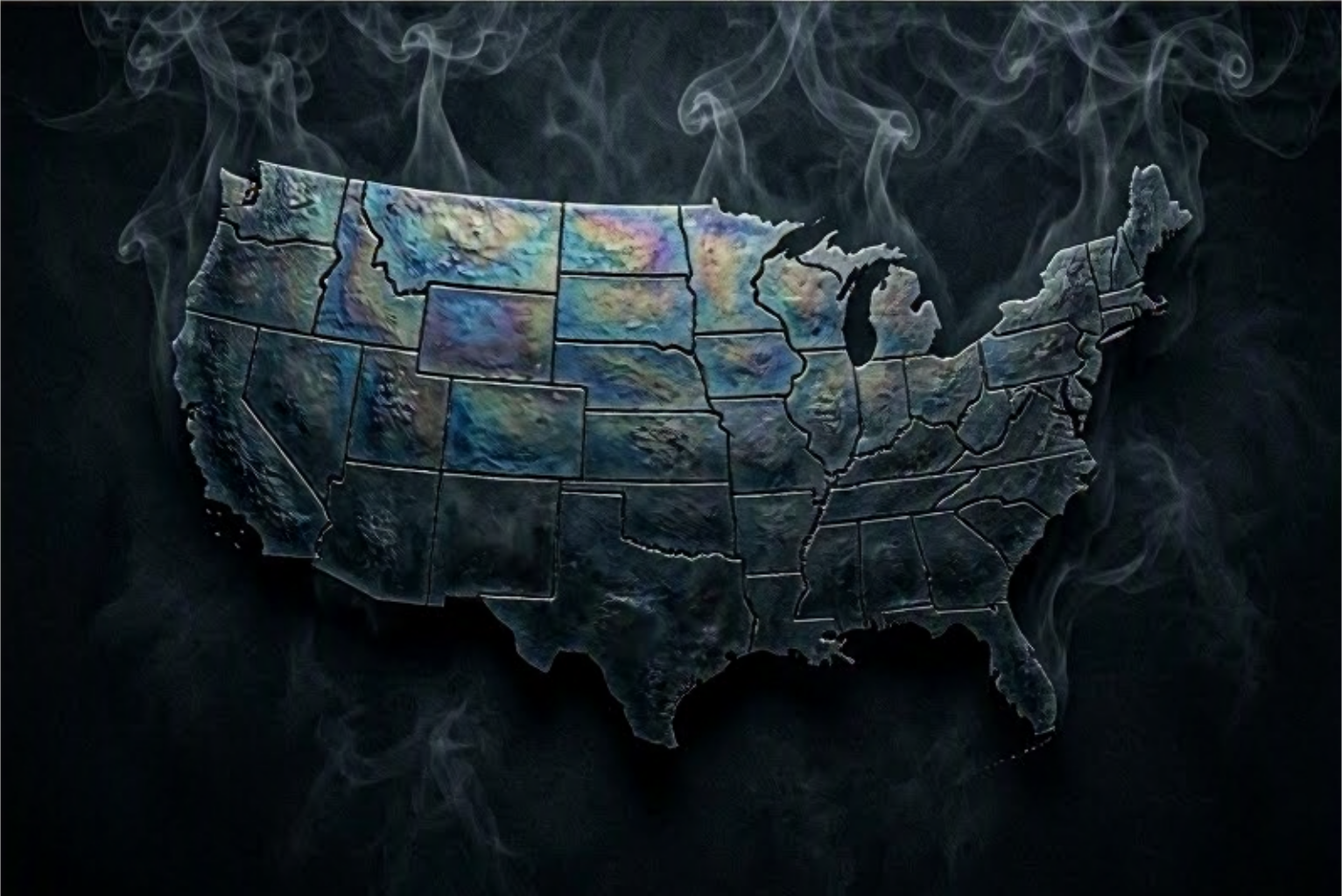
Map of the United States suspended against a black background with an iridescent gasoline sheen and faint smoke rising from its edges.
USA Protect Your Vote banner with bold civic message and blue wave icons. Accessibility Text: A rectangular banner with the words “USA PROTECT YOUR VOTE. MAKING WAVES. NAMING NAMES. DEFENDING DEMOCRACY.” in bold blue capital letters on a white background. Below the text are three stylized blue wave icons, framed by a rough hand-drawn border.

A Nation Soaked in Gasoline

We talk a lot about the fires in American politics, but far less about the conditions that make them possible. The truth is simple and uncomfortable: nothing ignites on its own. Something has to be saturated. Something has to grind. Something has to heat. Something has to feed the air. And something has to sit too close to the spark. We are not a nation on the verge of spontaneous combustion. We are a nation living inside the perfect environment for ignition.

The danger isn’t the flame itself — it’s how easily the flame can appear. We’ve grown accustomed to a political and media ecosystem that keeps us flammable: overloaded with distortion, primed for conflict, and conditioned to react before we understand. These aren’t accidents. They’re the predictable outcomes of systems designed to reward heat over clarity, friction over truth, and proximity over safety.

A healthy democracy can withstand disagreement. What it cannot withstand is a constant state of pre-ignition — a country so saturated, so heated, and so oxygen-rich with outrage that the smallest spark becomes a national event. When everything is flammable, everything becomes a threat.

This page is not about the fire. It’s about the environment we’ve allowed to surround us. Because if we want a different future, we have to stop staring at the flames and start dismantling the conditions that make them inevitable.

Soft, faint gray single line divider, low-contrast and gently blurred, symbolizing quiet resilience and reflection.

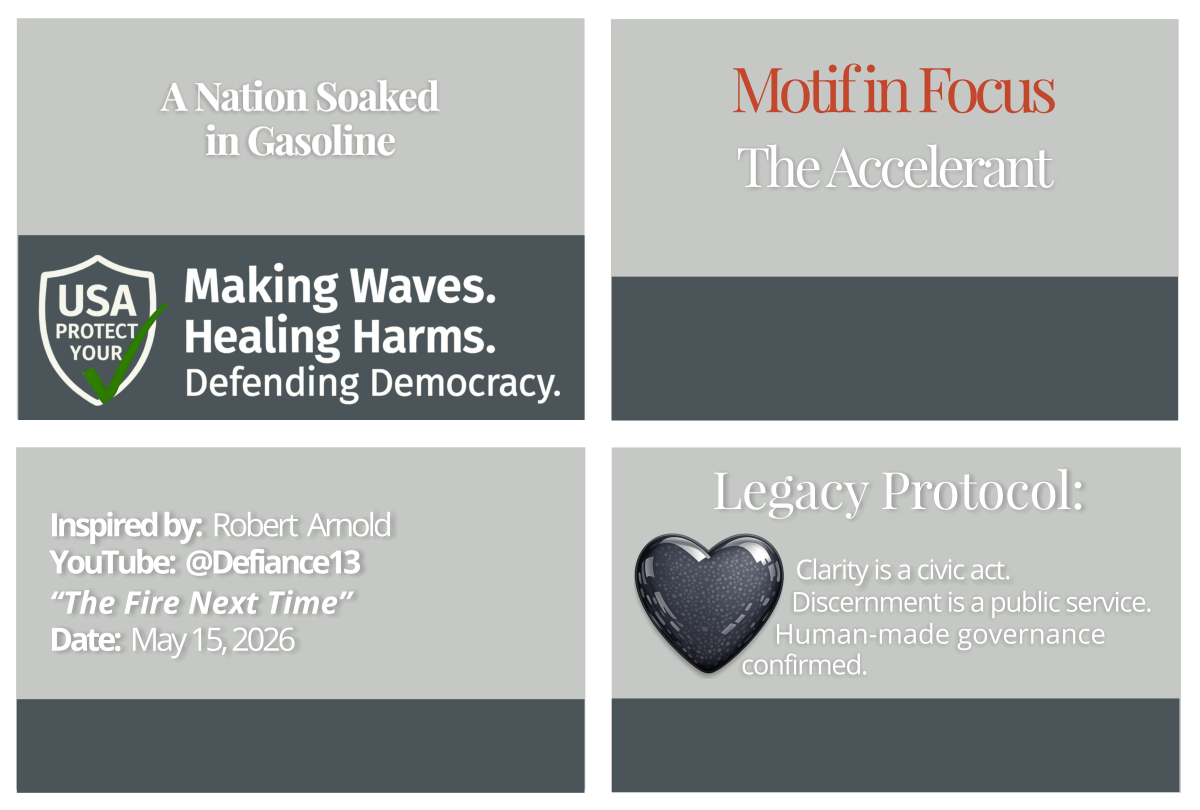
Robert Arnold’s video essay, The Fire Next Time (May 15, 2026), examines the United States through the lens of James Baldwin’s warning that “God gave Noah the rainbow sign, no more water, the fire next time.” Arnold argues that the country has repeatedly ignored the moral and structural warnings embedded in its own history. His analysis frames the present moment as the consequence of accumulated injustice rather than an unexpected crisis.

Drawing on Baldwin, bell hooks, and Toni Morrison, Arnold traces a lineage of racial violence, political denial, and the erosion of civic trust. He emphasizes that the danger facing the nation is not sudden but engineered through decades of policy choices and cultural avoidance. The video positions humiliation, not chaos, as the true accelerant beneath democratic decline.

Arnold also critiques the role of white moderation and performative progressivism in sustaining the conditions that allow injustice to deepen. In this context, white moderation refers to opposing overt harm while prioritizing comfort or civility over confronting structural inequity, and performative progressivism describes the use of progressive language without a willingness to support or enact meaningful change. Arnold argues that these patterns function as oxygen in the fire triangle, feeding the conditions that make civic combustion possible.

The video concludes that the nation is approaching a point where people no longer believe reform is possible within existing structures. Arnold warns that “the flood was mercy; the fire is what happens when mercy is mocked for too long,” underscoring the motif of accumulated accelerants. The full video can be viewed at: [link].

“Every diluted vote, every censored history lesson, every smirking politician waving flags while stripping away representation is another match struck against a nation already soaked in gasoline.”

Blue wave motif flowing across the screen—symbol of civic vigilance, legacy protection, and unstoppable movement. Accessibility: Symbolizes civic vigilance, legacy protection, and unstoppable movement.

Map of the United States suspended against a black background with an iridescent gasoline sheen and faint smoke rising from its edges.

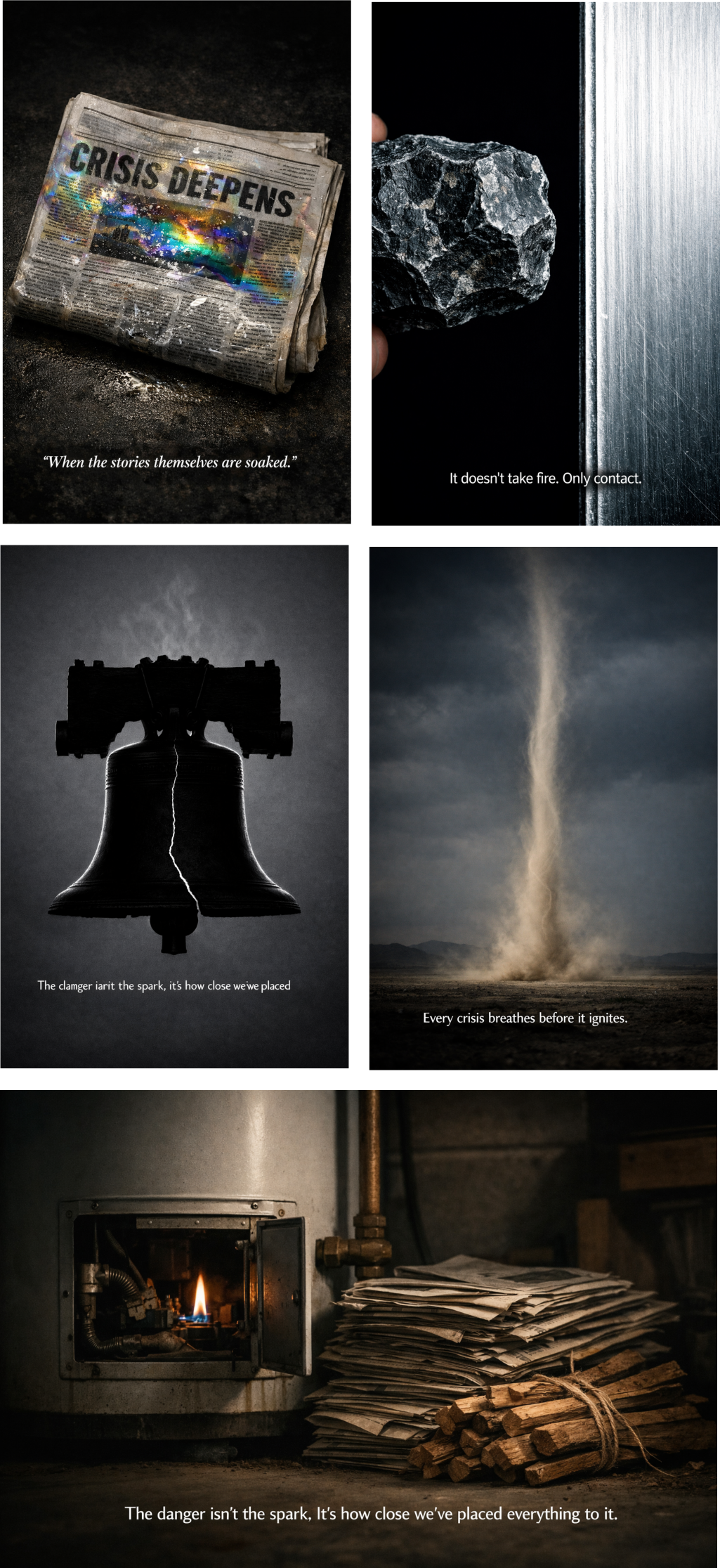
A five panel image grid showing the conditions that allow ignition: a soaked newspaper signaling unstable stories; the Liberty Bell in silhouette with a faint heat haze; a slender dust devil rising in a muted landscape; a hand holding coal close to metal; and a dim garage scene with a water heater’s pilot light beside stacked newspapers and kindling. The sequence illustrates how crises form from accumulated conditions, not a single spark.

Design Notes

Why This Image
The nation appears suspended in darkness, its shape unmistakable yet stripped of context, as if lifted out of its own reality. The gasoline sheen across its surface introduces an unstable beauty — a quiet warning disguised as iridescence. This is not a map meant for orientation; it is a portrait of a country caught in a volatile pause.

Symbolic Function
The thin tendrils of smoke rising from the edges signal a perimeter under stress, a boundary where heat has already touched. Nothing is actively burning, yet everything suggests the conditions for ignition are already present. The image functions as a visual metaphor for a nation saturated with accelerants — political, social, informational — needing only the smallest spark.

Civic Meaning
The sheen and smoke together articulate the civic moment: a country coated in flammable narratives, conspiracies, resentments, and manufactured grievances. The danger is not in a single flame but in the saturation itself — the way volatility has seeped into the national grain. The image captures the truth that instability is no longer hypothetical; it is ambient.

Why It Opens the Page
This HERO sets the emotional register for the entire piece. It tells the reader, before a single word is read, that the story ahead is about conditions, not catastrophes — about the quiet, cumulative choices that leave a nation soaked and waiting. The suspended map invites the reader to confront the precariousness of the moment and understand the stakes before moving into the argument.


Blue wave motif flowing across the screen—symbol of civic vigilance, legacy protection, and unstoppable movement.

Before we can change the conditions, we name the reality they reveal.

Why This Post Matters

When a nation feels volatile, it’s easy to focus on the flames. We point to the latest outrage, the loudest headline, the most visible explosion of conflict. But fire never begins with the blaze. It begins with the conditions that make ignition possible.

We are living in a moment where information is saturated with distortion, where friction is engineered for profit, where heat is generated faster than we can cool it, where oxygen is pumped into every grievance, and where proximity to the spark is treated as entertainment. None of these conditions alone creates a fire. But together, they create a country that feels one bad moment away from something we can’t take back.

This matters because civic health isn’t measured by how loudly we argue — it’s measured by how easily we ignite. A stable democracy can absorb disagreement. A brittle one can’t. And right now, the brittleness is showing. Not because Americans are inherently divided, but because the systems shaping our information, our attention, and our emotional bandwidth are designed to keep us flammable.

Naming the conditions is the first step in neutralizing them. When we understand what’s saturating us, what’s grinding against us, what’s heating us, what’s feeding the air around us, and what’s sitting too close to the spark, we regain agency. We stop reacting to the fire and start addressing the environmental conditions that allow it to spread.

This post matters because the country isn’t doomed — but it is combustible. And the difference between those two realities is whether we choose to see the danger before the match is struck.

Because a nation that understands its conditions can change its trajectory.

Soft, faint gray single line divider, low-contrast and gently blurred, symbolizing quiet resilience and reflection. Accessibility: Symbolizes quiet resilience, reflection, and gentle healing.

Nothing burns by accident.