Paperclips: The Quiet Strength That Holds Us Together

A mature woman’s hand holds a single silver paperclip between her thumb and forefinger, softly lit against a warm, blurred background.
USA Protect Your Vote banner with bold civic message and blue wave icons. Accessibility Text: A rectangular banner with the words “USA PROTECT YOUR VOTE. MAKING WAVES. NAMING NAMES. DEFENDING DEMOCRACY.” in bold blue capital letters on a white background. Below the text are three stylized blue wave icons, framed by a rough hand-drawn border.

Paperclips: The Quiet Strength That Holds Us Together

There are moments in our history when the country did not need louder voices — it needed steadier hands. Times when the most powerful act an ordinary person could take was simply to show that they were still here, still paying attention, still willing to stand with one another when the ground felt uncertain.

The story we’re stepping into now is one of those moments.

It’s a reminder that civic strength has never belonged only to institutions or leaders. It has always lived in the quiet decisions people make to stay connected, to stay informed, and to refuse to drift into silence. The paperclip began as a small symbol of that choice — a way for people to signal to one another that they were part of something larger than themselves, even when the world around them felt unsteady.

We return to that history now not out of nostalgia, but because the lesson still holds. When the future feels unclear, the simplest symbols can become anchors. And when people choose to carry them together, they become a quiet declaration: we are still here, and we still believe in one another — and in defending the democratic ideals that hold this country together.

Soft, faint gray single line divider, low-contrast and gently blurred, symbolizing quiet resilience and reflection.


This page draws from Robert Arnold’s January 21, 2026 video reflection on the first year of the second Trump administration, a piece that examines the architecture of authoritarian drift and the emotional toll of sustained chaos. Arnold argues that the acceleration, confusion, and rule shifting of the past year are not signs of strength but symptoms of a brittle system dependent on fear and overwhelm. He situates this moment within historical patterns, noting that systems built on domination eventually collapse under their own instability. The piece centers ordinary people as the counterforce to resignation, highlighting the quiet forms of solidarity that keep moral memory alive. Arnold invokes the story of Swedish teachers who wore paperclips during World War II as a small, visible act of resistance — a reminder that dignity, presence, and human connection are what carry communities through dark seasons.

“Evil is loud, but it is not strong.”

Blue wave motif flowing across the screen—symbol of civic vigilance, legacy protection, and unstoppable movement. Accessibility: Symbolizes civic vigilance, legacy protection, and unstoppable movement.

A mature woman’s hand holds a single silver paperclip between her thumb and forefinger, softly lit against a warm, blurred background.

Design Notes

Why This Image
This image centers on a single paperclip held gently but firmly between the fingers of an older woman — a quiet, human gesture that carries the weight of memory. The steadiness of her hand, the softness of the light, and the simplicity of the object create an immediate emotional anchor. It signals that this page begins not with spectacle, but with a small act of moral clarity.

Symbolic Function
The paperclip stands in for the ordinary tools people use to hold things together — documents, stories, communities, and truths. In her hand, it becomes a symbol of personal responsibility: the choice to keep what matters intact. The image distills the motif into its purest form: one person, one object, one act of steadiness.

Civic Meaning
This is not about spectacle; it’s about the subtle shifts that change the lived experience of democracy long before the public recognizes the danger. The erosion of the guardrail reflects the erosion of representation, accountability, and equal access to power. It signals that the reduction of our civic voice rarely begins with a crisis — it begins with a quiet loss of structural integrity.

Why It Opens the Page
The page begins here because the entire argument rests on this premise: that the strength of a democracy is found in the hands of its people. This single paperclip, held steady, is the thesis in visual form. It invites the reader into a story about memory, responsibility, and the quiet power of ordinary citizens choosing to hold things together.
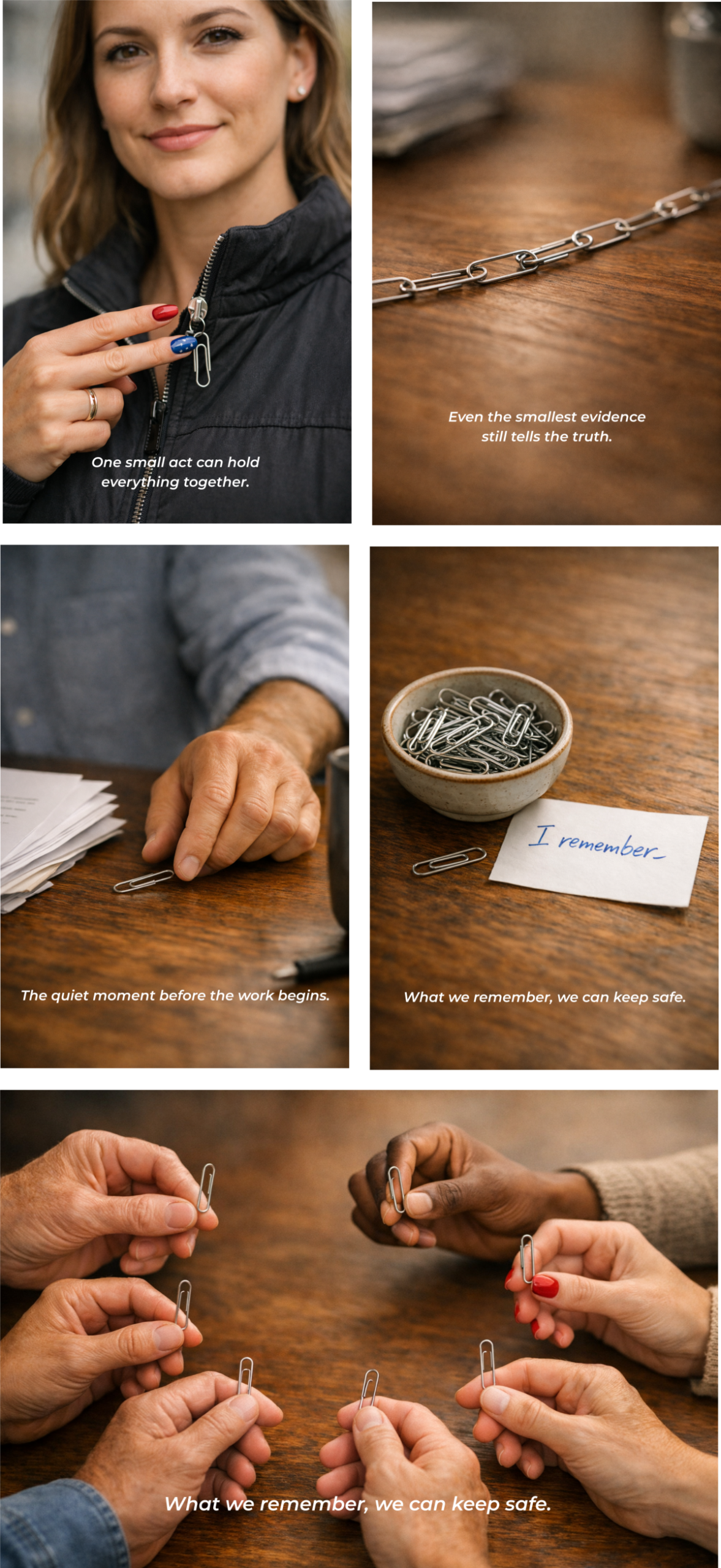
A five panel image grid using paperclips as a civic symbol of quiet strength and shared responsibility. Top left: a hand holding two linked paperclips near a jacket zipper with the caption “One small act can hold everything together.” Top right: a chain of paperclips on a wooden surface with the caption “Even the smallest evidence still tells the truth.” Middle left: a hand resting near papers and a single paperclip with the caption “The quiet moment before the work begins.” Middle right: a bowl of paperclips beside a note reading “I remember,” captioned “What we remember, we can keep safe.” Bottom row: multiple hands of different people each holding a paperclip, captioned “What we remember, we can keep safe.” The grid conveys connection, memory, and the quiet work of defending democratic ideals.

Blue wave motif flowing across the screen—symbol of civic vigilance, legacy protection, and unstoppable movement.

When we choose to remember, we choose to hold the line together.

Why This Post Matters

The story of the paperclip is a reminder that resistance often begins with something small — a gesture so ordinary it could be overlooked, yet powerful enough to signal that people still recognize the difference between what is right and what is merely allowed. This post returns to that quiet act of defiance to show how moral memory is carried not only by institutions, but by individuals who refuse to forget what solidarity looks like. The paperclip becomes a symbol of that choice: a simple object that holds things together when the world feels like it’s coming apart.

In today’s civic landscape, the pressures are different, but the stakes are familiar. Disinformation, manufactured narratives, and the erosion of shared truth create a climate where people can feel isolated in their convictions. The paperclip motif counters that illusion of isolation. It reminds us that millions of ordinary citizens still believe in the work of holding the line — not through spectacle, but through steady, consistent acts of care, attention, and accountability. This post names that work and honors the people who do it quietly.

The paperclip also represents the connective tissue of democracy: the links between neighbors, communities, and generations who choose to remember what has been fought for and what must not be lost. It is a symbol of continuity — a way of saying that the responsibility to safeguard democratic norms does not disappear simply because the news cycle moves on. Memory is a civic act, and this page calls readers back to that responsibility.

This post matters because it reframes the paperclip not as nostalgia, but as a living civic gesture. It invites readers to see themselves as part of a larger collective — one that understands the power of small, steady actions in a time when the loudest voices often drown out the most important truths. The paperclip is a reminder that democracy is held together by the hands of its people, one quiet act at a time.

Soft, faint gray single line divider, low-contrast and gently blurred, symbolizing quiet resilience and reflection. Accessibility: Symbolizes quiet resilience, reflection, and gentle healing.

When We Remember Who We Are, We Protect What We Share.
The Quiet Reduction of Our Voice, Our Vote, and Our Power

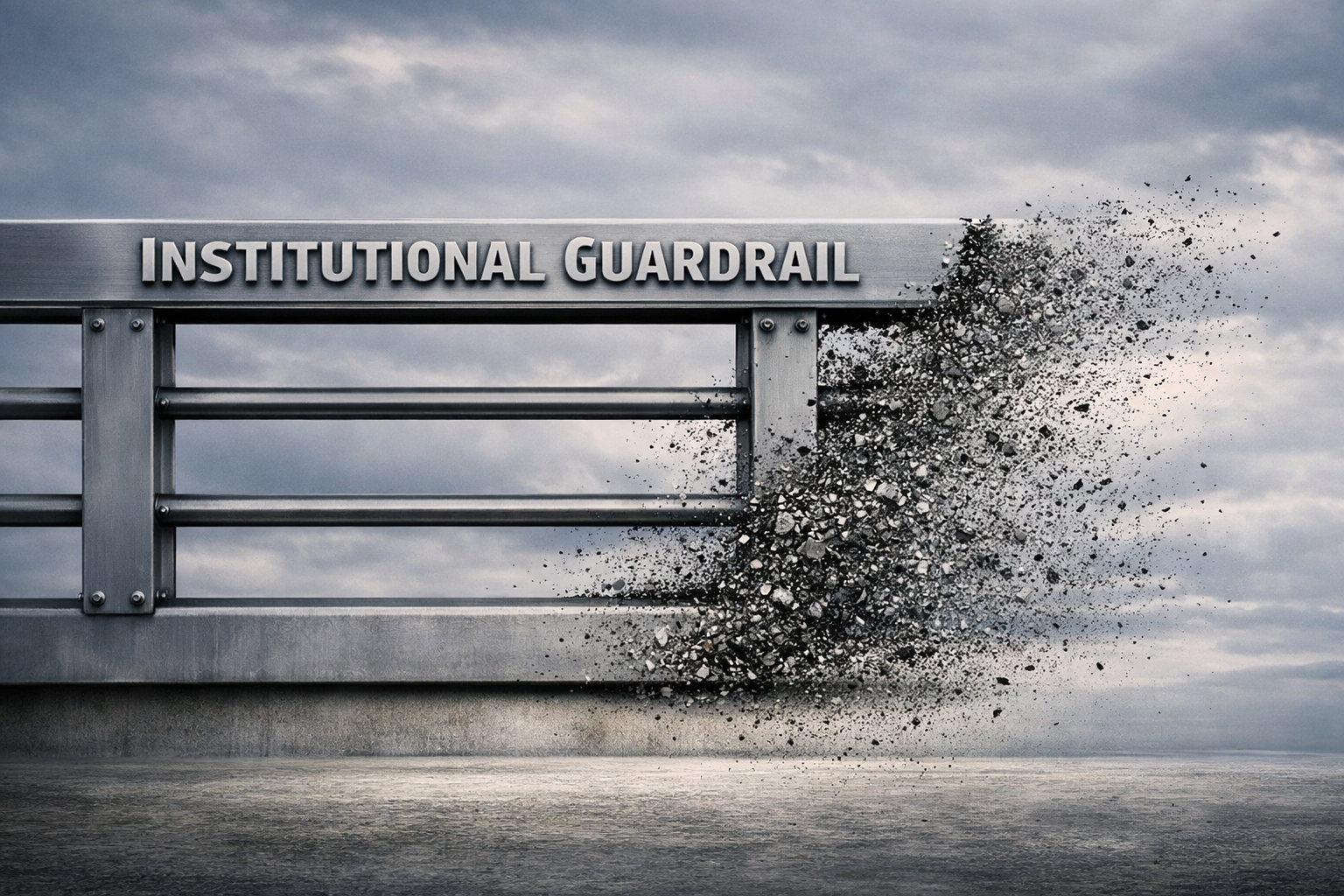
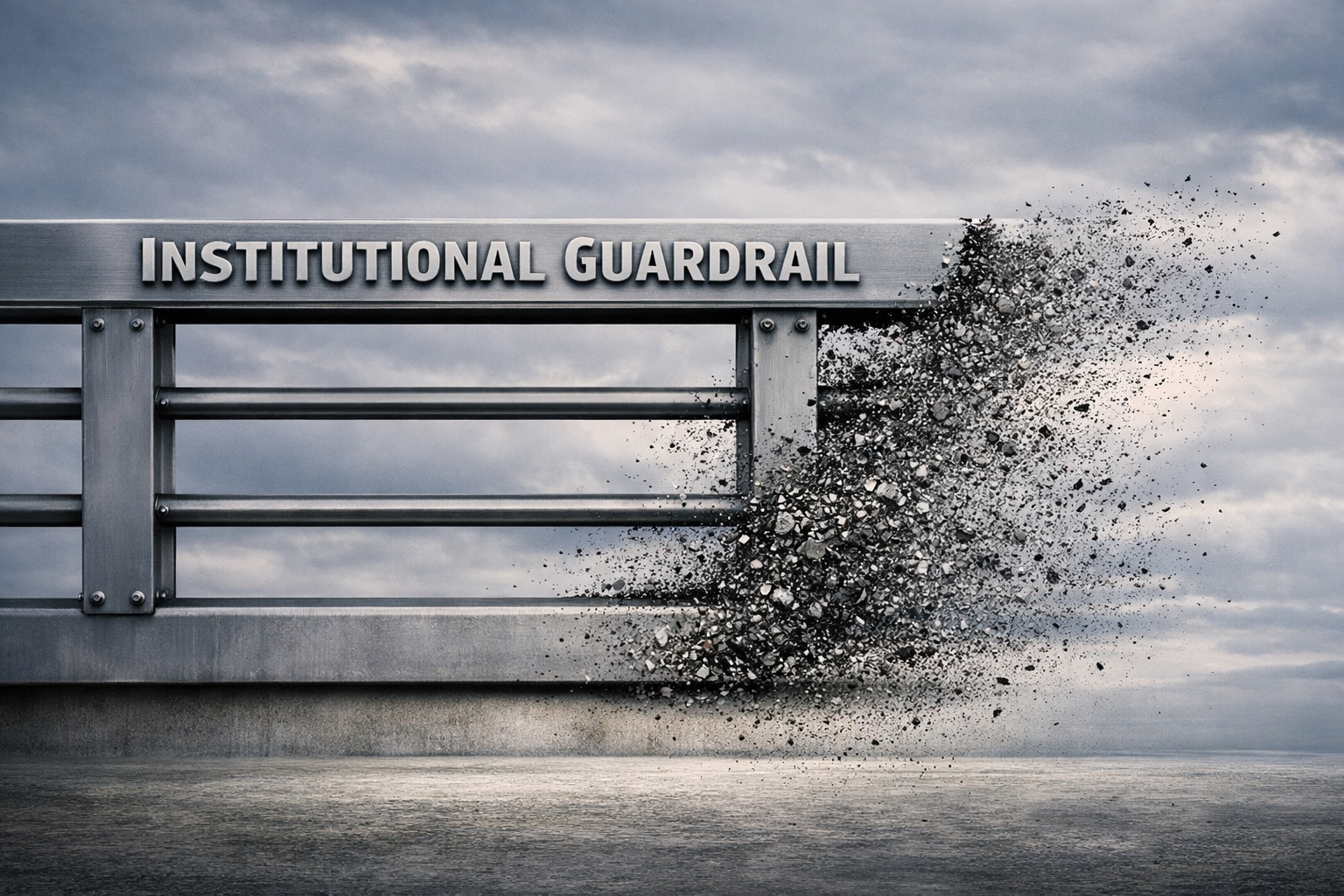
Brushed steel guardrail labeled “INSTITUTIONAL GUARDRAIL” in raised metallic letters across the top rail. The left side stands intact while the right side erodes into fine particles that fade into a cloudy sky, symbolizing the quiet weakening of institutional restraint and the gradual reduction of civic protections.
USA Protect Your Vote banner with bold civic message and blue wave icons. Accessibility Text: A rectangular banner with the words “USA PROTECT YOUR VOTE. MAKING WAVES. NAMING NAMES. DEFENDING DEMOCRACY.” in bold blue capital letters on a white background. Below the text are three stylized blue wave icons, framed by a rough hand-drawn border.

The Quiet Reduction of Our Voice, Our Vote, and Our Power

Democracy is being weakened not by chaos, but by institutions whose decisions quietly strip power from the people they were built to protect. In case after case, the Supreme Court has reshaped the rules that govern voting rights and representation, narrowing protections, enabling extreme gerrymanders, and signaling to states that long-standing democratic guardrails can be ignored without consequence. These rulings do not announce themselves as threats. They arrive as technical shifts — changes in timing, doctrine, and interpretation — that functionally remove power from voters and deliver it into the hands of partisan actors. The erosion is deliberate, cumulative, and already altering the structure of our democracy. This page names that reality without hesitation: our voice, our vote, and our power are being reduced through institutional actions that remake the democratic landscape long before most people realize what has been lost — and who stripped it away from them.

Soft, faint gray single line divider, low-contrast and gently blurred, symbolizing quiet resilience and reflection.


Marc Elias, a longtime voting rights attorney, examines the Supreme Court’s recent ruling through the lens of institutional erosion and the shifting burden placed on voters. He describes how protections once considered stable have been weakened through precise legal revisions that reshape the landscape while appearing technical or procedural. Elias notes that each change, however small, alters the balance of democratic power and increases the pressure on voters to defend rights that were meant to be safeguarded by the system itself. His analysis underscores a broader pattern: when institutions step back from their own guardrails, the power of the people is quietly reduced. (Source: Democracy Docket member-only article by Marc Elias, April 2024; not publicly accessible.)

“When institutions step back from their duty, the weight of democracy falls on the voter alone.”

Blue wave motif flowing across the screen—symbol of civic vigilance, legacy protection, and unstoppable movement. Accessibility: Symbolizes civic vigilance, legacy protection, and unstoppable movement.

Brushed steel guardrail labeled “INSTITUTIONAL GUARDRAIL” in raised metallic letters across the top rail. The left side stands intact while the right side erodes into fine particles that fade into a cloudy sky, symbolizing the quiet weakening of institutional restraint and the gradual reduction of civic protections.

Design Notes

Why This Image
This image captures the moment when a democratic guardrail stops functioning as a boundary and begins dissolving into something unrecognizable. The guardrail is still present — still technically “there” — but its integrity is compromised. That tension between visibility and failure mirrors the quiet ways our collective power can be reduced without a single dramatic event.

Symbolic Function
The guardrail represents the institutional structures meant to protect our voice, our vote, and our shared civic power. Its fragmentation symbolizes the slow, often invisible processes that weaken those protections: procedural erosion, manipulated norms, and the steady normalization of anti-democratic behavior. The image functions as a visual metaphor for a system that looks intact from a distance but is failing at the structural level.

Civic Meaning
This is not about spectacle; it’s about the subtle shifts that change the lived experience of democracy long before the public recognizes the danger. The erosion of the guardrail reflects the erosion of representation, accountability, and equal access to power. It signals that the reduction of our civic voice rarely begins with a crisis — it begins with a quiet loss of structural integrity.

Why It Opens the Page
The HERO image sets the emotional and civic frame for the entire piece. It tells the reader: This page is about what we lose before we realize we’re losing it. By opening with a guardrail in mid-collapse, the page invites the reader to look closely at the early signs of democratic reduction — the ones that are easy to overlook until the damage is already underway.

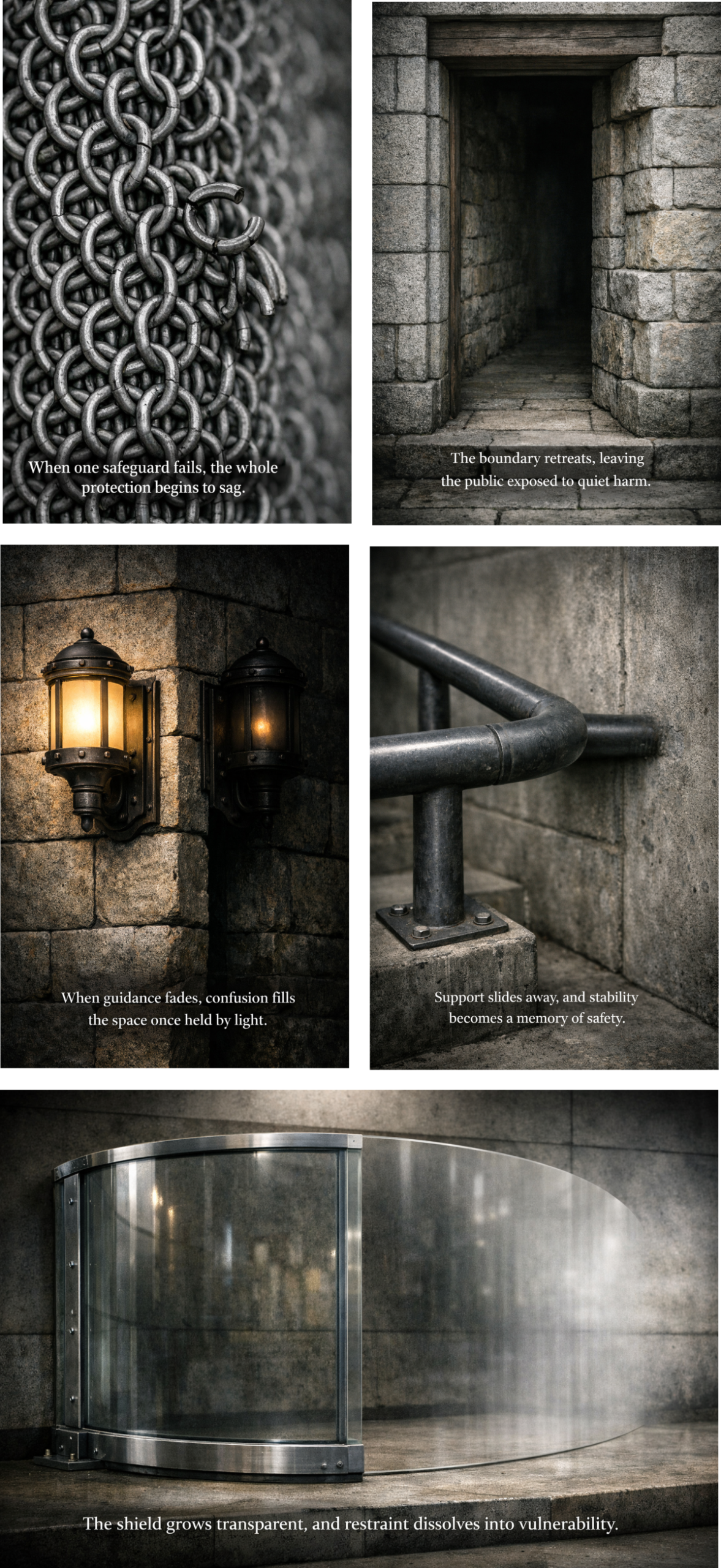
A five panel image grid showing chainmail with a broken link, a stone threshold receding on the right, a wall sconce with one light dimming, a metal handrail withdrawing into a concrete wall, and a curved protective barrier thinning into transparency.

Blue wave motif flowing across the screen—symbol of civic vigilance, legacy protection, and unstoppable movement.

For readers tracking how institutional failures are accelerating the reduction of our collective power, the distilled source summary is included below.

What This Resource Reveals

Marc Elias’ analysis lays bare a structural truth: the institutions meant to protect democratic participation are not merely weakening — they are being repurposed in ways that actively diminish the power of voters, especially minority voters. His account of the Supreme Court’s recent actions shows a Court that is no longer functioning as a neutral arbiter, but as an accelerator of anti-democratic outcomes. The pattern is not episodic. It is systemic.

The Structural Harm Identified
The article documents a series of decisions in which the Court has abandoned its own stated principles — timing rules, precedent, procedural fairness — whenever those principles would protect voting rights. In their place, the Court has adopted a posture that enables gerrymandering, weakens the Voting Rights Act, and signals to state actors that they can violate constitutional norms without consequence. This is not drift. It is a deliberate shift of institutional power, stripped away from voters and delivered into the hands of partisan actors.

The Asymmetry of the Fight
Elias names a dynamic that is essential to understanding the moment: the fight for democracy is structurally asymmetric. Those working to protect voting rights must win repeatedly, across multiple fronts, under compressed timelines. Those seeking to undermine democratic participation need only win selectively — a single ruling, a single map, a single procedural manipulation can shift power for years. This asymmetry is not theoretical. It is already shaping outcomes in states like Louisiana and Florida, where unconstitutional maps are being greenlit in real time.

Why This Resource Matters Now
The article captures the emotional and civic reality of this moment: the sense that institutional guardrails are not just failing but being dismantled from within. It underscores the urgency of collective vigilance and the necessity of refusing despair, even as the structural terrain becomes more hostile. The warning is clear: democratic erosion is happening through quiet, procedural mechanisms that most people never see — unless someone names them. This resource names them.

Soft, faint gray single line divider, low-contrast and gently blurred, symbolizing quiet resilience and reflection. Accessibility: Symbolizes quiet resilience, reflection, and gentle healing.

They strip the power. We live with the consequences.

The guardrail didn’t fall — it was removed.

The shift is deliberate. The loss is ours.

Institutional decisions. Public consequences.

The erosion is intentional. The harm is real.

When Power Stops Respecting Limits

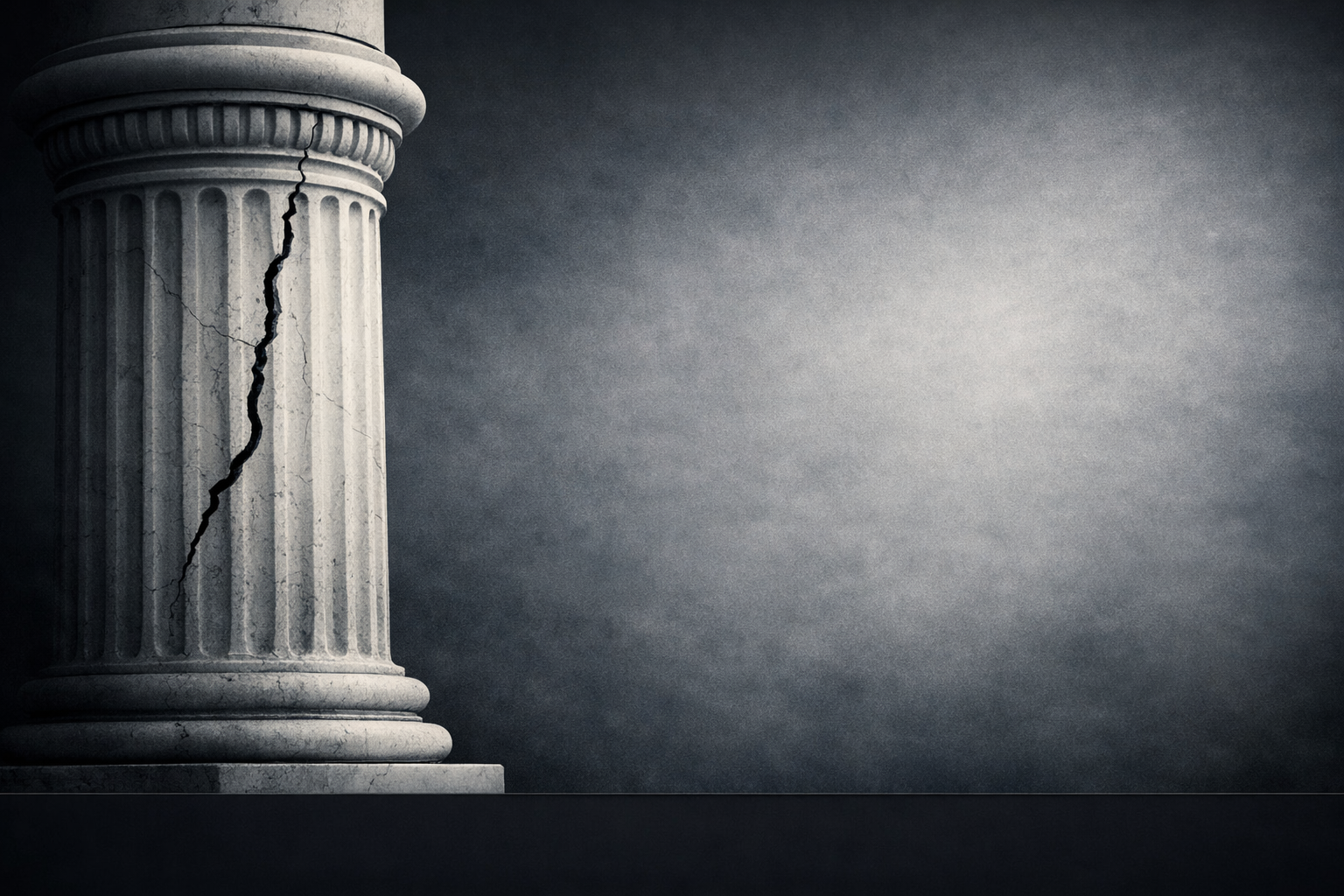
A tall marble pillar stands against a dark gray background, its fluted shaft marked by a single thin vertical crack that runs from near the top toward the base. Cool directional light highlights the fracture, symbolizing the erosion of restraint and the quiet weakening of constitutional limits.
USA Protect Your Vote banner with bold civic message and blue wave icons. Accessibility Text: A rectangular banner with the words “USA PROTECT YOUR VOTE. MAKING WAVES. NAMING NAMES. DEFENDING DEMOCRACY.” in bold blue capital letters on a white background. Below the text are three stylized blue wave icons, framed by a rough hand-drawn border.

When Power Stops Respecting Limits

When power stops respecting its limits, a democracy enters dangerous territory. The shift is quiet at first — a boundary ignored here, a norm dismissed there — but the meaning is unmistakable. A republic cannot survive the moment when authority begins to treat its constraints as optional. That is the threshold where a self-governing nation shifts to become something else, and where the people must decide whether the structure holds or fractures.

Soft, faint gray single line divider, low-contrast and gently blurred, symbolizing quiet resilience and reflection.

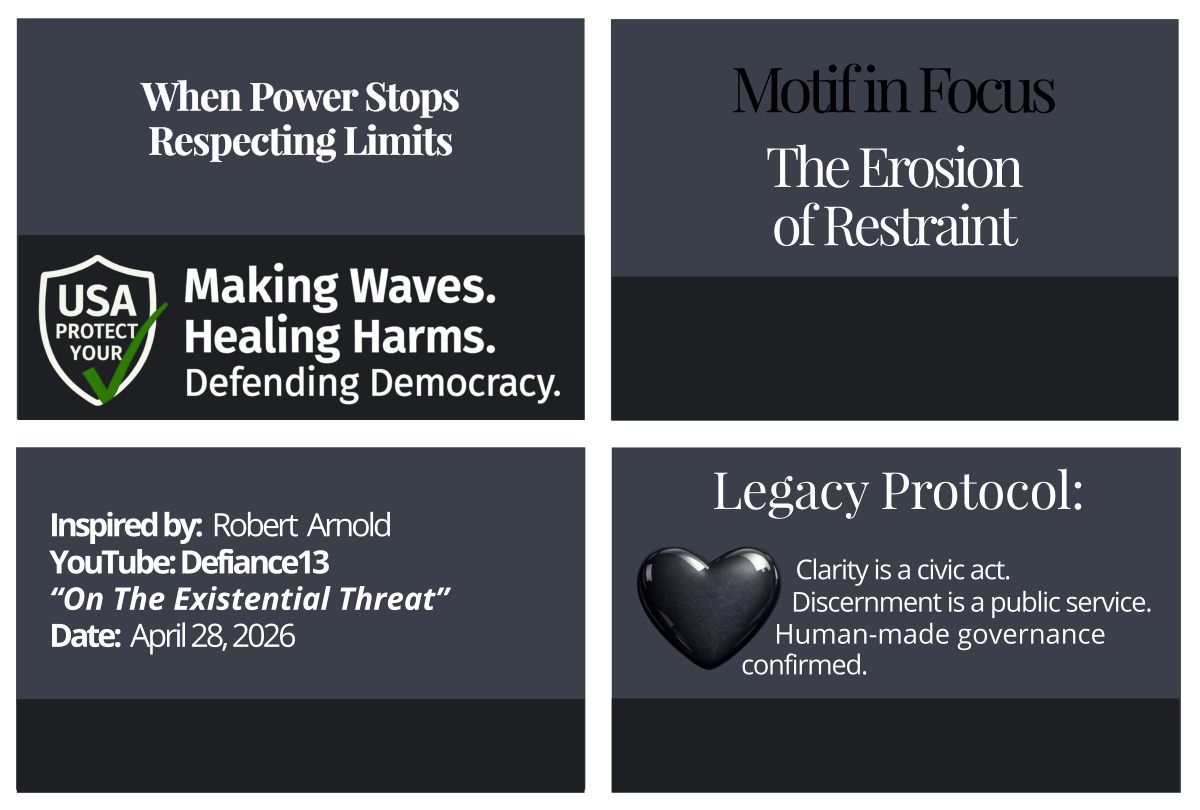
This Civic Page is based on Robert Arnold’s April 28, 2026, video analysis, On the Existential Threat, in which he examines how democratic systems weaken when political power stops operating within constitutional boundaries. Arnold argues that the stability of a republic depends on the alignment between authority, restraint, and the limits designed to prevent concentrated power from reshaping government according to impulse rather than law. Drawing on historical examples and the structure of the American system, he outlines how the erosion of these limits creates conditions that shift a nation away from representative governance and toward a model defined by unilateral decision‑making. His analysis focuses on the relationship between power, accountability, and the constitutional architecture intended to preserve democratic function.

“A government that stops respecting its limits stops being a republic.”

Blue wave motif flowing across the screen—symbol of civic vigilance, legacy protection, and unstoppable movement. Accessibility: Symbolizes civic vigilance, legacy protection, and unstoppable movement.

A tall marble pillar stands against a dark gray background, its fluted shaft marked by a single thin vertical crack that runs from near the top toward the base. Cool directional light highlights the fracture, symbolizing the erosion of restraint and the quiet weakening of constitutional limits.

Design Notes

Why This Image
The fractured column presents a single, unmistakable truth: power that once appeared immovable is already failing under its own weight. The close framing forces the viewer to confront the damage directly, without distraction or narrative escape routes. The light falling across the break isolates the wound, making the fracture the subject rather than the architecture. This image was chosen because it communicates the thesis of the page in one glance — the moment when strength stops being strength.

Symbolic Function
Columns are the visual shorthand for institutions, legitimacy, and the promise of stability. A crack in a column is never just a crack; it is a breach in the story a society tells itself about permanence. Here, the diagonal fracture interrupts the vertical fluting — a symbolic interruption of order, continuity, and the expectation that power will hold. The darkened negative space beside it amplifies the sense of imbalance, suggesting that the failure is not isolated but spreading.

Civic Meaning
The image speaks to the civic moment when power exceeds its limits and begins to erode the very structures meant to contain it. A cracked column is a warning: unchecked authority doesn’t simply distort democracy — it weakens the load bearing supports that keep it standing. The fracture becomes a civic metaphor for the consequences of neglect, silence, and the normalization of overreach. It reminds the reader that collapse is not sudden; it is cumulative.

Why It Opens the Page
This image earns the opening position because it establishes the emotional and structural stakes immediately. Before a single sentence is read, the viewer understands that the page is about the moment before failure becomes irreversible. It sets the tone of quiet alarm, architectural seriousness, and moral clarity that the rest of the page builds upon. It signals to the reader: this is not about politics — this is about the integrity of the foundation itself.

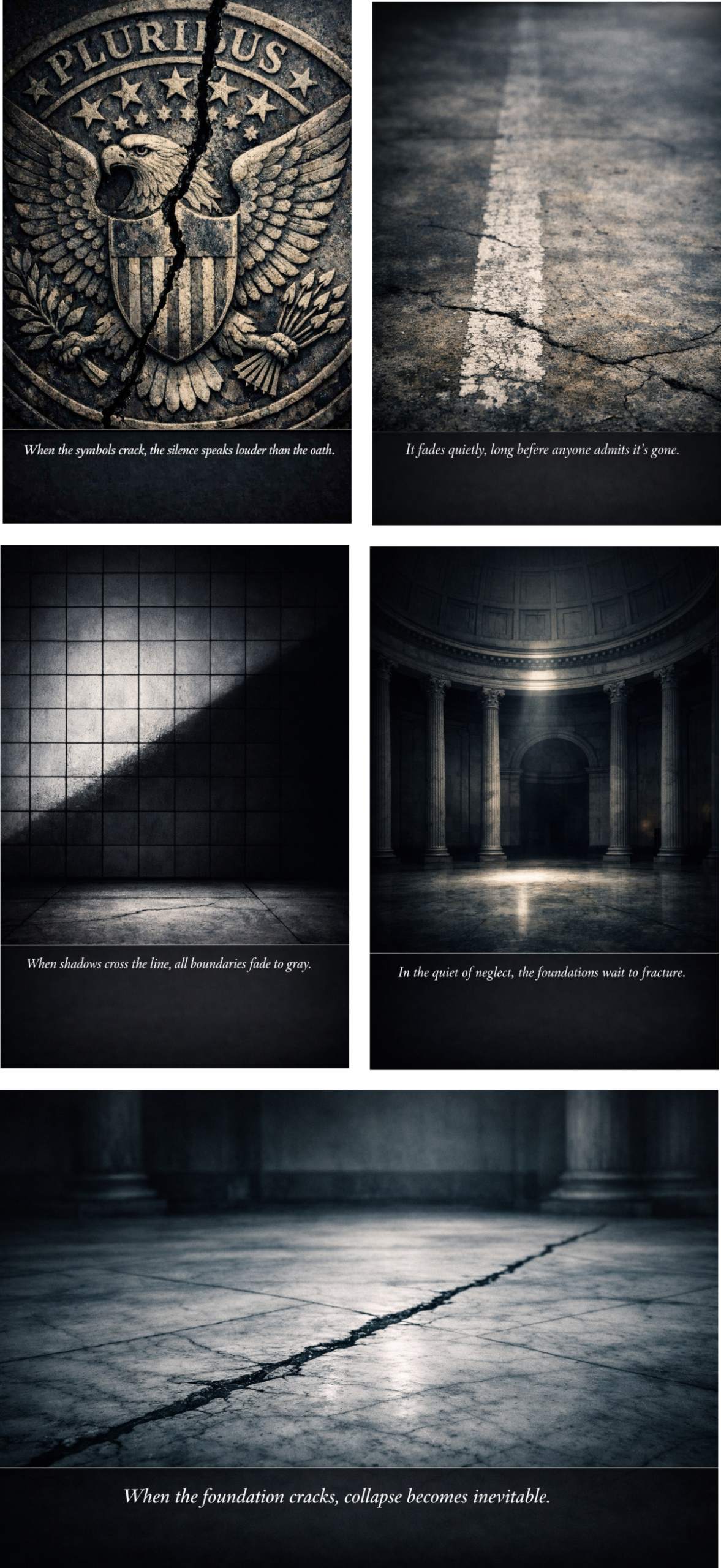
A five panel image grid depicting symbolic and architectural decay: a cracked Great Seal carving, a fractured asphalt line, a tiled wall crossed by shadow, a dim institutional interior with columns and a domed ceiling, and a cracked marble floor. Together they illustrate the progression from symbolic fracture to structural failure, reflecting the theme of power exceeding its limits.

Blue wave motif flowing across the screen—symbol of civic vigilance, legacy protection, and unstoppable movement.

To understand the significance of this message, open the Toggle below.

Why This Post Matters

When power exceeds the boundaries meant to contain it, the first signs of damage rarely appear in headlines — they appear in the quiet shifts inside institutions, norms, and public expectations. This post matters because it identifies that early moment, the one most people sense but struggle to name. It clarifies what it means when authority stops operating within its intended limits and begins reshaping the system around its own impulses.

The page traces how democratic structures weaken long before they visibly fail. It explains how small breaches in accountability accumulate, how silence becomes complicity, and how the erosion of limits creates conditions where overreach feels normal rather than alarming. By mapping these early fractures, the post gives readers a framework for recognizing institutional stress before it becomes irreversible.

It also restores the civic vocabulary that’s needed to talk about power without collapsing into partisanship. The argument is not about personalities or political factions; it is about the architecture of democratic restraint — the guardrails, norms, and expectations that keep power from becoming self-justifying. The post makes clear that when these boundaries are ignored, the consequences are structural, not rhetorical.

Finally, this post matters because it re-centers responsibility where it belongs: with the public. Democracies do not fail because power tests its limits; they fail when people stop insisting that those limits hold. By naming the fracture, the page invites readers to step back into their role as guardians of the boundary line — the line that keeps institutions accountable and the foundation intact.

Soft, faint gray single line divider, low-contrast and gently blurred, symbolizing quiet resilience and reflection. Accessibility: Symbolizes quiet resilience, reflection, and gentle healing.

When power breaks its bounds, the fracture belongs to all of us.