To the 90 Million Americans Who Didn’t Vote — This Is Your Moment

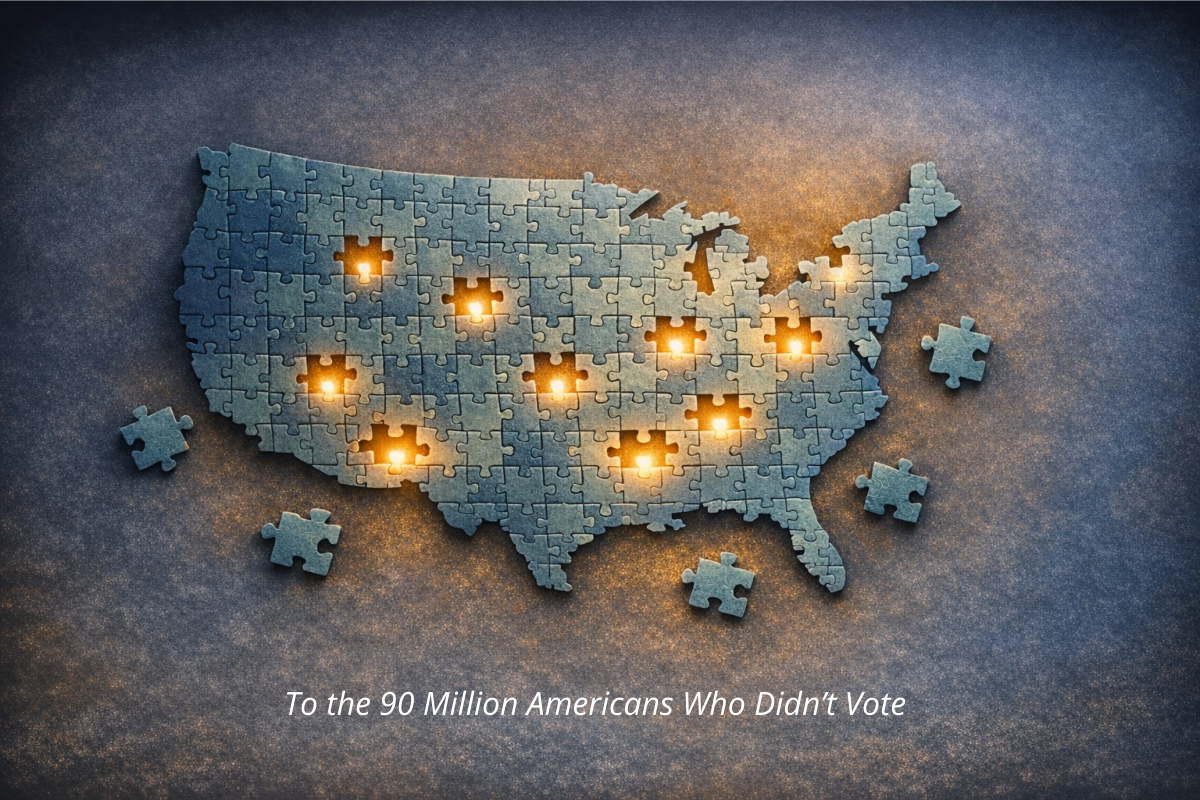
Silhouette of the United States formed from many small puzzle pieces, with several evenly spaced pieces missing that glow warmly from behind.
USA Protect Your Vote banner with bold civic message and blue wave icons. Accessibility Text: A rectangular banner with the words “USA PROTECT YOUR VOTE. MAKING WAVES. NAMING NAMES. DEFENDING DEMOCRACY.” in bold blue capital letters on a white background. Below the text are three stylized blue wave icons, framed by a rough hand-drawn border.

To the 90 Million Americans Who Did Not Vote — This Is Your Moment

Something shifted in the last election — not in the numbers, but in the public’s emotional center of gravity.
A quiet withdrawal took shape, born not of apathy but of exhaustion, disillusionment, and a sense that the system no longer saw them.
This page begins there, naming the silence that reshaped the map, the country, our reality — and the truth it’s been carrying all along.

Soft, faint gray single line divider, low-contrast and gently blurred, symbolizing quiet resilience and reflection.
 

This page draws from Joanna Johnson’s video, “90 Million Americans Didn’t Vote”, in which she addresses the roughly ninety million eligible Americans who did not participate in the last election. Johnson argues that this group is not apathetic or hateful, but a powerful, overlooked majority whose disengagement has shaped the nation’s political landscape. She warns that authoritarian movements rely on the silence of this voting bloc to attain and maintain power, and urges these Americans to recognize their collective influence, stating, “You have all of the power.”

“Ninety million Americans, the buck stops with you.”

Blue wave motif flowing across the screen—symbol of civic vigilance, legacy protection, and unstoppable movement. Accessibility: Symbolizes civic vigilance, legacy protection, and unstoppable movement.


Silhouette of the United States formed from many small puzzle pieces, with several evenly spaced pieces missing that glow warmly from behind.

Design Notes

Why This Image
This image presents the United States as a single, continuous silhouette composed of many small puzzle pieces. Several pieces are missing, but the outline remains whole. The design makes visible a truth that is often abstract: participation is not theoretical — it is structural. When pieces are absent, the shape still stands, but its integrity is changed. This image captures that tension with clarity and restraint.

Symbolic Function
Each puzzle piece represents an individual voice within the democratic structure. The evenly distributed missing pieces signal that disengagement is not isolated to one region or one type of community — it is a national pattern. The warm glow behind each absence reframes the missing pieces not as failures, but as openings: places where participation could return, where light could re-enter the system. The floating pieces around the silhouette reinforce the idea that what is missing is not lost; it is simply not yet placed.

Civic Meaning
The image communicates a central civic truth: the Union is resilient, but resilience is not the same as completeness. A nation can hold its shape while still carrying the imprint of millions of absent voices. The glowing gaps invite the viewer to consider what those missing contributions mean — not in terms of blame, but in terms of potential. The image reframes non-participation as a structural absence with real consequences, and as a place where renewal is possible.

Why It Opens the Page
This HERO sets the emotional and conceptual frame for the entire piece. It establishes the national scale, the structural metaphor, and the central thesis: the Union remains intact, but it is marked by the absence of millions who did not participate. By opening with a visual that is both strong and incomplete, the page invites the reader into a conversation about what it means to belong, to contribute, and to be counted. It establishes the national context, allowing the images that follow to show the viewer the lived, everyday spaces where participation actually happens.
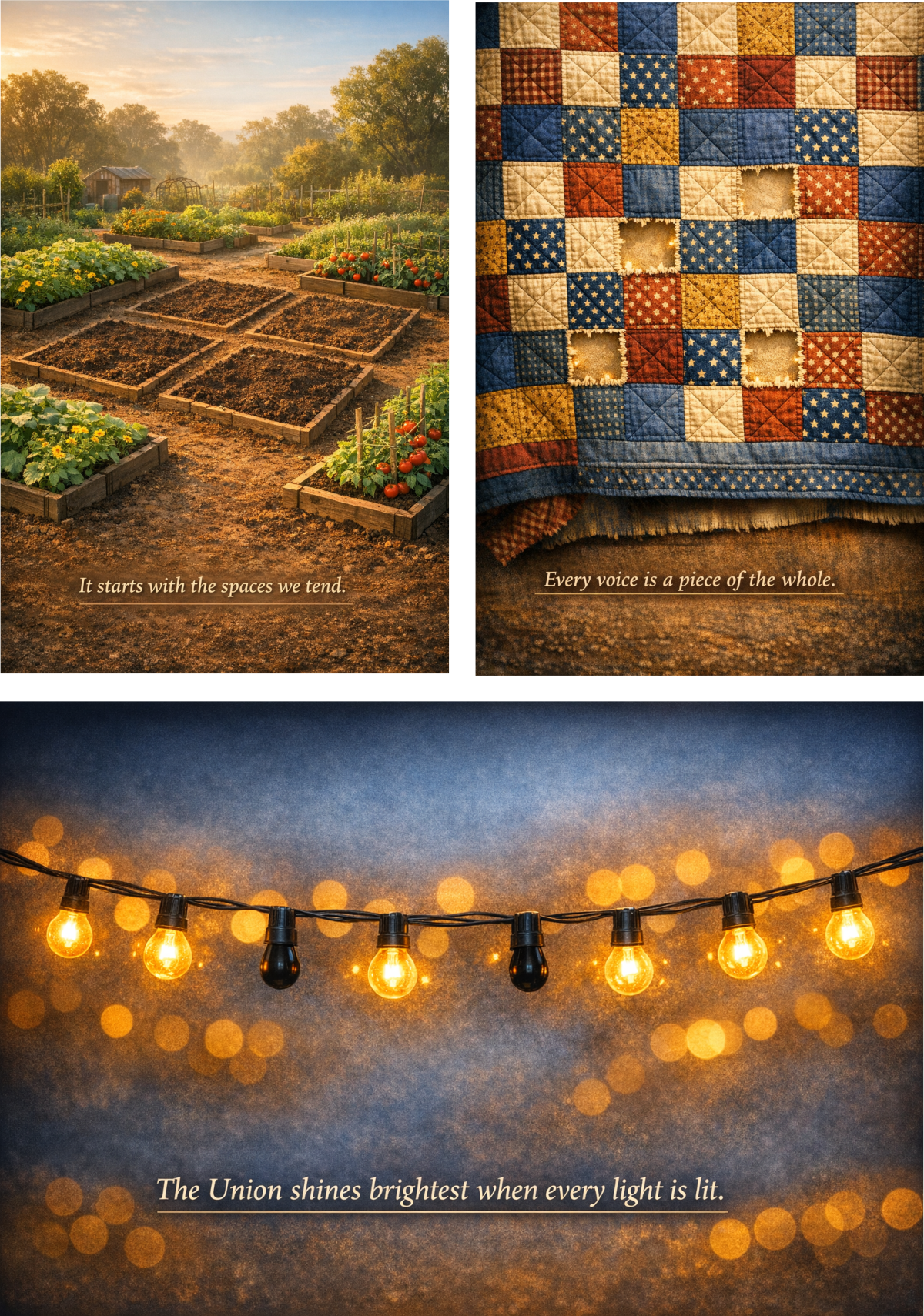
Three‑panel image grid showing: a community garden with thriving beds on the sides and two empty plots in the center; a handmade patchwork quilt with several completed squares and four missing squares exposing the batting; and a horizontal string of glowing lights with several dark, empty sockets against a soft blue‑gold background.


Blue wave motif flowing across the screen—symbol of civic vigilance, legacy protection, and unstoppable movement.
 

If you want the context behind this message, open the Toggle below.

Why This Post Matters

The 90 million Americans who didn’t vote in the last election are not one group, and they are not a mystery. They are our neighbors, coworkers, family members, and friends — people threaded through every community in the country. This post exists to make their absence visible without shaming them, and to name the civic truth that their participation would reshape the entire landscape of our democracy.

For decades, the narrative around non-voters has been built on assumptions: apathy, disengagement, and disinterest. But the data tells a different story. Many of these missing voters are not checked out — they are shut out, overwhelmed, underrepresented, or unconvinced that their voice and their vote matter. By distributing the absences across the images, this page reflects the reality that the missing voters are everywhere, not concentrated in one place or one demographic.

This post matters because it reframes the conversation. Instead of asking why people didn’t vote, it asks what conditions would make them feel welcomed, included, and empowered to take their seat at the table. It shifts the focus from blame to belonging, from judgment to invitation. The goal is not to point fingers — it is to open the door.

When we understand who is missing and why, we can begin to imagine what becomes possible when they arrive. This page is the first step in that imagining.

Soft, faint gray single line divider, low-contrast and gently blurred, symbolizing quiet resilience and reflection. Accessibility: Symbolizes quiet resilience, reflection, and gentle healing.


Where You Tend the Soil, the Union Grows.
Where You Shine, the Nation Brightens.
 

Where the War Actually Lands

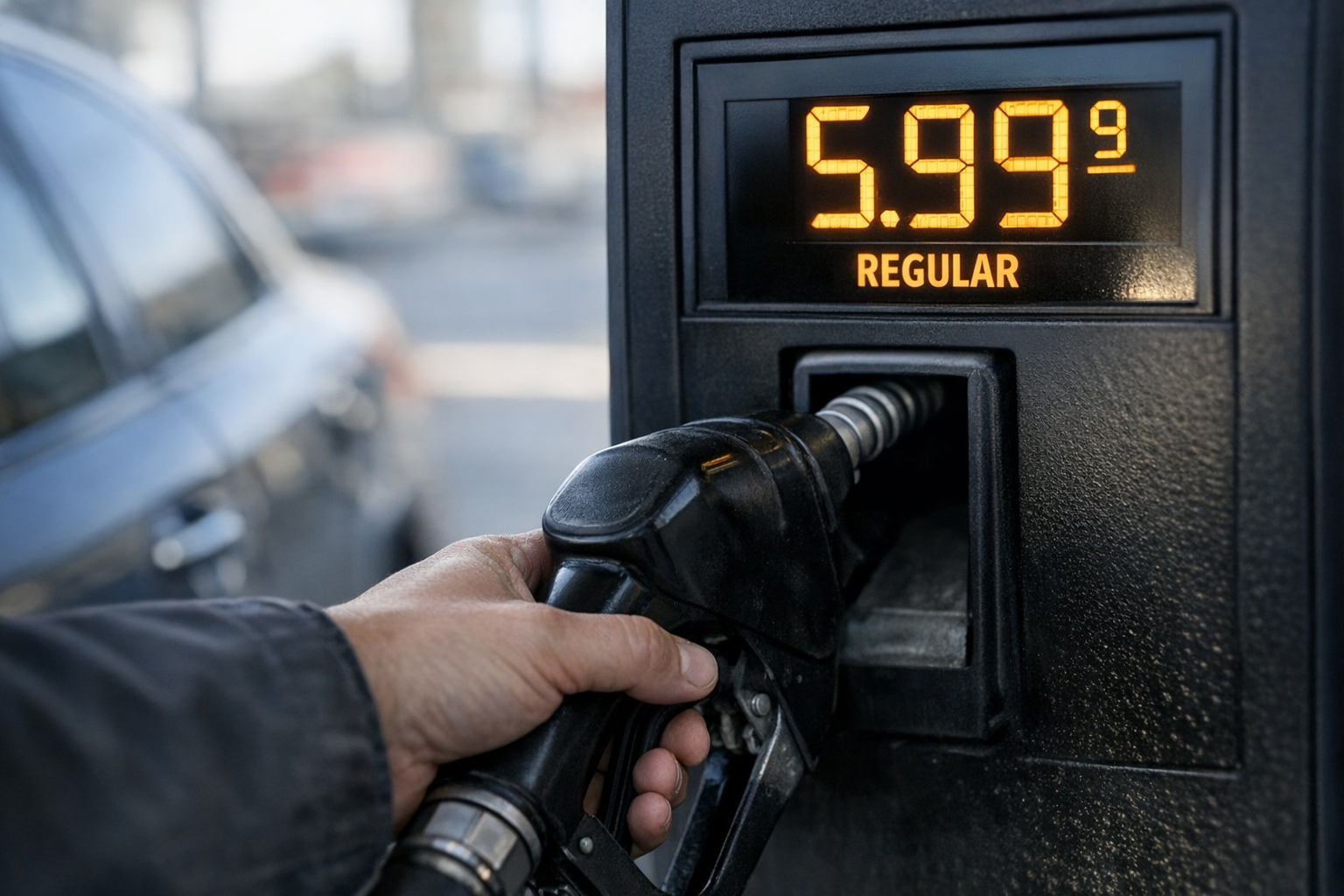
A hand pauses on a gas pump handle as a $5.99 per gallon price glows on the display, capturing the quiet pressure of rising costs.
USA Protect Your Vote banner with bold civic message and blue wave icons. Accessibility Text: A rectangular banner with the words “USA PROTECT YOUR VOTE. MAKING WAVES. NAMING NAMES. DEFENDING DEMOCRACY.” in bold blue capital letters on a white background. Below the text are three stylized blue wave icons, framed by a rough hand-drawn border.

Where the War Actually Lands

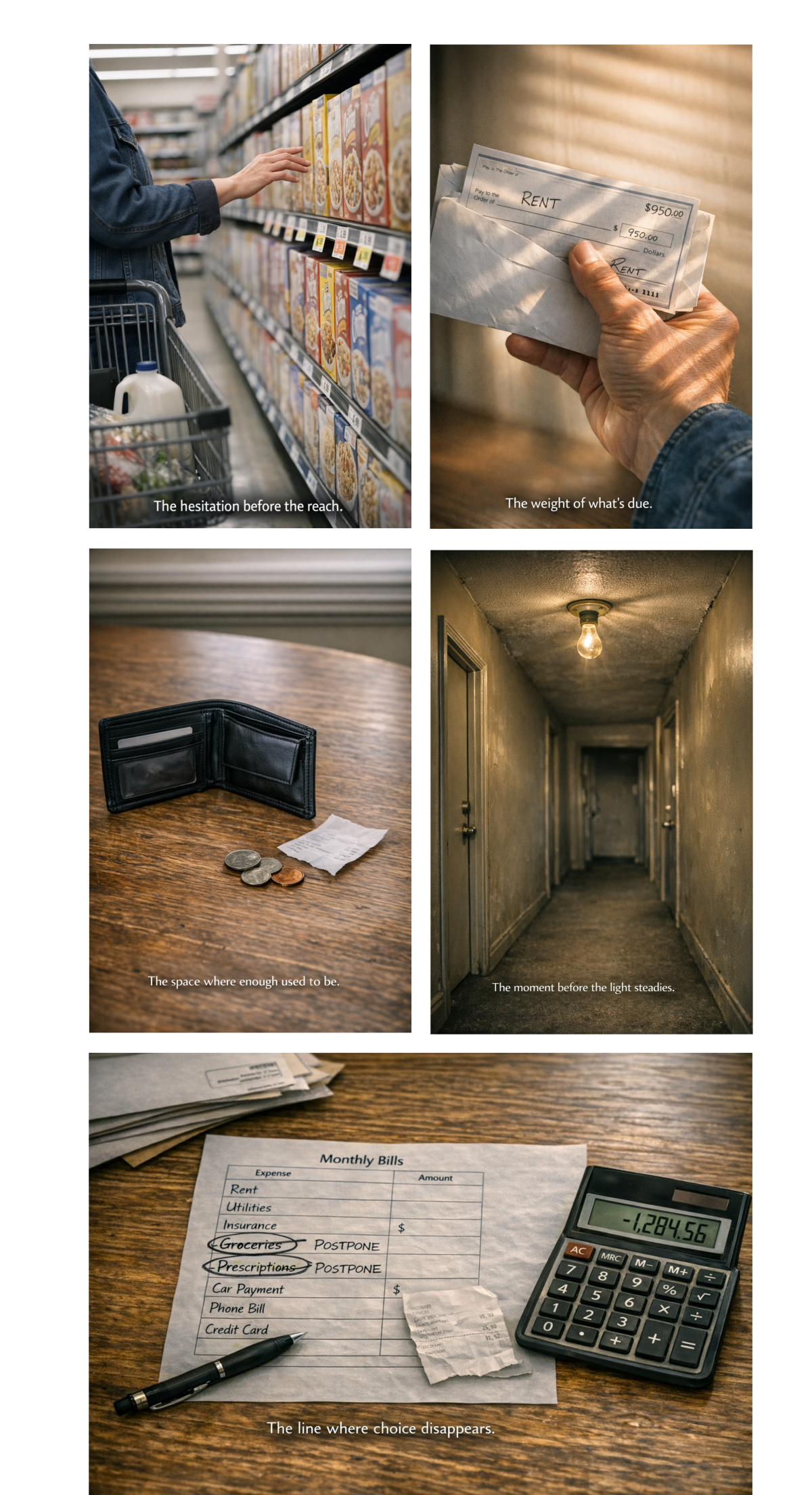
The Pressure Line is where ordinary life absorbs the impact first — in the aisles, at the tables, in the moments when choice narrows to almost nothing. It’s where people feel the strain long before leaders admit it exists, and this page names what that pressure looks like before it becomes a headline.

Soft, faint gray single line divider, low-contrast and gently blurred, symbolizing quiet resilience and reflection.

In his April 6 Substack post, “So… Here We Are: March 1st – April 5th, 2026,” Robert L. Arnold offers a month-long reflection on the accumulating pressures shaping public life, outlining how economic strain, political volatility, and escalating uncertainty have converged into a period defined by tension rather than resolution. He frames the month as a sequence of compounding stressors rather than isolated events, noting that the through line is not any single headline but the steady rise in what people are carrying day to day. Arnold describes this period as one in which “the pressure didn’t spike — it stacked,” emphasizing that the story of March into early April is the weight of ongoing conditions rather than sudden shocks. His analysis situates the moment as a lived experience of mounting strain, offering context for understanding how the national atmosphere has shifted over the past five weeks.

This is how war arrives in America now.
Not with sirens… but with numbers that don’t add up anymore.

Blue wave motif flowing across the screen—symbol of civic vigilance, legacy protection, and unstoppable movement. Accessibility: Symbolizes civic vigilance, legacy protection, and unstoppable movement.

A hand pauses on a gas pump handle as a $5.99 per gallon price glows on the display, capturing the quiet pressure of rising costs.

Design Notes

Why This Image
This image was chosen because it captures a moment that is both ordinary and destabilizing: a simple gas pump display showing a price that no longer fits within the mental math of daily life. The $5.99⁹ figure is not symbolic or exaggerated — it is the literal price at a local Sacramento, California station on the day this page was built. That specificity grounds the image in lived reality rather than abstraction. It is a real number from a real place, and that authenticity is what gives the image its weight.

Symbolic Function
The gas pump display functions as a pressure gauge — a visual instrument that measures the strain people are carrying. The glowing amber “REGULAR” label becomes a quiet indictment: nothing about this is regular anymore. The stacked digits, the nine-tenths fraction, and the cold digital glow all work together to communicate a system that is still operating but no longer functioning in a way that feels sustainable. The image symbolizes the moment when everyday transactions become stress points.

Civic Meaning
Civically, the image illustrates how national instability lands on ordinary people long before it appears in official language. It shows where policy failures, economic shocks, and political volatility actually register: not in speeches or headlines, but in the numbers people confront at the pump, the grocery store, and the checkout line. The price is not just a cost — it is a signal of accumulated strain. It reflects the widening gap between political narratives and the lived experience of the public.

Why It Opens the Page
This image opens the page because it establishes the central thesis immediately: the war does not arrive with spectacle, but with pressure. It sets the emotional temperature for the entire motif by showing the reader the exact point where the national story intersects with their daily life. Before any analysis, before any commentary, the HERO forces the reader to confront the quiet, relentless math of the moment. It is the clearest entry point into understanding where the war actually lands.

Blue wave motif flowing across the screen—symbol of civic vigilance, legacy protection, and unstoppable movement.

Some pressures don’t announce themselves — they accumulate.

Why This Post Matters

The Quiet Math of a Country Under Strain.
This post matters because it identifies the moment when national instability stops being theoretical and becomes something people feel in their daily routines. The story of this period isn’t defined by dramatic events or breaking news cycles — it’s defined by the slow, steady rise of pressures that land in the most ordinary parts of American life. When the cost of basic movement becomes a source of anxiety, it signals a deeper shift in the country’s emotional and economic landscape.

The price on a gas pump may be a headline, but it is also a warning. The rapid jump to $5.99⁹ in Sacramento reflects more than a moment of economic volatility — it marks the point where national decisions and global instability land directly in the lives of ordinary families. Headlines can report the spike, but they cannot capture the quiet dread of watching essential costs rise faster than people can adjust. This page documents that lived impact. It shows how the strain of the past month has stacked rather than spiked, creating a background pressure that people carry with them even when they’re not consciously thinking about it.

By grounding the page in a real price from a real station in Sacramento, the post restores something that has been missing from the national conversation: specificity. Not symbolism, not abstraction — specificity. It acknowledges that the war Americans are experiencing is not fought with weapons, but with numbers that no longer make sense, systems that no longer feel stable, and routines that now require emotional calculation. This is where the national story becomes personal.

This matters because people need language for what they’re living through. They need a way to understand why everything feels heavier, why the month felt longer than it should have, and why the pressure seems to be coming from everywhere at once. This page gives shape to that experience. It names the weight without dramatizing it, and it offers a frame for understanding the strain before it becomes a crisis.

This is where the story begins — with the weight people are already carrying.

Soft, faint gray single line divider, low-contrast and gently blurred, symbolizing quiet resilience and reflection. Accessibility: Symbolizes quiet resilience, reflection, and gentle healing.

The Cost Tells the Story Now.

No Calvary. Just Courage.

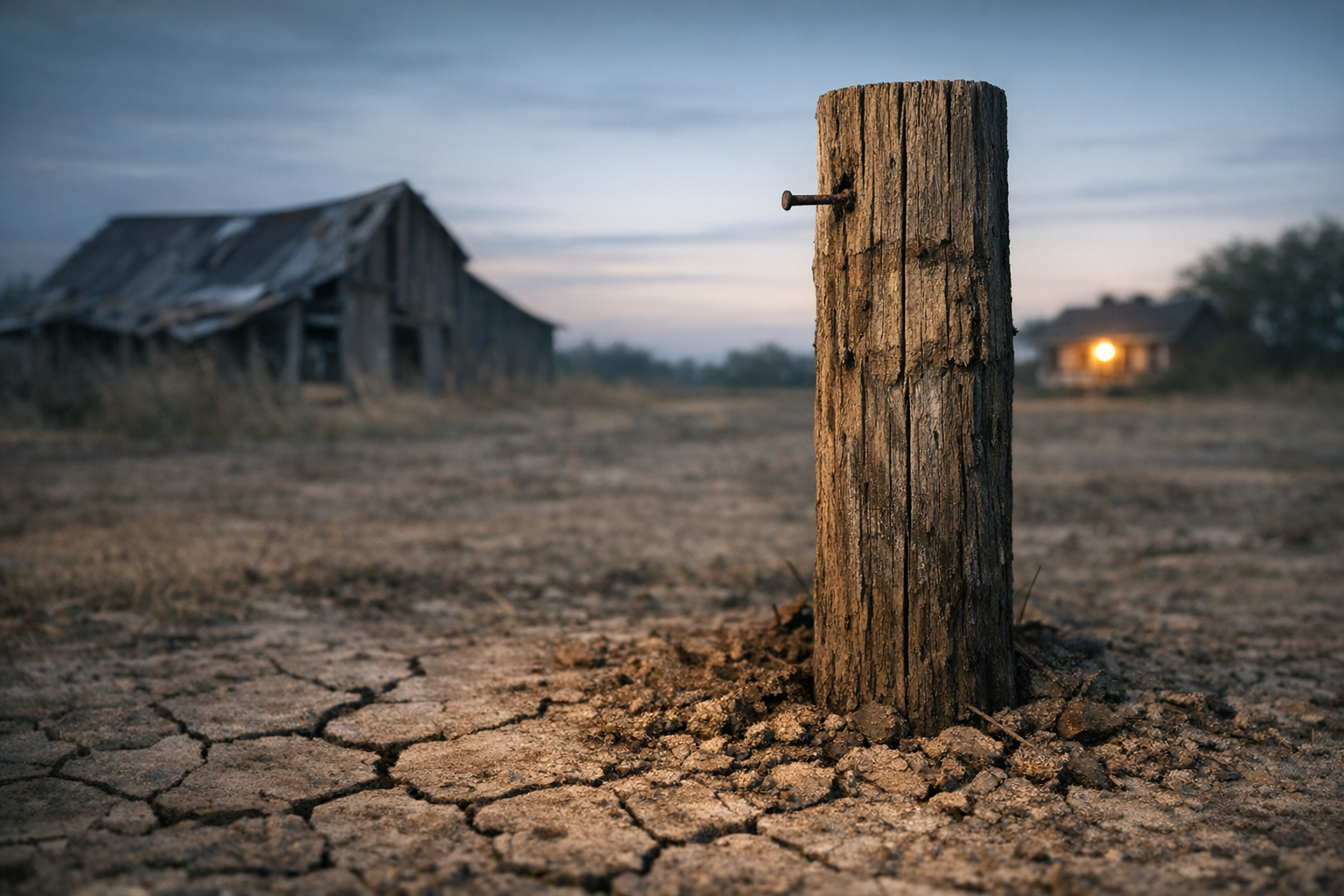
A wooden post standing in cracked soil with a distant porch light and a leaning barn, symbolizing endurance amid structural strain.
USA Protect Your Vote banner with bold civic message and blue wave icons. Accessibility Text: A rectangular banner with the words “USA PROTECT YOUR VOTE. MAKING WAVES. NAMING NAMES. DEFENDING DEMOCRACY.” in bold blue capital letters on a white background. Below the text are three stylized blue wave icons, framed by a rough hand-drawn border.

No Calvary. Just Courage.

The ground didn’t suddenly change — we finally started paying attention to the people who’ve been tending it all along.
Mississippi didn’t deliver a miracle; it revealed a truth this country keeps trying to ignore: communities rise when they are seen, invested in, and taken seriously. This page names that shift and refuses to let the old narratives stand unchallenged.

Soft, faint gray single line divider, low-contrast and gently blurred, symbolizing quiet resilience and reflection.


In “On Blessed Hearts and Better Ones,”
Robert Arnold reflects on recent electoral shifts in Mississippi and the broader South, describing community‑driven organizing efforts and long‑standing regional dynamics. The video discusses local engagement, historical context, and the conditions that shaped the outcome. You may watch the video HERE:

They built their own momentum without the cavalry. No national spotlight, no deep‑pocketed campaign machinery.”

Blue wave motif flowing across the screen—symbol of civic vigilance, legacy protection, and unstoppable movement. Accessibility: Symbolizes civic vigilance, legacy protection, and unstoppable movement.

A wooden post standing in cracked soil with a distant porch light and a leaning barn, symbolizing endurance amid structural strain.

Design Notes

Why This Image Looks the Way It Does
The image centers on a single wooden post standing in cracked soil to express structural endurance under strain. The leaning barn and the distant porch light are placed to show surrounding instability without overshadowing the upright form in the foreground. Every element is chosen to reflect conditions that are stressed but still holding, consistent with the motif’s focus on resilience in the face of collapse.

What to Look For
Notice the nail embedded in the post and the faint impressions where a sign once hung — subtle indicators of past weight and ongoing purpose. The barn’s sagging roof contrasts with the post’s upright stance, while the porch light introduces a small but persistent point of steadiness in the distance. The cracked soil grounds the entire scene in visible pressure.

Why It Matters
This composition highlights the quiet strength required to remain standing when the structures around you are faltering. The image reinforces the page’s central theme: courage is not the absence of strain but the decision to hold firm within it. The visual cues prepare the viewer for the narrative that follows, anchoring the emotional architecture of the page

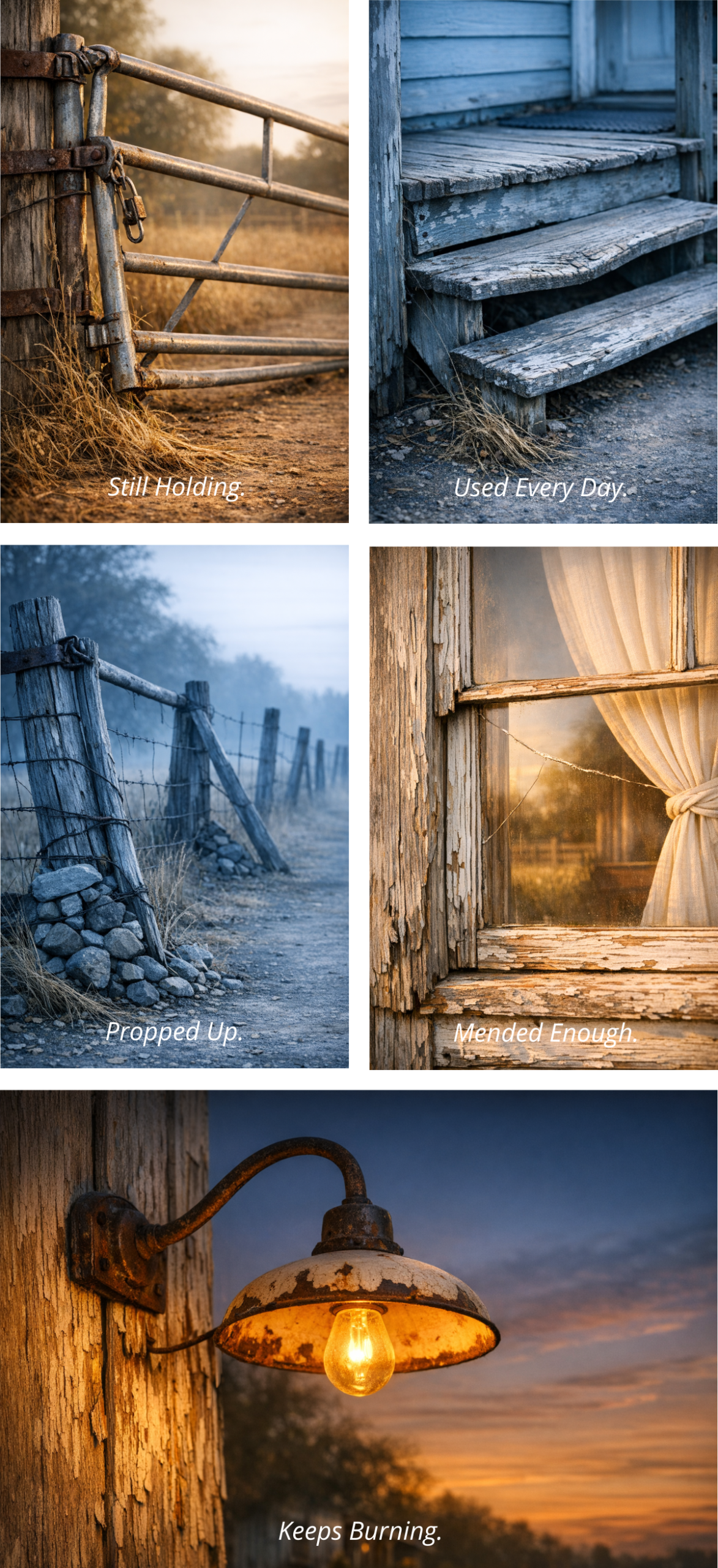
Five‑panel grid of weathered objects showing resilience: locked gate at sunset, worn blue steps, leaning barbed‑wire fence, cracked window with tied curtain, and glowing rusted light fixture

Artist’s Note

Origin Vignette — The Ranch Years

Before the civic pages and the careful grids, there was a ranch — a place where the world was
measured not in deadlines but in chores, sunlight, and the sound of hooves. I was twelve when
I first stood on a gate like the one in Still Holding, testing its strength and my own.
By thirteen, I was driving the Jeep across the pasture, learning the geometry of motion and trust.

The mornings smelled of hay and soap; the afternoons of dust and diesel. I learned the rhythm
of milking, the patience of feeding pigs, the strange tenderness of repair — how a bent hinge or
cracked frame could still hold if you cared enough to mend it.

And somewhere between the fences and the fields, I met Ralph — my first love, my first proof
that even in hard work, there’s room for wonder.

Those years taught me what endurance looks like: not perfection, but persistence. Every image
in this series — the gate, the steps, the fence, the window, the light — carries that lesson
forward. They are the architecture of care, built from the same hands that once steadied a Jeep
on uneven ground and learned that love, like a fence line, sometimes leans but never quite falls.

Blue wave motif flowing across the screen—symbol of civic vigilance, legacy protection, and unstoppable movement.

A brief note about the post that sparked this page

Details

Why This Post Matters
This post matters because Mississippi just proved something the rest of the country keeps forgetting:
the South is not silent, and it is not waiting for permission. What happened there wasn’t a miracle,
of new voters or a sudden shift in demographics — it was the people who’ve been here all along
deciding they were done being dismissed. Done being written off. Done being told their voices
don’t count.

This moment is a reminder that the ground is already fertile. The organizers are already working.
The communities are already awake. What’s been missing isn’t will — it’s investment, belief, and
the basic respect of being taken seriously.

Mississippi cracked the myth of inevitability. It showed that hope isn’t imported from the coasts;
it grows in the dirt, in the sweat, in the stubborn grace of people who have never stopped trying
to make this place better. This post honors that truth. It names the shift. It calls out the
institutions that still don’t see it. And it stands with the people who are doing the work anyway.

Because the South isn’t lost. It’s rising. And this time, it’s rising on its own terms.

Soft, faint gray single line divider, low-contrast and gently blurred, symbolizing quiet resilience and reflection. Accessibility: Symbolizes quiet resilience, reflection, and gentle healing.

Rise From Where You Stand.