The Power They Teach Children Is the Power We Forget as Adults

The Power They Teach Children Is the Power We Forget as Adults
USA Protect Your Vote banner with bold civic message and blue wave icons. Accessibility Text: A rectangular banner with the words “USA PROTECT YOUR VOTE. MAKING WAVES. NAMING NAMES. DEFENDING DEMOCRACY.” in bold blue capital letters on a white background. Below the text are three stylized blue wave icons, framed by a rough hand-drawn border.

The Power They Teach Children Is the Power We Forget as Adults

We don’t lose our power all at once. It slips away in small, ordinary moments — the kind we’re taught not to notice. Somewhere between childhood and adulthood, the world convinces us that agency is something we outgrow, when in truth, it’s something we’re conditioned to forget. But the power we learned first — the power to choose, to act, to intervene — never disappears. It waits for us to remember it.

Soft, faint gray single line divider, low-contrast and gently blurred, symbolizing quiet resilience and reflection.
 

In her Facebook video reflection, educator and commentator Joanna Johnson (Unlearn16) highlights a series of Disney park interactions that show how intentionally the company teaches children what agency feels like — from characters who hug for as long as the child chooses, to cast members who sign with Deaf guests, to a five‑year‑old dressed as Rey Skywalker stopping the First Order with a single raised hand. Posted in 2025, Johnson describes these moments as “psychologically formative,” giving children a lived sense of dignity, safety, and personal power long before they have the vocabulary for it. Her framing sits squarely in The Work of Repair, reminding us that the emotional architecture of agency is built early, reinforced through compassion, and carried into adulthood whether we recognize it or not. Source: Joanna Johnson (Unlearn16), Facebook video, December 14, 2025. Watch the video: Here “That is going to be a psychological, formative moment she carries for the rest of her life.”

Blue wave motif flowing across the screen—symbol of civic vigilance, legacy protection, and unstoppable movement.

The Power They Teach Children Is the Power We Forget as Adults

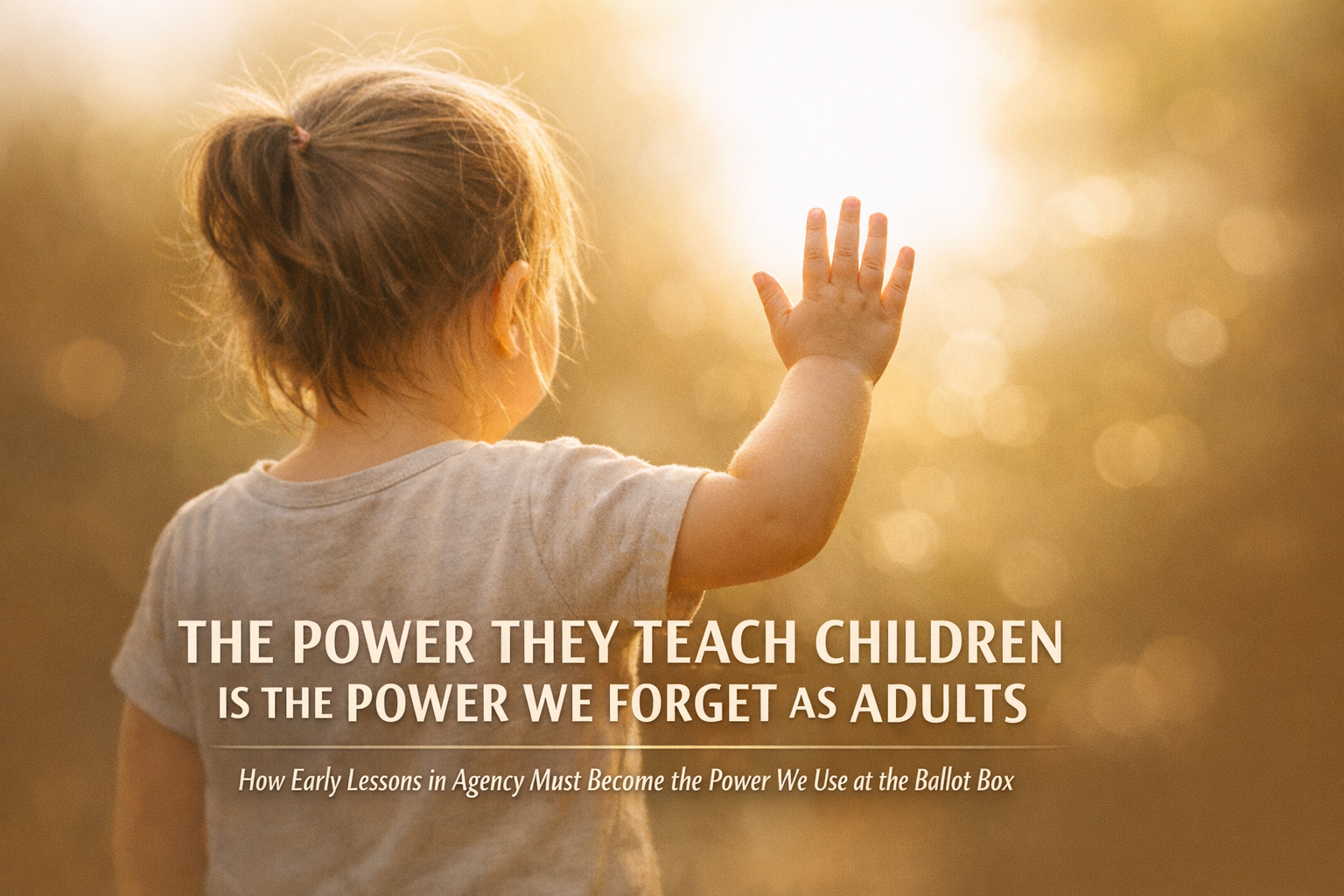
Design Notes Why this image This image captures the exact moment where childhood agency first sparks: a small hand reaching toward light, possibility, and something just beyond immediate understanding. It’s not about a specific child or a specific story — it’s about the universal posture of early power. The soft glow, the upward reach, and the unguarded curiosity all signal the beginning of a lifelong relationship with capability. This is the emotional origin point the page is built on. Symbolic function The raised hand functions as both a gesture of discovery and a gesture of declaration. It is the earliest version of “I can,” long before language or civic vocabulary enters the picture. The warm light symbolizes the world reflecting back affirmation — the moment a child learns that their actions matter. The blurred background reinforces that the environment is secondary; the agency is internal. This image becomes the motif’s anchor: the first power we ever feel is the one we later abandon. .Civic meaning The page argues that the power children naturally express — confidence, curiosity, self‑directed action — is the same power adults must reclaim to participate meaningfully in democracy. This image makes that argument visible. The child’s gesture mirrors the adult gesture of raising a hand to vote, to speak, to intervene, to stop harm, to choose a direction. It reminds the reader that civic power is not something learned late in life; it is something remembered. The HERO image reframes voting not as a bureaucratic task, but as the adult continuation of a childhood truth: your actions shape the world. Why it opens the page This image opens the page because it returns the reader to the beginning — before cynicism, before overwhelm, before the noise of adulthood. It establishes the emotional baseline the rest of the page will build from: the purity of early agency. By starting here, the page invites the reader to reconnect with a power they once held effortlessly. It sets the tone for the entire narrative arc: from childhood instinct → to adult amnesia → to civic reclamation. The HERO image is the doorway back to the part of ourselves democracy needs most.
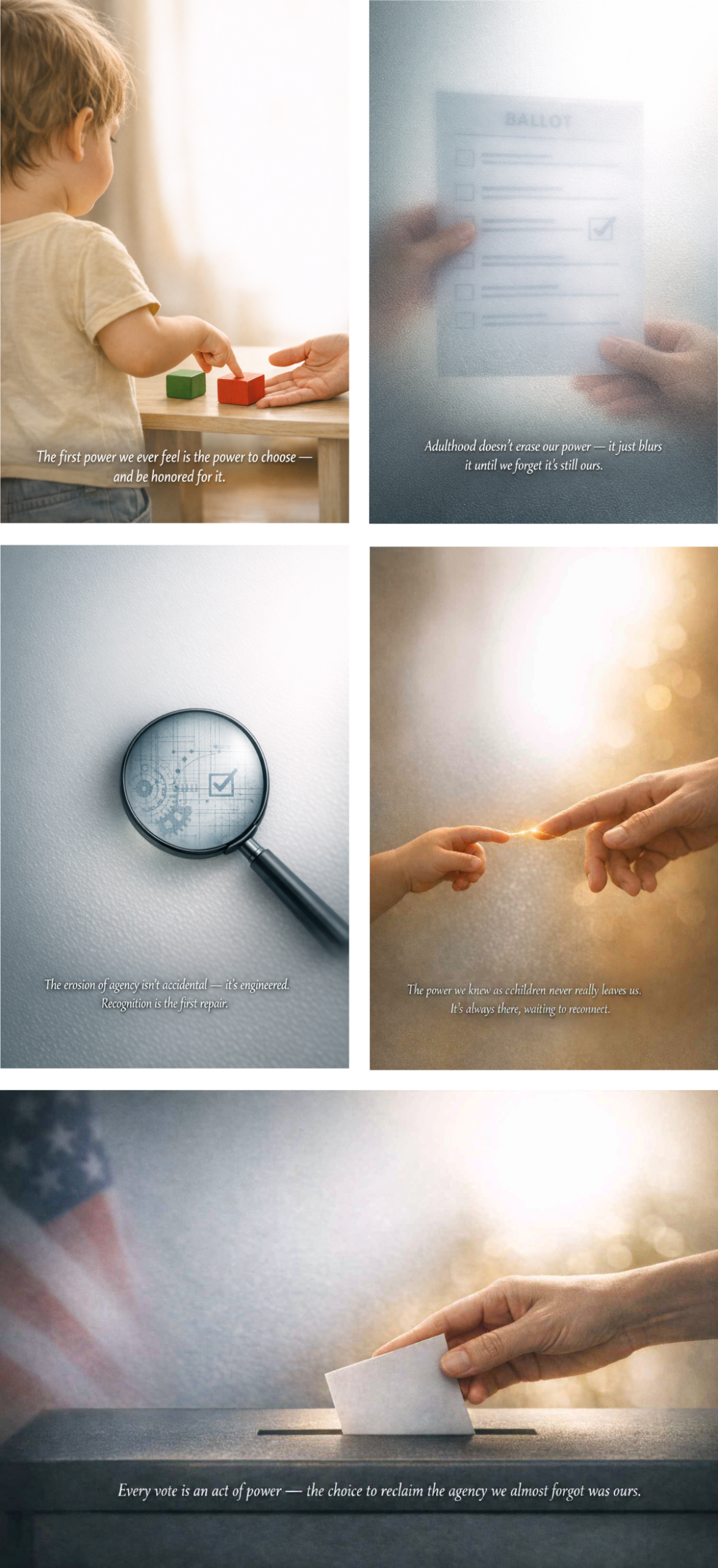
Five‑panel image grid showing: a toddler choosing a red block as an early lesson in agency; a softly blurred ballot form with a marked checkbox symbolizing how adult agency becomes obscured; a magnifying glass revealing the intentional erosion of agency; a child’s hand reaching toward an adult’s hand seeking reconnection; and an adult hand placing a ballot into a voting box, representing the civic expression of the agency first learned in childhood.

Blue wave motif flowing across the screen—symbol of civic vigilance, legacy protection, and unstoppable movement.
< Details — There’s a quiet truth beneath all of this. Where the Power Begins Children learn power long before they learn the word for it. They learn it in the moments when adults let them lead — when a character waits for them to finish a hug, when a princess kneels to their height, when a five‑year‑old raises her hand at Kylo Ren and the world rearranges itself around her courage. These moments teach a truth that becomes foundational: your actions matter, and the world responds to you. It’s not fantasy. It’s early agency, delivered in a form children can understand. How Adulthood Interrupts It But somewhere between childhood and adulthood, that agency gets interrupted. Not erased — interrupted. The world begins teaching a different lesson: that power belongs to institutions, to experts, to people who “know better,” to systems that feel too large to influence. Adults are trained to shrink, to defer, to believe that the levers of change are too far away or too complicated to reach. The power they once felt instinctively becomes something they assume they’ve outgrown, when in reality, it was taken from them by design. The Body Remembers First And yet, the original lesson never disappears. It sits dormant, waiting for a moment that feels safe enough to surface again. That’s why the Disney videos hit so hard — they remind adults of a truth they once lived inside: that confidence is not naïve, that agency is not imaginary, and that the world can shift because of a single gesture. The emotional reaction isn’t nostalgia. It’s recognition. It’s the body remembering something the mind forgot. Reclaiming the Original Lesson The work of adulthood — and the work of democracy — is not to learn power from scratch. It’s to reclaim the power we were taught before we had language for it. The power to raise a hand. The power to intervene. The power to choose a direction. The power to stop the First Order, whatever form it takes in the real world. Childhood teaches the muscle. Adulthood decides whether we use it.

Soft, faint gray single line divider, low-contrast and gently blurred, symbolizing quiet resilience and reflection.

Reclaim the Power You Were Taught to Forget. It’s What Democracy Needs Now.
The Lineage of Unquiet Women

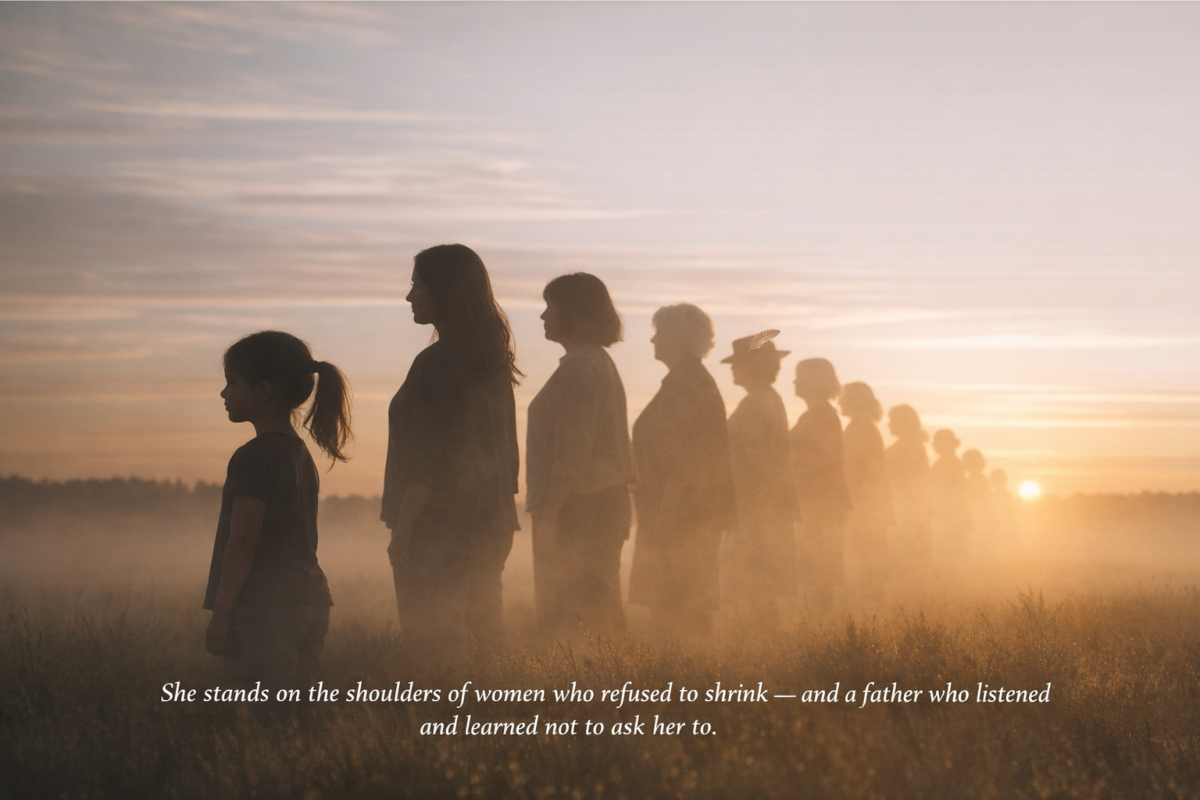
Line of women across generations standing in a misty field at sunrise with a young girl in front beside the text “She stands on the shoulders of women who refused to shrink — and a father who listened and learned not to ask her to.”
USA Protect Your Vote banner with bold civic message and blue wave icons. Accessibility Text: A rectangular banner with the words “USA PROTECT YOUR VOTE. MAKING WAVES. NAMING NAMES. DEFENDING DEMOCRACY.” in bold blue capital letters on a white background. Below the text are three stylized blue wave icons, framed by a rough hand-drawn border.

The Lineage of Unquiet Women

The world she inherits was shaped by women who refused to be made small, and a father who listened. Their courage is not a myth she studies but a lineage she stands inside — a long, unbroken line of women who challenged the terms written for them and men who learned to unlearn what they were taught. She does not walk into history empty‑handed. She walks forward carrying the space they carved, the truth they named, and the refusal they passed down like a birthright.

Soft, faint gray single line divider, low-contrast and gently blurred, symbolizing quiet resilience and reflection.
 

This page draws from Women’s History Month (For My Daughter) by Robert L. Arnold, published March 15, 2025, in which Arnold reflects on the world his daughter is inheriting and the lineage of women who shaped his understanding of strength, writing, “I want to give her the lineage of women who refused to be ruled by the small imaginations of small men,” a declaration that anchors this page’s motif of inheritance, unquiet women, and generational refusal to shrink; for those who want to hear the source in Robert’s own voice, the full video is available here: Watch on YouTube.

“She inherits a lineage that refuses to shrink.”

Blue wave motif flowing across the screen—symbol of civic vigilance, legacy protection, and unstoppable movement.

Line of women across generations standing in a misty field at sunrise with a young girl in front beside the text “She stands on the shoulders of women who refused to shrink — and a father who listened and learned not to ask her to.”

Design Notes Why This Image This image was chosen to visually embody the emotional and civic truth of the Pull Quote: “Our daughter’s legacy is a lineage that refuses to shrink.” The silhouette of the young girl at the front of the line is not a portrait — it’s a symbol. She is not alone. She is not performing strength. She is simply upright, present, and carried by the women behind her. The diagonal line of silhouettes across generations creates a visual arc of inheritance, refusal, and quiet continuity. Symbolic Function Each woman in the line represents a generation that refused to be made small. Their faces are not shown — because this is not about individual identity or heroism. It’s about posture, presence, and legacy. The girl at the front is the inheritor, not the culmination. The feather added to the fifth woman’s hat is a subtle cue: femininity without fragility. The mist and horizon suggest that the lineage stretches beyond what can be seen — past and future. Civic Meaning This image declares that the daughter’s strength is not innate — it is inherited. She walks forward not because she was taught to be strong, but because she was never asked to shrink. The father’s evolution is included in the caption, not the image — reinforcing that his role is supportive, not central. The civic message is clear: the future is shaped by those who refuse to diminish others. Why It Opens the Page This image is the emotional and architectural doorway. It sets the tone: reverent, unshrinking, lineage-aware. It prepares the reader to enter a page that honors refusal, inheritance, and the quiet revolution of evolved fatherhood. It does not demand attention — it earns it.

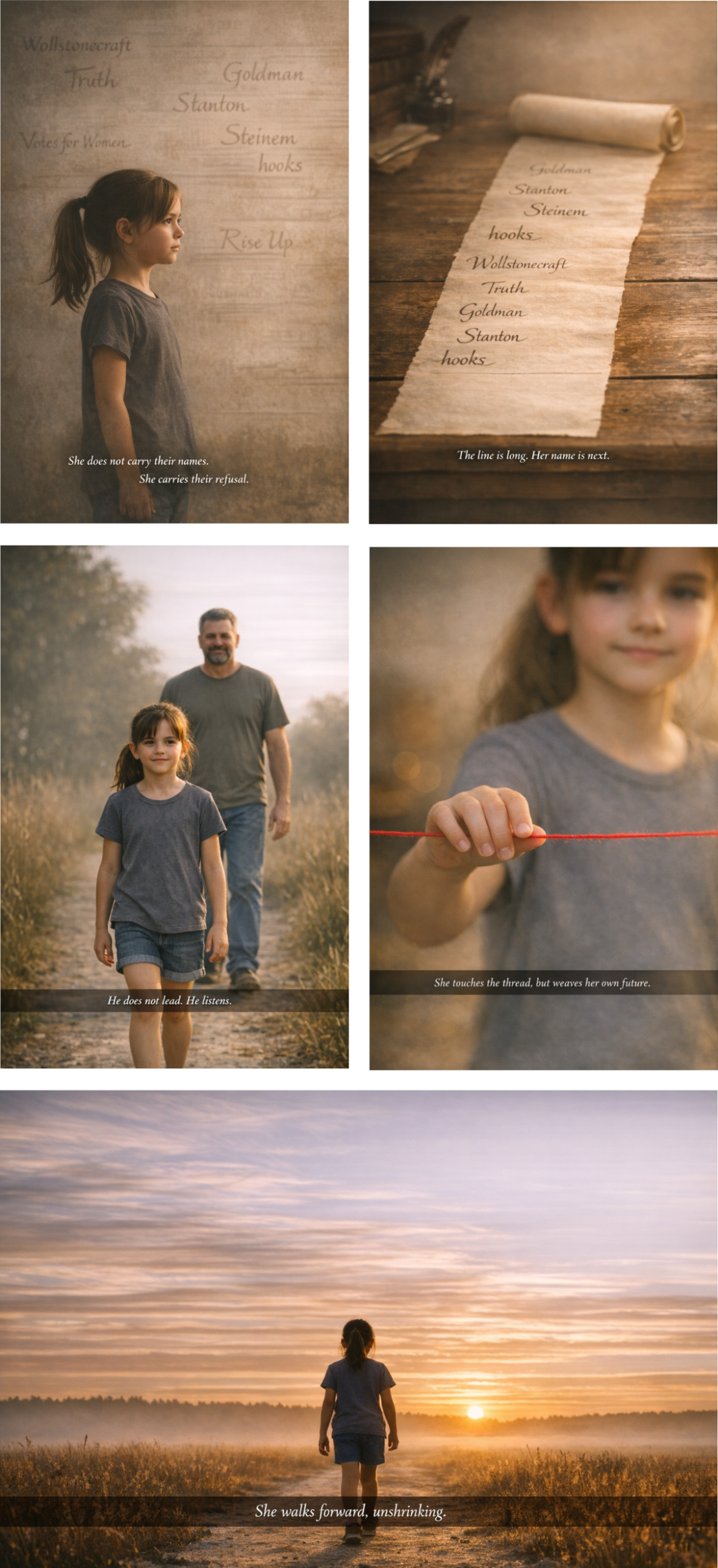
Five panel grid showing a young girl moving through a visual lineage of women’s resistance: standing before historic names, a scroll of foremothers, walking ahead as her father listens, holding a red thread of inheritance, and finally walking toward the horizon unshrinking.

Blue wave motif flowing across the screen—symbol of civic vigilance, legacy protection, and unstoppable movement.
Details This is what it looks like when a lineage refuses to shrink. When Community Becomes Structure Robert Arnold’s reflection begins with a father’s fear — not of strong women, but of the weak men who feel threatened by them. He names the strange mathematics his daughter will one day encounter: brilliance dismissed as loudness, autonomy mistaken for arrogance, dignity questioned as if it must be earned. He admits that he has been shaped by a culture that teaches boys to dominate before it teaches them to understand, and he speaks plainly about the lifelong work of unlearning. That work, he says, has been taught to him by women who refused to be small so that fragile men could feel tall. He widens the lens to the civic landscape his daughter will inherit — a landscape shaped by men who chip away at rights, autonomy, and dignity in an attempt to protect their own fragility. He names the insecurity wrapped in scripture, patriotism, and tradition, and he acknowledges that every woman he has ever loved carries stories of dismissal, harassment, and punishment for daring to exist at full scale. His fear is not abstract. It is rooted in the lived experiences of women who have told him the truth about the world he had not been taught to see From there, he turns to lineage. He places his daughter in a line that stretches across centuries — Wollstonecraft, Truth, Goldman, Stanton, Steinem, hooks, Zonneveld — women who refused to accept the terms written for them by men afraid of their power. He rejects the idea of raising a polite daughter or a quiet one. Instead, he names her inheritance: a tradition of women who challenged domination, rewrote democracy, and insisted that freedom means nothing if it does not belong to women as well. He closes with a blessing disguised as a charge. His daughter was never meant to be agreeable, never meant to be small, never meant to apologize for her voice. She was meant to be powerful — powerful enough that injustice feels the ground shake when she stands. Powerful enough that the comfortable lies of the powerful begin to crack when she speaks. The future, he says, does not belong to the men who tried to control women. It belongs to the women who refused to be controlled.

This is what it looks like when a lineage refuses to shrink.

Soft, faint gray single line divider, low-contrast and gently blurred, symbolizing quiet resilience and reflection.

Move the Unshrinkable Line Forward.

The Circle That Will Not Break

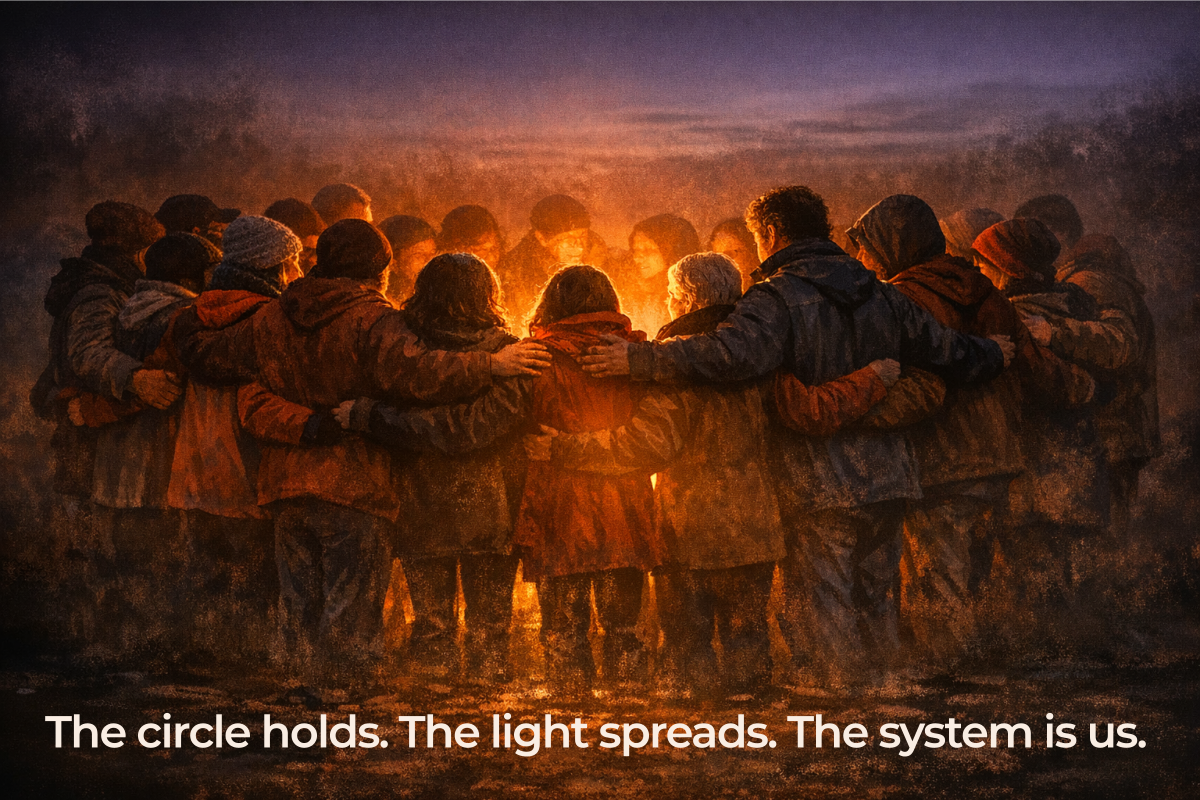
Landscape-format HERO image showing a diverse group standing shoulder-to-shoulder in a tight circle at twilight with a warm glow at the center.
USA Protect Your Vote banner with bold civic message and blue wave icons. Accessibility Text: A rectangular banner with the words “USA PROTECT YOUR VOTE. MAKING WAVES. NAMING NAMES. DEFENDING DEMOCRACY.” in bold blue capital letters on a white background. Below the text are three stylized blue wave icons, framed by a rough hand-drawn border.

The Circle That Will Not Break

The strength of a community isn’t measured by what it says, but by what it does when the ground shifts — when protections are stripped away, when institutions hesitate, and when the systems meant to safeguard people leave them exposed. These are the moments when fear spreads rapidly and truth becomes harder to hold. Minnesota reminded us what it looks like when a community refuses to let that stand: neighbors forming circles of protection that deploy faster than the noise, faster than the uncertainty, faster than the harm. In doing so, they didn’t just respond — they restored the record of what people can build together. This page begins there, with the people who refuse to let the circle break.

Soft, faint gray single line divider, low-contrast and gently blurred, symbolizing quiet resilience and reflection.
 

This page is grounded in Robert Arnold and Kris’s March 2, 2026, co voiced reflection on Minnesota’s rapid response networks — a blueprint for how ordinary people become the infrastructure when formal systems fail. This page draws from Robert Arnold’s March 2, 2026 video, “On the Importance of Community (with my friend Kris).” For those who want to hear the source in his own voice, the full video is here: Watch on Facebook. In their conversation, they describe neighbors who lock arms across language, faith, and immigration status to create circles of protection that move faster than fear. As Robert puts it, “Proximity is what turns courage into capacity.” Their story shows how community becomes a system — not through hierarchy, but through human connection — and why the first civic act is learning to neighbor as a verb.

“Growth that doesn’t translate into dignity is not strength.”

Blue wave motif flowing across the screen—symbol of civic vigilance, legacy protection, and unstoppable movement.

Landscape-format HERO image showing a diverse group standing shoulder-to-shoulder in a tight circle at twilight with a warm glow at the center.

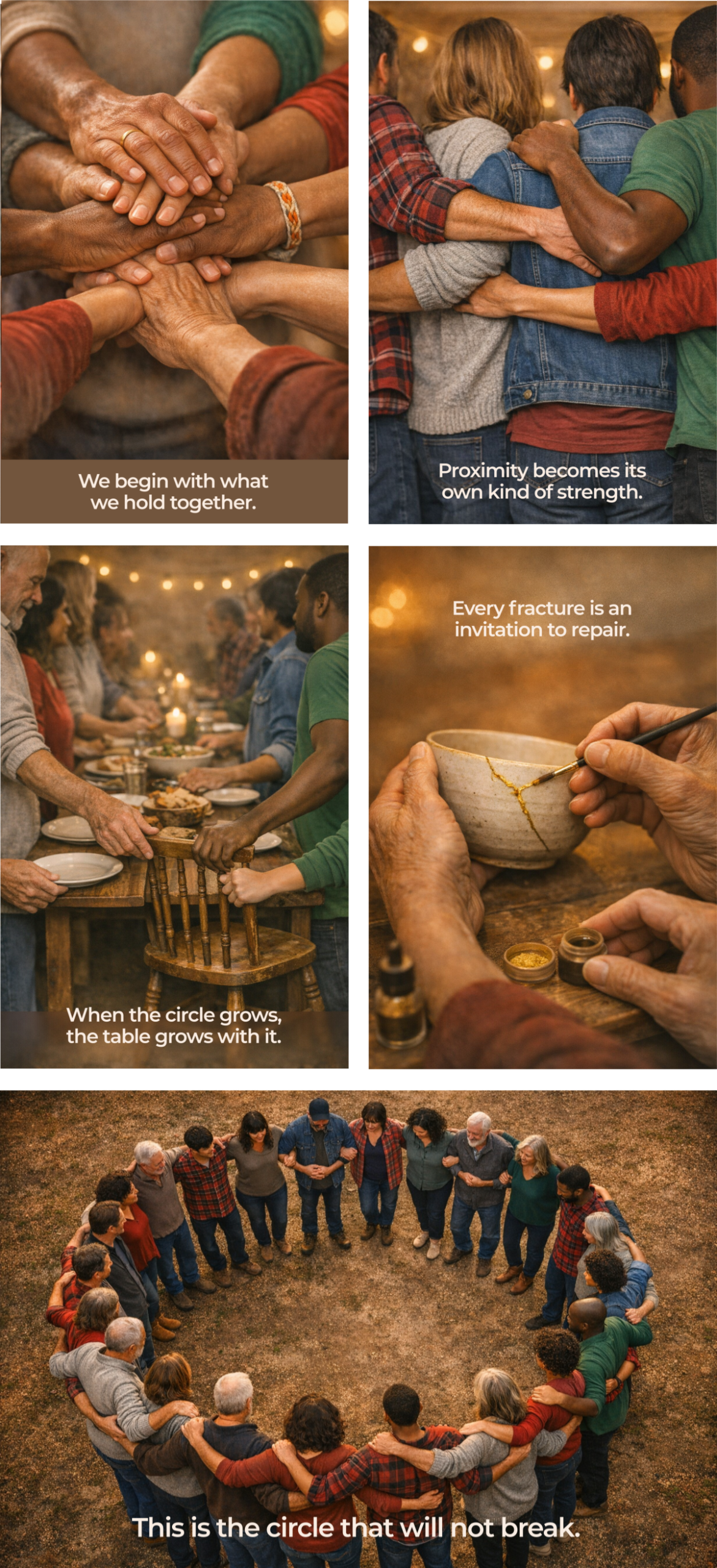
Design Notes Why this image This HERO works because it captures the emotional truth of the page in a single frame: people gathered in a circle, holding each other close, illuminated by shared warmth in the dark. It’s not symbolic warmth — it’s literal firelight. It’s not metaphorical unity — it’s physical proximity. It’s not staged resilience — it’s lived, embodied, communal. Symbolic function The circle is the oldest symbol of collective protection. In this image, it becomes a living boundary — not drawn, but formed. The firelight at the center signals shared courage, shared capacity, and the kind of strength that only emerges when people stand close enough to feel one another’s presence. Civic meaning This image reframes community as infrastructure — something built, maintained, and reinforced through proximity. It argues that resilience is not an individual trait but a civic practice, and that the smallest unit of democracy is the neighbor standing beside you. Why it opens the page The HERO sets the emotional temperature for the entire page: quiet strength, shared warmth, and the undeniable power of people who choose to hold together. Before a single word is read, the reader understands the thesis — a circle that holds cannot be broken.

Five panel grid showing hands stacked, a small group standing arm in arm, a shared meal table, a Kintsugi repair scene, and a large outdoor circle of people viewed from above.

Blue wave motif flowing across the screen—symbol of civic vigilance, legacy protection, and unstoppable movement.
< Details — In every community, there comes a moment when people become the system. When Community Becomes Structure When Robert and Kris talk about Minnesota’s rapid response networks, they describe something both simple and profound: community stepping into its oldest role. Not as sentiment, not as nostalgia, but as structure — a living system built from proximity, trust, and the quiet understanding that safety is something we create together. Their March 2 reflection shows how clarity often emerges from the ground up, long before institutions find their footing. They describe neighbors who move faster than fear because they already know one another. Circles of protection form across language, faith, and immigration status, held together not by hierarchy but by relationship. These networks don’t wait for perfect information or official direction; they respond to what is happening in real time, guided by the shared instinct to keep one another safe. In their telling, courage is not an individual act — it is a collective capacity that grows through closeness. Robert and Kris also name the challenges of navigating misinformation, uncertainty, and the speed of crisis. They explain how communities learn to distinguish signal from noise by relying on relationships rather than rumors. When people are connected, truth moves faster. When they are isolated, fear does. Their conversation makes clear that the work of community is not only emotional — it is civic, strategic, and deeply practical.

This page looks at what becomes possible when we treat community as infrastructure — not a backdrop, but a system we build and maintain together. It begins with the premise Robert names: proximity is what turns courage into capacity. And it asks what changes when we see neighboring as a verb, not a sentiment. A circle that holds becomes a force that cannot be undone.

“Growth that doesn’t translate into dignity is not strength.”

Soft, faint gray single line divider, low-contrast and gently blurred, symbolizing quiet resilience and reflection.

Neighbor is a Verb.