Part I I I — The Reveal We Were Never Meant to See

A golden curtain hangs in soft vertical folds, slightly parted to reveal the stage rigging behind it — ropes, pulleys, and counterweights. The illusion is intact, but the machinery is visible. The moment of clarity is near.
USA Protect Your Vote banner with bold civic message and blue wave icons. Accessibility Text: A rectangular banner with the words “USA PROTECT YOUR VOTE. MAKING WAVES. NAMING NAMES. DEFENDING DEMOCRACY.” in bold blue capital letters on a white background. Below the text are three stylized blue wave icons, framed by a rough hand-drawn border.

Part III — The Reveal We Were Never Meant to See

The performance was never the problem. It was our willingness to accept it as reality. For a long time, the relentless repetition felt like truth, and the bold confidence felt like competence. The story was simple, steady, and familiar — not polished, but delivered with enough certainty to feel easier than the complicated world beneath it. But once you notice the seams — the cues, the choreography, the careful construction — the illusion loses its weight. What once felt solid becomes recognizable as a story told with purpose, not a truth lived with consequence. And from that moment on, you can’t unsee.

Soft, faint gray single line divider, low-contrast and gently blurred, symbolizing quiet resilience and reflection.
 

Robert Arnold’s reflection on President Trump’s 2026 State of the Union examines the speech as a carefully constructed performance designed to project stability, strength, and national coherence. This page draws from Robert Arnold’s February 25, 2026 video, “The State of the Union.” For those who want to hear the source in his own voice, the full video is here: Watch on YouTube. In his analysis, Robert highlights the contrast between the polished narrative presented on stage and the lived realities that remain unspoken behind it. He notes the administration’s reliance on spectacle, repetition, and emotional choreography to shape public perception, while pointing to the deeper human and civic truths that the performance obscures. His video invites viewers to look past the presentation and toward the people, systems, and consequences hidden behind the curtain — the very shift this page explores.

“Growth that doesn’t translate into dignity is not strength.”

Blue wave motif flowing across the screen—symbol of civic vigilance, legacy protection, and unstoppable movement.

A golden curtain hangs in soft vertical folds, slightly parted to reveal the stage rigging behind it — ropes, pulleys, and counterweights. The illusion is intact, but the machinery is visible. The moment of clarity is near.

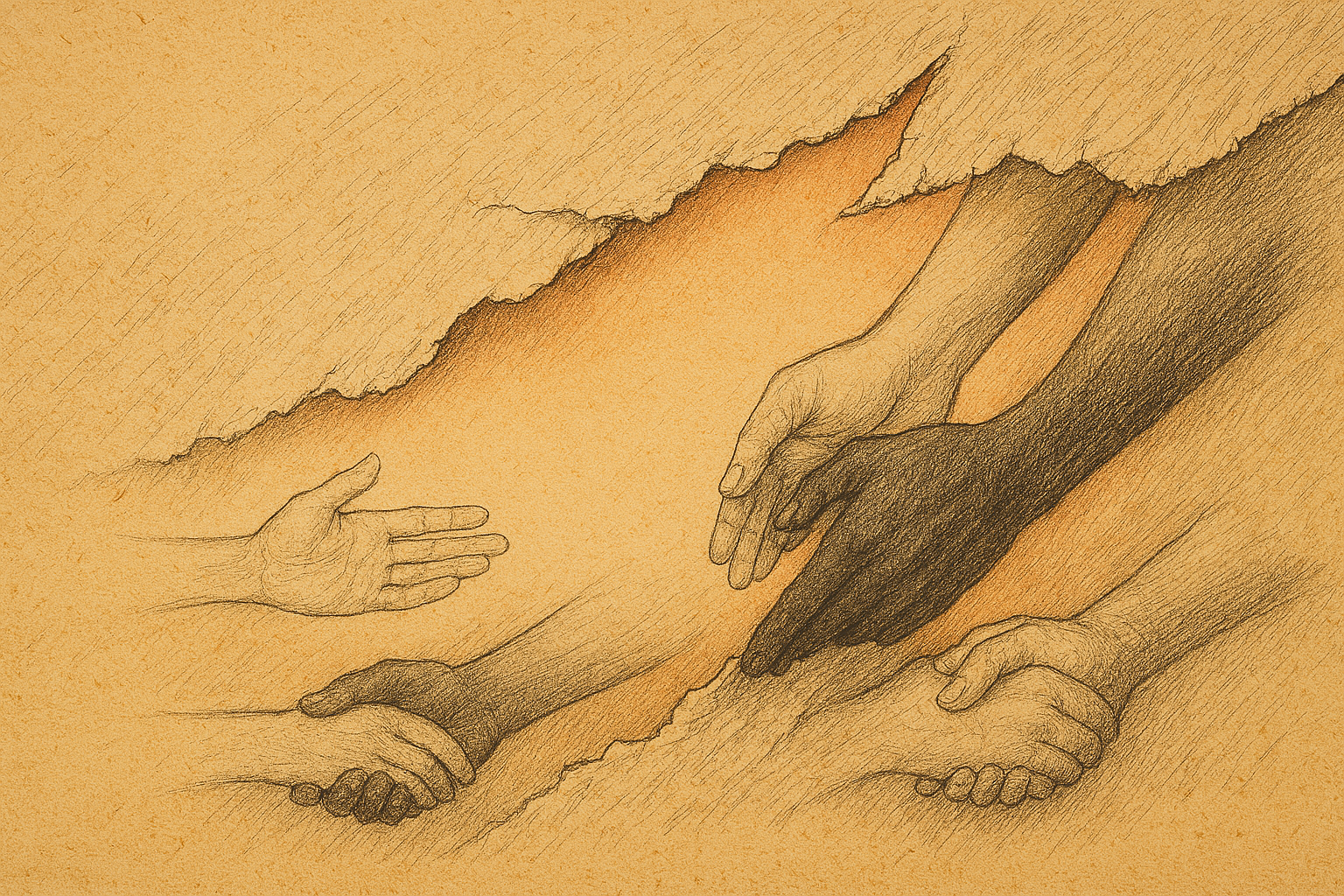
Design Notes Why this image The HERO image reveals a rising diagonal tear in handmade ivory parchment, its warm brown fibers exposed, the top edge curling upward in a soft shadow. Through that opening, seven hands emerge in a deliberate sequence — not chaotic, not frantic, but intentional. This image was chosen because Part III is about the moment when the polished narrative fractures just enough for the human truth to come through. The morning light behind the parchment signals clarity, not crisis. Symbolic function Each hand is rendered in a different artistic medium — ink, graphite, charcoal, cross‑hatch — emphasizing that truth is multifaceted and never produced by a single voice. The arrangement along the rising diagonal creates a visual progression: reach, steady, lift, support, and finally the committed clasp at the apex. The two outstretched hands that do not yet touch represent the civic distance we are still trying to close. The tear itself is not violent; it is a reveal. It shows what was always there, waiting to be seen. Civic meaning This image reframes the State of the Union not as a solitary performance but as a collective reality shaped by millions of unseen hands. The HERO makes visible the people whose labor, harm, resilience, and humanity are often obscured by political spectacle. The diversity of the hands — in tone, gesture, and medium — underscores that civic truth is built through connection, not choreography. This is the antidote to distortion: the reappearance of the human story. Why it opens the page The HERO opens Part III because it marks the exact threshold the viewer is crossing: from consuming the performance to witnessing the people behind it.  The rising diagonal guides the eye upward, signaling movement toward clarity. The hands are not symbols of crisis but of recognition — the moment when the viewer understands that the reveal is not about the tear, but about the humanity it exposes. This sets the emotional and intellectual frame for the entire page.
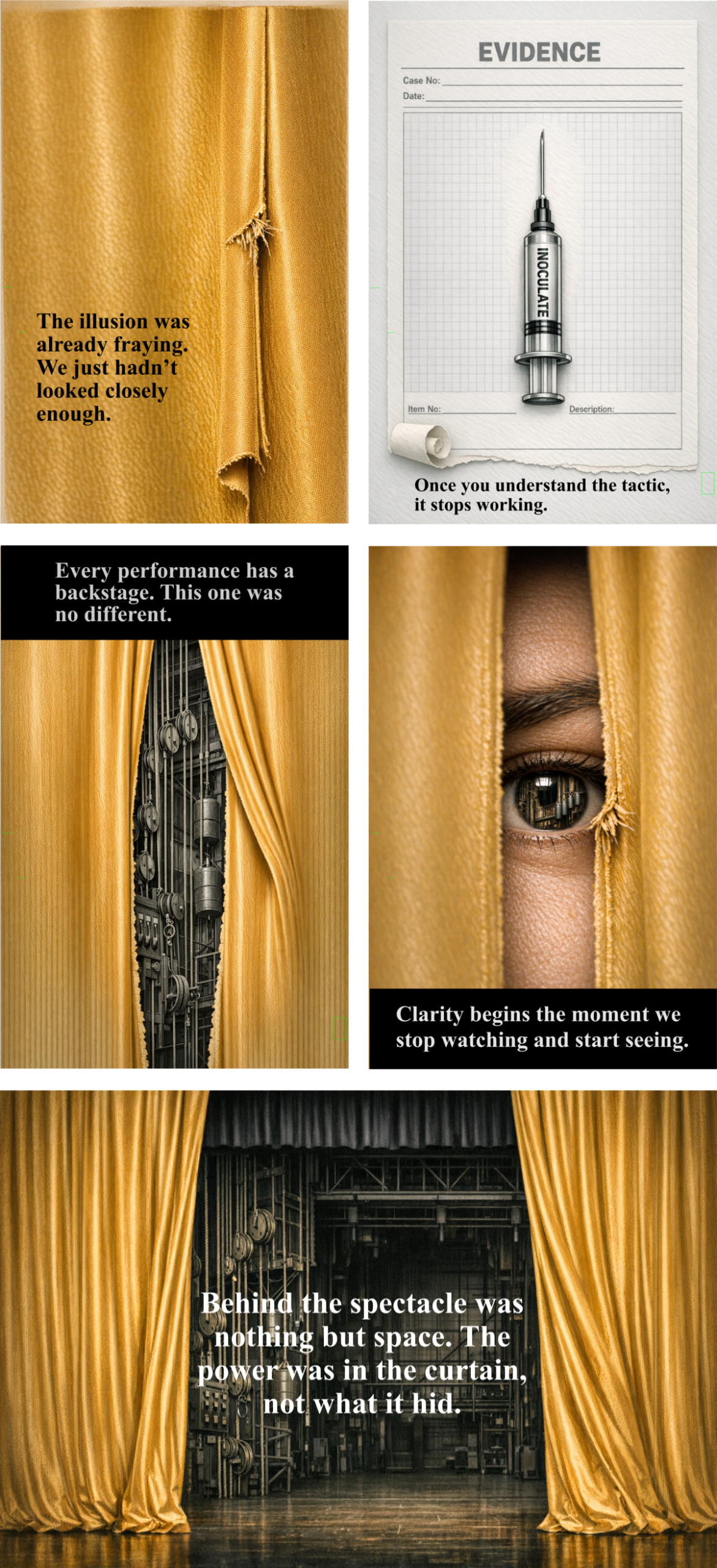
Five‑panel grid using a golden theater‑curtain motif, showing frayed fabric, an inoculation syringe on an evidence sheet, backstage machinery, an eye looking through a curtain tear, and an empty backstage revealed behind an open curtain.

Blue wave motif flowing across the screen—symbol of civic vigilance, legacy protection, and unstoppable movement.
How Distortion Maintains Its Power The Method Distortion doesn’t rely on chaos — it relies on choreography. It works by presenting a simple, steady narrative delivered with enough confidence to feel true, even when the underlying reality is missing. The performance is repetitive and emotionally consistent, creating the illusion of stability through sheer familiarity. The Vulnerability People are most susceptible to distortion when they are tired, overwhelmed, or trying to make sense of conflicting information. In those moments, a clean, confident story feels like relief. Distortion exploits that human need for coherence. It offers a version of reality that is easier to hold than the complicated truth — and once accepted, it becomes the lens through which everything else is interpreted. The Reveal Distortion loses its power the moment the viewer notices the machinery behind it. Not because the performance changes, but because the viewer does. Once you see the pattern — the repetition, the emotional cues, the selective framing — the spell breaks. The narrative no longer feels inevitable. It becomes recognizable as a constructed reality, not a lived one. That shift in awareness is the beginning of civic clarity.

Once you see the machinery, the story can’t pretend to be reality anymore.

Explore the Trilogy:

Part I I — The Years We Stopped Noticing

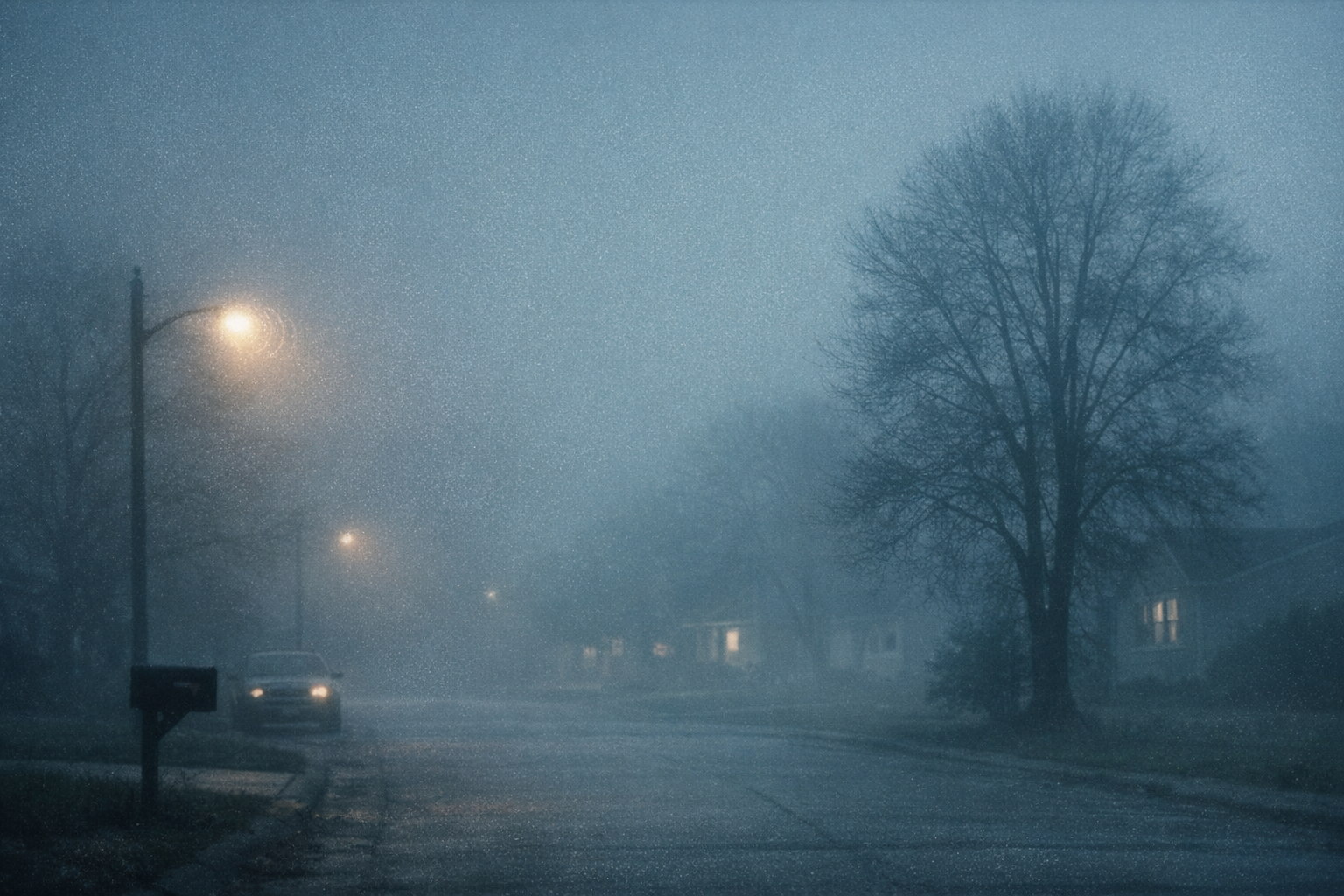
Fog‑soaked neighborhood street at night where streetlights, headlights, and house windows glow through heavy mist, creating a scene where familiar signals appear softened and trustworthy even as visibility erodes—mirroring how manufactured reality distorts perception slowly enough that the danger feels like ambience instead of warning.
USA Protect Your Vote banner with bold civic message and blue wave icons. Accessibility Text: A rectangular banner with the words “USA PROTECT YOUR VOTE. MAKING WAVES. NAMING NAMES. DEFENDING DEMOCRACY.” in bold blue capital letters on a white background. Below the text are three stylized blue wave icons, framed by a rough hand-drawn border.

Part II — The Years We Stopped Noticing

The shift didn’t announce itself. It settled in slowly, softening the edges of what we thought we understood, reshaping the familiar until the familiar no longer meant what it used to. Signals blurred, certainty thinned, and the line between truth and repetition grew faint enough to mistake one for the other. By the time we realized how much had changed, we were already living inside the distortion—adjusting to it, navigating by it, and trusting it simply because it had been there long enough to feel normal.

Soft, faint gray single line divider, low-contrast and gently blurred, symbolizing quiet resilience and reflection.

This chapter draws from Robert Arnold’s 2026 State of the Union reflection on the slow erosion of public attention during the years when manufactured reality became the country’s default atmosphere. For those who want to hear his February 25, 2026 video, “The State of the Union,” in his own voice, you may view it here: Watch on YouTube. Arnold warns, “The danger wasn’t the lies themselves — it was how quickly we stopped noticing them.” His analysis documents how political actors exploited distraction, fatigue, and information overload to reshape public perception without resistance, turning disorientation into a political tool that numbed the public into passivity. This page uses the Fog of the Familiar motif to illuminate the civic cost of that drift: a nation whose anchors didn’t break, but gradually blurred at the edges.

“Skepticism without evidence becomes corrosion, and it eats at trust, and it hollows out confidence.”

Blue wave motif flowing across the screen—symbol of civic vigilance, legacy protection, and unstoppable movement.


Fog‑soaked neighborhood street at night where streetlights, headlights, and house windows glow through heavy mist, creating a scene where familiar signals appear softened and trustworthy even as visibility erodes—mirroring how manufactured reality distorts perception slowly enough that the danger feels like ambience instead of warning.

Notes on the symbolism behind the HERO image

Design Notes

Why This Image Looks the Way It Does

This image captures the quiet, cumulative disorientation that defined the years when the country stopped noticing what was happening to it. The suburban street at dusk represents the ordinary American backdrop where the erosion of attention took place—not in moments of crisis, but in the soft, numbing drift of daily life. The thin haze is not dramatic fog; it’s the visual metaphor for manufactured reality: subtle, ambient, and easy to ignore until it becomes the air everyone breathes. The tree rendered in faint double exposure symbolizes the instability of our civic root system—anchors that once held firm but began slipping out of phase during this era.

What to Look For

  • The Tree in Double Exposure: Positioned in the right third of the frame, the tree’s silhouette is rendered with a faint vertical offset, creating a subtle double-exposure effect. This signals the loss of grounding and symbolizes the instability of our civic root system. The distortion is localized to the tree alone, reinforcing the idea that the anchor itself has slipped out of phase. The fog softens the branches, making the silhouette feel less trustworthy, while the trunk remains mostly intact — because the danger in Part II is not collapse, but drift.
  • The Flickering Streetlight: A warped halo around the light represents signals that were still present but increasingly distorted.
  • Muted, Cool Palette: Desaturated blues and grays create the emotional temperature of numbness and drift.
  • Subtle Grain Texture: A light interference pattern evokes the feeling of a broadcast losing signal, reinforcing the theme of reality becoming unreliable.
  • Stillness That Feels Wrong: The quiet, almost frozen quality of the scene mirrors the years when abnormality became normalized.

Why It Matters

Part II is the hinge of the trilogy—the chapter that explains how the public lost its ability to distinguish signal from noise. This image teaches the viewer to recognize the danger not in chaos, but in the slow erosion of attention. By destabilizing the tree—the symbol of rootedness—the image encodes the civic truth of this era: our anchors didn’t break; they blurred. The HERO image prepares the audience for the narrative shift from resilience (Part I) to revelation (Part III), grounding the viewer in the emotional and symbolic logic of the trilogy’s middle movement.

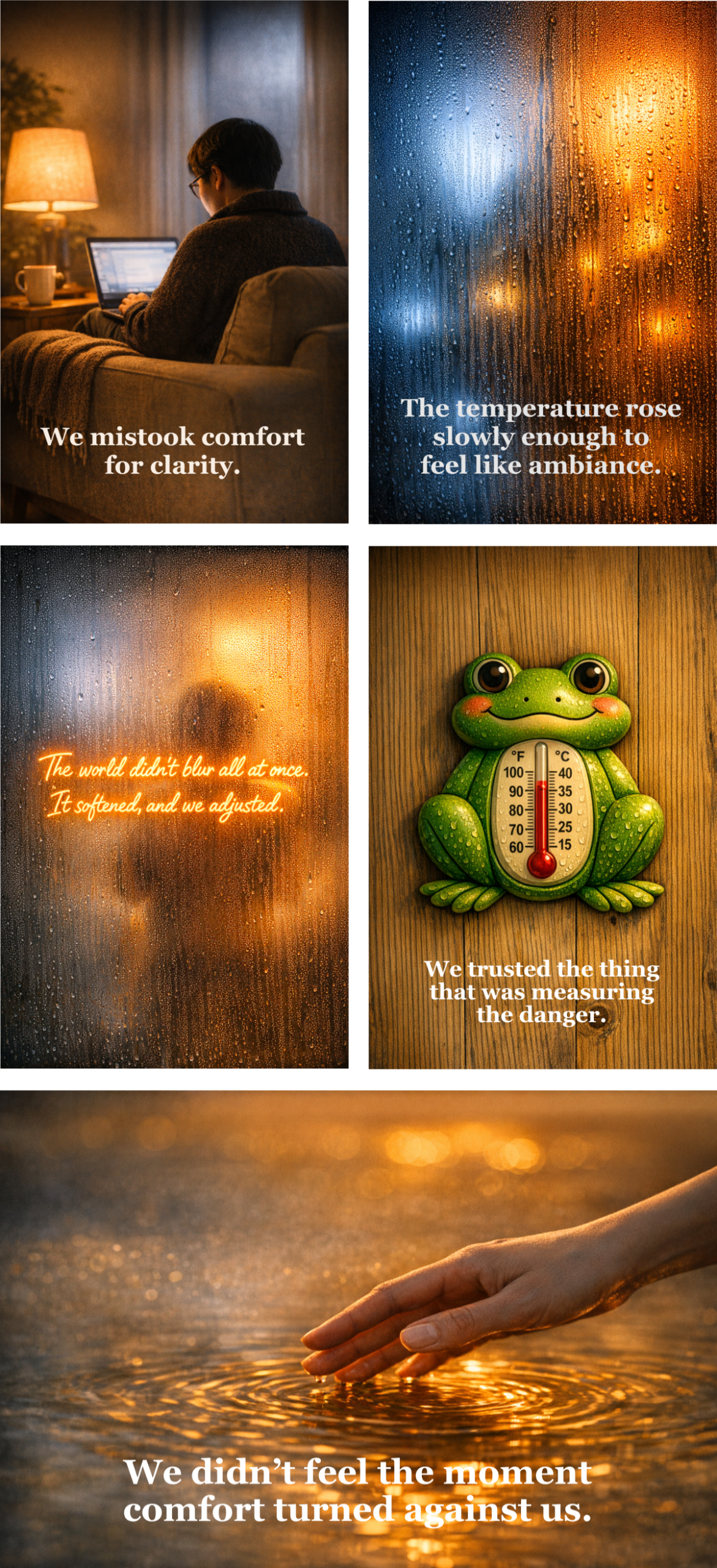
Five-panel image grid illustrating the Fog of the Familiar motif for Part II.

Blue wave motif flowing across the screen—symbol of civic vigilance, legacy protection, and unstoppable movement.

A brief note about the post that sparked this page

The Slow Drift of RealityThere was no single moment when the country lost its footing. No headline, no crisis, no shattering event. The danger arrived quietly, settling over daily life like a thin haze—soft enough to ignore, steady enough to reshape what people believed was real. We stopped noticing because the distortion began subtly, and once it became familiar, its amplification went unnoticed & unchecked. The years of fog didn’t break our anchors; they simply blurred them at the edges.The years covered in this chapter unfolded against a backdrop of constant noise. Distraction became a daily companion, fatigue settled into the national bloodstream, and the sheer volume of information made it harder to tell what mattered from what merely demanded attention. In that environment, repetition carried more weight than truth, and familiar distortions felt safer than unfamiliar facts. The fog didn’t descend because people stopped caring; it formed because the conditions around them made clarity harder to see, and even harder to grasp.We didn’t ignore the heat; it rose at a pace that felt like comforting relief, the kind of warmth you lean into without thinking. Each degree arrived disguised as ease, as convenience, as one less thing to hold in a world already asking too much of us. And by the time the warmth crossed the line between soothing and scalding, we had adapted so completely that the shift didn’t register at all. We didn’t feel the moment comfort turned against us, because the warmth had already taught us not to notice.

We didn’t notice the shift because it arrived at the speed of familiarity.

Explore the Trilogy:

Part I — The State of the Union is Resilient, Hopeful, and Willing to Fight

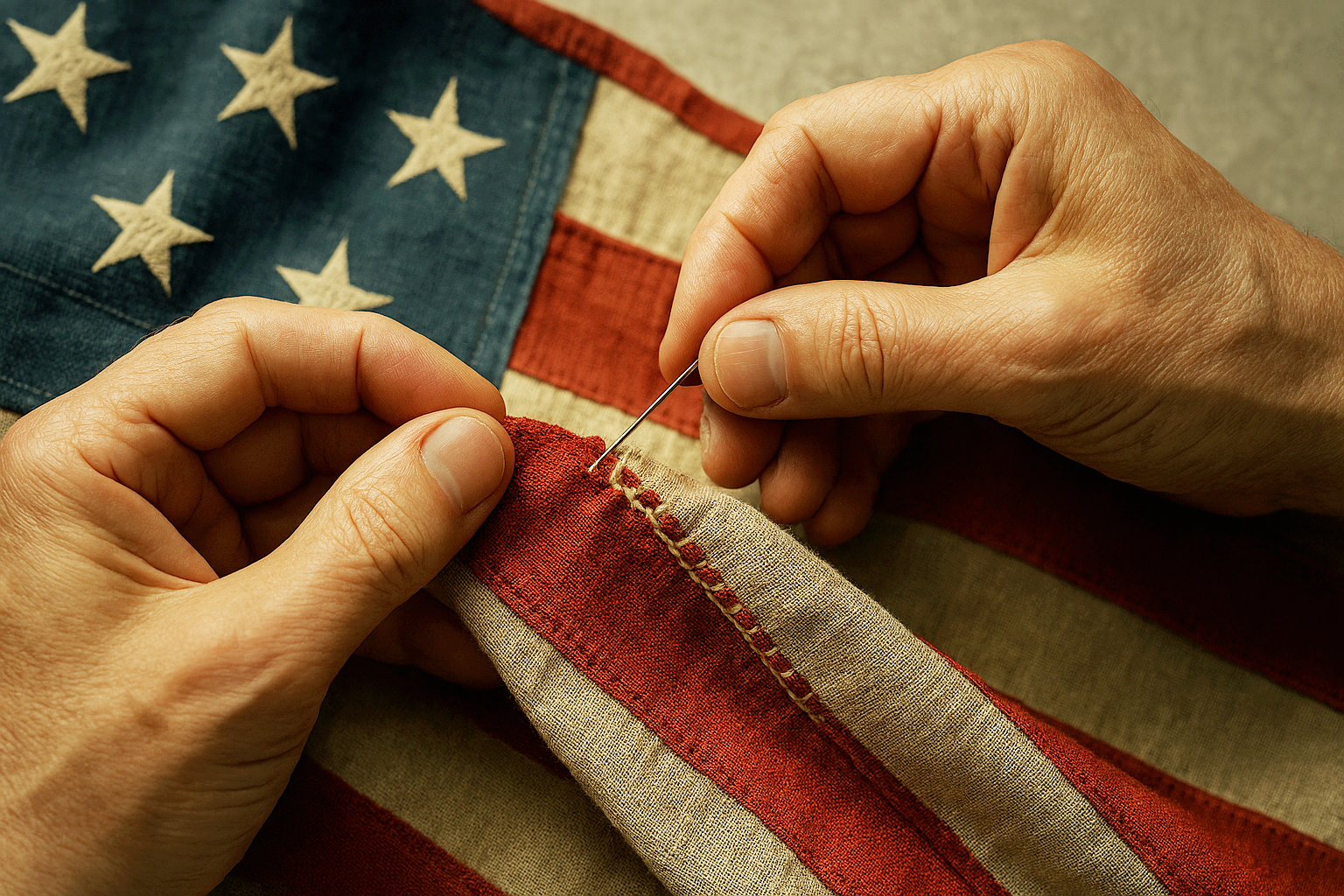
Weathered American flag being repaired by steady hands, frayed seams visible, soft directional light emphasizing careful stitching and the quiet resolve of restoring a symbol that still matters.
USA Protect Your Vote banner with bold civic message and blue wave icons. Accessibility Text: A rectangular banner with the words “USA PROTECT YOUR VOTE. MAKING WAVES. NAMING NAMES. DEFENDING DEMOCRACY.” in bold blue capital letters on a white background. Below the text are three stylized blue wave icons, framed by a rough hand-drawn border.

Part I — The State of the Union is Resilient, Hopeful, and Willing to Fight

When the Curtain Isn’t Pulled Back— It’s Missing

We like to imagine that the danger comes from what’s hidden. But in this moment, the real threat is what’s been left in plain sight: a political ecosystem so normalized, so unchallenged, that its machinery no longer bothers to disguise itself. The curtain isn’t being pulled back — it’s simply not there. Part 1 begins with that recognition. Before we can confront the actors, we have to understand the stage – who built it, who benefits from it, and why the audience was trained not to look too closely. This is the anatomy of the vacuum — the quiet, structural neglect that made everything else possible.

Soft, faint gray single line divider, low-contrast and gently blurred, symbolizing quiet resilience and reflection.

Robert’s State of the Union reflection video, published shortly after the address, acknowledges the real wounds this country carries while refusing the slide into cynicism.  This page draws from Robert Arnold’s February 25, 2026 video, “The State of the Union.” For those who want to hear the source in his own voice, the full video is here: Watch on YouTube.  He names the strain on our institutions and our shared civic fabric, yet insists the nation’s core strength remains intact. As he puts it, “But the state of the Union is also resilient and hopeful, and willing to fight again.” His message frames this moment not as collapse, but as a call to repair—an act echoed in the page’s central motif of steady hands mending a weathered flag.

“We acknowledge the damage, but we have not forgotten how to mend what matters.”

Blue wave motif flowing across the screen—symbol of civic vigilance, legacy protection, and unstoppable movement.


 Weathered American flag being repaired by steady hands, frayed seams visible, soft directional light emphasizing careful stitching and the quiet resolve of restoring a symbol that still matters.

Notes on the symbolism behind the HERO image

Design Notes

For years, the country has lived inside The Engine of Erosion — a cycle of manufactured division, institutional weakening, and moral drift. None of these forces acted alone. Each one fed the next, creating a slow, grinding harm that left the nation strained, tired, and unsure of its own reflection. This wasn’t a single event or a single villain. It was a system of pressures that pushed us further apart, hollowed out trust, and blurred the shared moral compass that once helped us navigate hard moments together.

For years, manufactured division weakened our institutions and blurred our shared moral compass. The damage is real, but so is our capacity to repair it.

Manufactured division made neighbors suspicious of one another, turning disagreement into distance and distance into fracture. Institutional weakening followed, as the structures meant to hold us steady were stretched thin by conflict, neglect, and the erosion of shared purpose — leaving gaps that ordinary people have been trying to bridge ever since. Moral drift settled in last — not as a collapse, but as a quiet forgetting of what we owe one another.

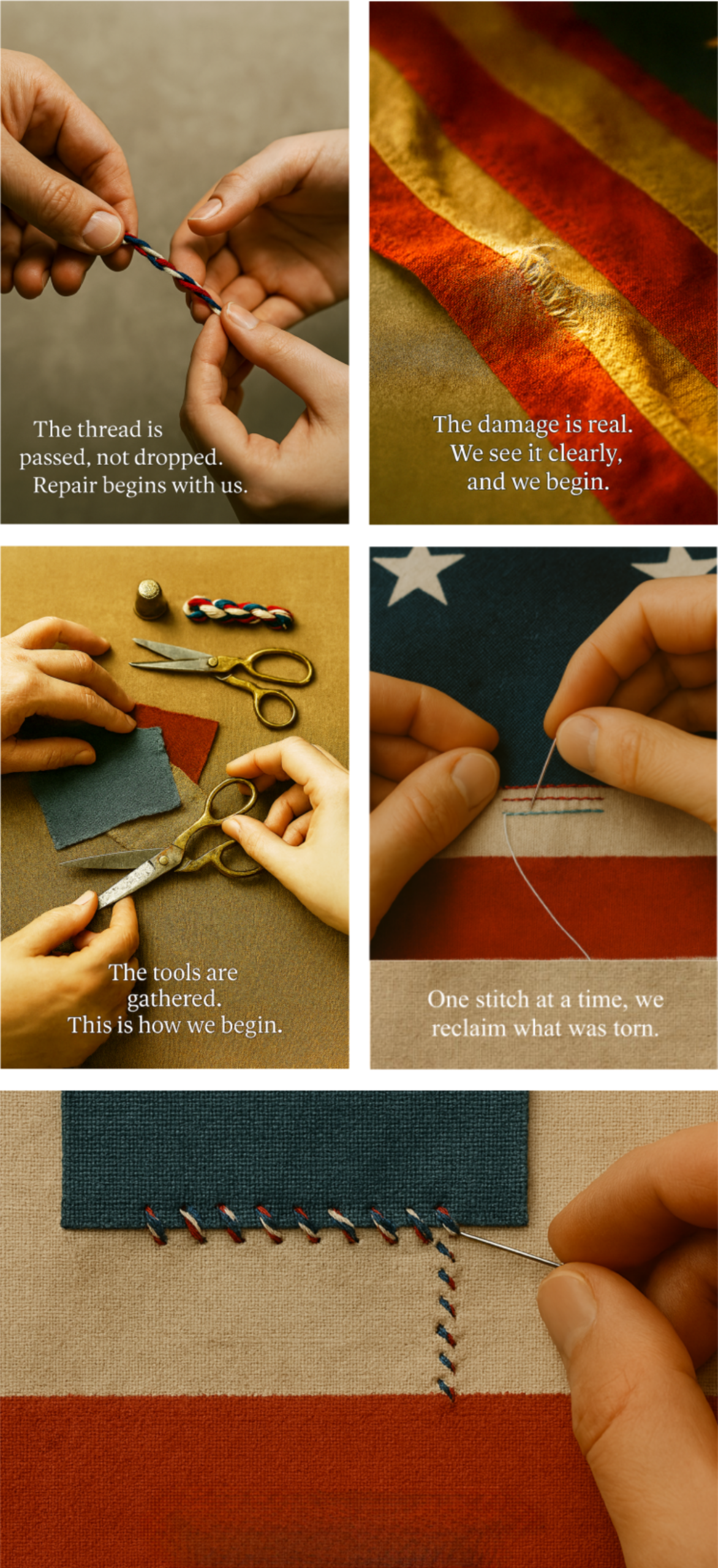
A six-panel collage depicting the symbolic repair of a damaged American flag, presented in a cracked concrete visual environment consistent with the series’ motif language. Symbolic Interpretation — The grid frames repair as a civic act: we acknowledge the damage, gather what we need, and mend the fabric of the nation together. Legacy Protocol — ALT text written to preserve motif integrity, emotional tone, and narrative continuity across the The Union Behind the Curtain series.

Blue wave motif flowing across the screen—symbol of civic vigilance, legacy protection, and unstoppable movement.

A brief note about the post that sparked this page

Details

The Work That Holds
Repair is not dramatic work. It rarely makes headlines, and it never arrives with fanfare.
It happens in the quiet spaces where people choose steadiness over spectacle and responsibility
over resentment. The country’s strength has always lived in those choices — in the hands that
keep showing up, even when the fabric is worn thin and the thread feels too small for the size
of the tear.

The truth is simple: the work of mending has already begun. You can see it in communities that
refuse to let division define them, in neighbors who step in where institutions faltered, and
in the millions of small, unglamorous acts that keep the country from sliding further into
fracture. These are not grand gestures. They are the daily stitches that keep the whole from
coming apart.

Repair asks something different from us than outrage or despair. It asks for patience, clarity,
and a willingness to see one another as part of the same fabric — even when the weave has been
strained. The tri‑colored thread in our hands is not a symbol of perfection. It is a reminder
that the country is held together by people who still believe it is worth the effort.

We mend because the nation matters. We mend because the damage is real. And we mend because the
alternative — surrendering to the forces that pulled us apart — is not who we are. The work is
slow, imperfect, and sometimes invisible, but it holds. It always has.

Explore the Trilogy:

The Quiet Strength Ahead

Repair is not a promise that everything will return to what it once was. It is a commitment to carry forward what is still true, still strong, and still worth protecting. The country has been tested by forces that tried to pull it apart, yet here it stands — not unscarred, but unbroken. The work of mending has revealed something essential: even after years of strain, the nation’s core strength remains in the hands of people who refuse to give up on one another.

There is a quiet strength in choosing repair over resentment. There is dignity in acknowledging the damage without surrendering to it. And there is hope — real, grounded hope — in the simple act of picking up the thread again. The tri‑colored thread running through our hands is not a symbol of perfection. It is a reminder that the country’s fabric is held together by millions of people performing ordinary acts of care, courage, and clarity.

We move forward not because the path is easy, but because the work is ours. The nation’s resilience is not theoretical. It is lived, daily, in the choices people make to mend what matters. This is the strength that carries us into the next chapter — not with naïveté, and not with fear, but with an uplifting resolve that honors both the wound and the will to heal it.

What we mend together becomes stronger than what tried to pull us apart.