The Union Behind the Curtain

USA Protect Your Vote banner with bold civic message and blue wave icons. Accessibility Text: A rectangular banner with the words “USA PROTECT YOUR VOTE. MAKING WAVES. NAMING NAMES. DEFENDING DEMOCRACY.” in bold blue capital letters on a white background. Below the text are three stylized blue wave icons, framed by a rough hand-drawn border.

The Union Behind the Curtain 

For years, we lived inside a performance without realizing it. The curtain rose, the lights shifted, and a polished version of the country was presented to us as if it were the whole truth. We didn’t question the staging because we were told it was normal. We didn’t see the machinery because it was designed to stay hidden. And over time, the spectacle became so familiar that we stopped noticing the difference between what was performed and what was real.

Soft, faint gray single line divider, low-contrast and gently blurred, symbolizing quiet resilience and reflection. Accessibility: Symbolizes quiet resilience, reflection, and gentle healing.

Why This Series Exists

For too long, the country has been asked to accept a polished version of itself as if it were the whole story. The curtain didn’t rise by accident, and the performance didn’t sustain itself on charisma alone. It endured because it was engineered to hide in plain sight. It endured because we were encouraged to look at the spectacle instead of the structure. And it endured because the longer a performance runs, the more natural it begins to feel.

This series exists to break that spell.

It exists to show how the illusion was built, how it was maintained, and how it shaped what millions of people came to believe about the Union. It exists to name the gap between the performance and the country’s actual condition. And it exists to return something essential to the reader: the ability to see the machinery for what it is, and the clarity to recognize it the next time it appears.

The purpose is not outrage. It is not spectacle. It is not partisan heat.
The purpose is understanding — the kind that restores agency.

The Three-Part Arc

This series unfolds in three movements, each one revealing a different layer of the performance we’ve been living inside.

Part I — The State of the Union is Resilient, Hopeful, and Willing to Fight

We begin with reality itself — the real condition of the Union, stripped of spectacle and political choreography. Before we can understand the illusion, we have to understand what it was hiding.

Part II — The Years We Stopped Noticing

Next, we turn to the long stretch of time when the curtain blended into the background. This is the chapter where we name the cultural drift — the fatigue, the normalization, the slow erosion of civic expectations — that allowed the performance to stand unchallenged.

Part III — The Reveal We Were Never Meant to See

Finally, we arrive at the moment of revelation. This is where the curtain is pulled back, the machinery becomes visible, and the illusion loses its power. It is the chapter that restores agency by showing the reader how the system worked — and how to recognize it the next time it appears.

Together, these three parts form a single arc:
grounded reality → conditioned drift → clear revelation.
A return to clarity, one layer at a time.

Blue wave motif flowing across the screen—symbol of civic vigilance, legacy protection, and unstoppable movement. Accessibility: Symbolizes civic vigilance, legacy protection, and unstoppable movement.

What the Reader Will Learn

The first step in learning to identify patterns is recognizing that perception itself can be shaped by repetition. When something is repeated often enough, it begins to feel familiar, and familiarity can create the illusion of understanding. Over time, the mind adapts to what it sees most frequently, and the unfamiliar details — the ones that matter most — can slip quietly out of view.

This series teaches the reader how to recognize that process. It shows how attention can be guided without awareness, how certain cues become invisible through overexposure, and how the mind fills in gaps with assumptions that feel natural simply because they are familiar, and those assumptions can gradually take on the weight of truth. By understanding how repetition shapes perception, the reader begins to see the difference between what is genuinely clear and what has merely become comfortable

As the trilogy unfolds, the reader gains a new capability: the ability to notice the subtle shifts that once blended into the background. They learn to distinguish between surface impressions and underlying structure, between what draws the eye and what directs it. Most importantly, they develop a steadier sense of clarity — one that comes from understanding how perception works, and how to recognize the moment when something hidden becomes visible again.

Explore the Series:

Codified Suspicion

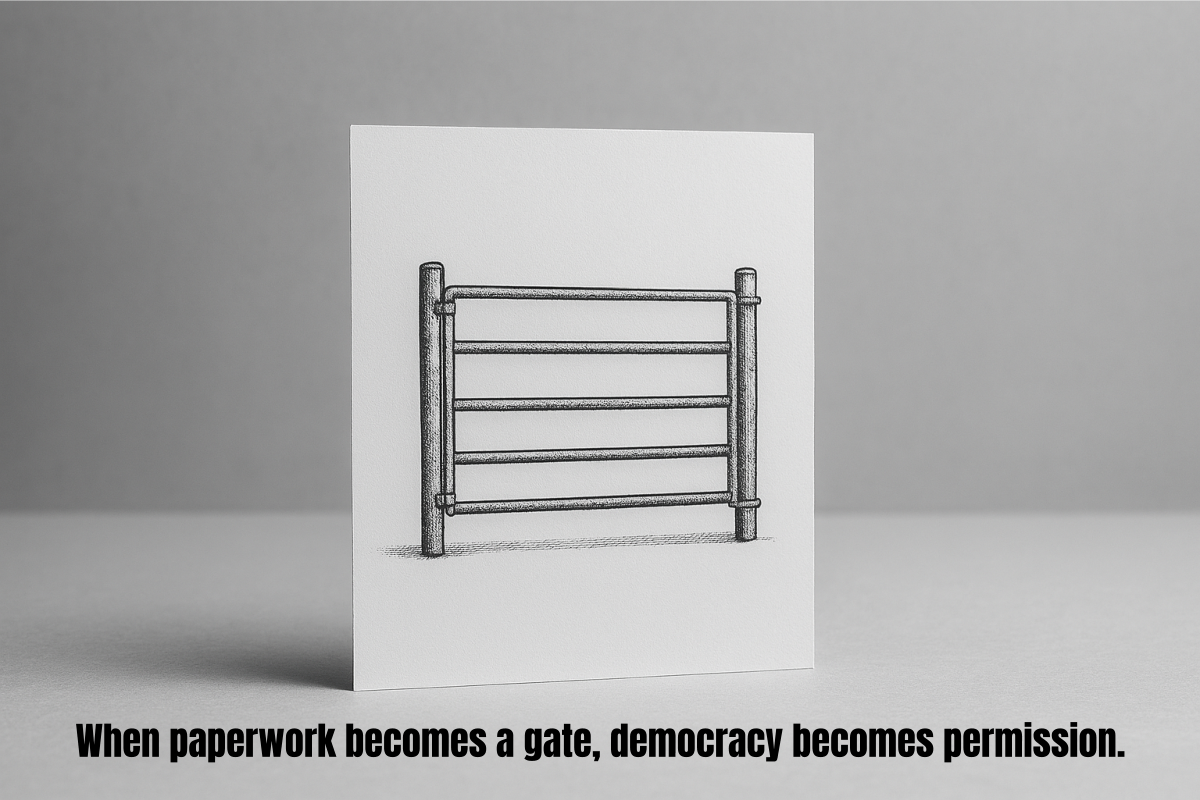
Paper standing upright with a hand‑drawn metal gate creating the illusion of a real barrier.
USA Protect Your Vote banner with bold civic message and blue wave icons. Accessibility Text: A rectangular banner with the words “USA PROTECT YOUR VOTE. MAKING WAVES. NAMING NAMES. DEFENDING DEMOCRACY.” in bold blue capital letters on a white background. Below the text are three stylized blue wave icons, framed by a rough hand-drawn border.

Codified Suspicion

When Paperwork Becomes a Weapon

Paperwork is supposed to record a right, not regulate it. But when the system treats documents as proof of worthiness, the process becomes the barrier. What looks like routine administration becomes a quiet sorting mechanism, narrowing who gets to vote and who doesn’t, long before a ballot is ever cast.

Soft, faint gray single line divider, low-contrast and gently blurred, symbolizing quiet resilience and reflection.

This video examines the SAVE Act as a bureaucratic weapon that narrows the electorate under the guise of “integrity.” Through historical memory, lived experience, and civic analysis, it exposes how paperwork, documentation demands, and administrative fear function as modern tools of voter suppression. The piece argues that when a government adds friction without overwhelming evidence of fraud, it is not protecting democracy — it is deciding whose voice is expendable.

When the state demands proof instead of trust, citizens become applicants.

Blue wave motif flowing across the screen—symbol of civic vigilance, legacy protection, and unstoppable movement. Accessibility: Symbolizes civic vigilance, legacy protection, and unstoppable movement.

Paper standing upright with a hand‑drawn metal gate creating the illusion of a real barrier.

Design Notes

Why This Image
This HERO image is designed with intentional symbolism to support the civic argument of this page. Each visual element — color, light, texture, and object placement — reflects the emotional and structural themes explored below

What to Look For
• Symbolic elements that represent power, absence, protection, fracture, or dignity
• Lighting and contrast that signal emotional tone
• Textures and surfaces that echo civic decay or resilience
• Objects chosen for metaphor rather than literal depiction

Why It Matters
The HERO image sets the emotional and conceptual frame for the entire page. Understanding its design deepens the reader’s ability to recognize civic patterns, decode visual rhetoric, and see how power operates in the world around them.

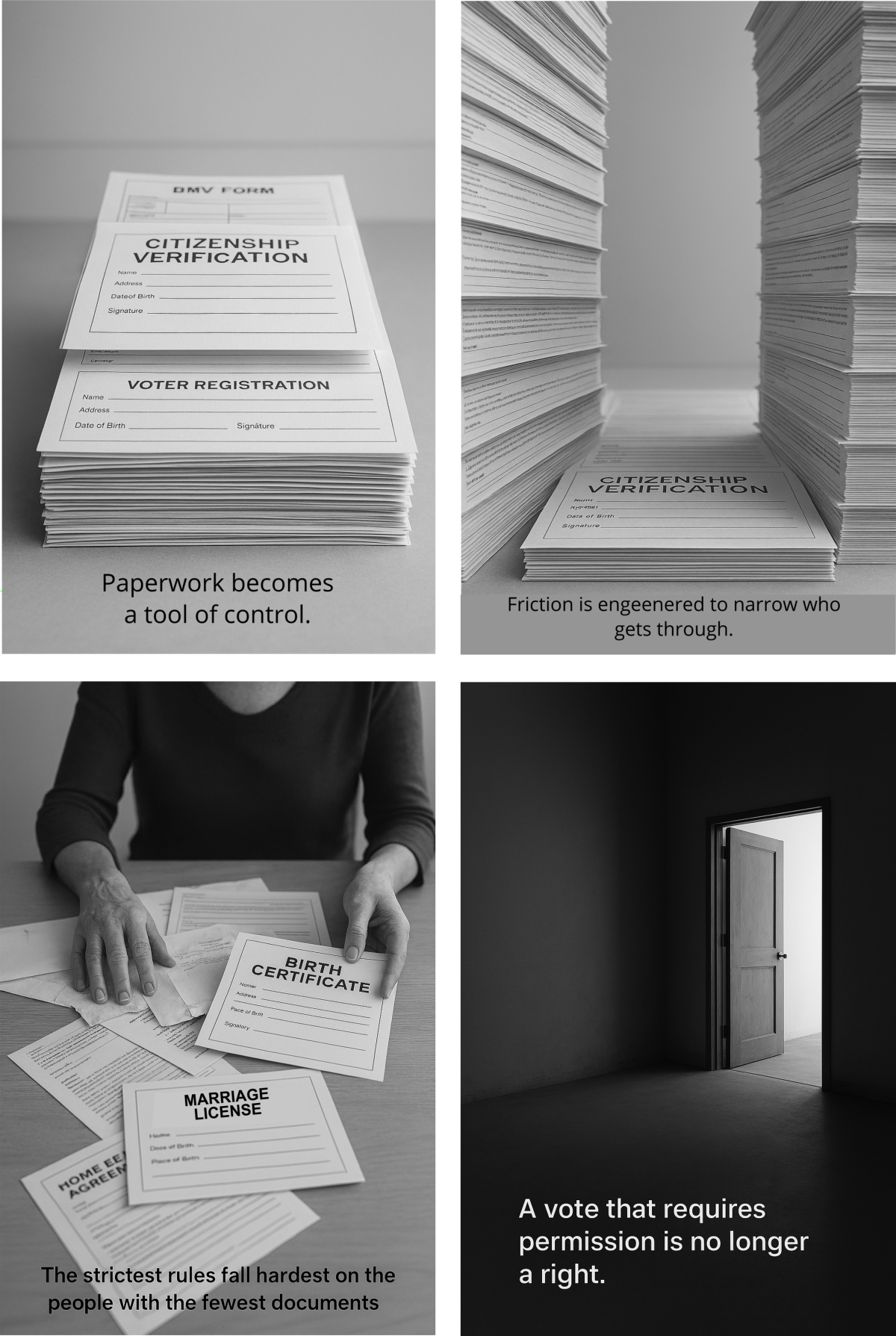
Four‑panel image grid illustrating bureaucratic barriers to voting: stacks of official forms, a narrow passage formed by paperwork, a person sorting identity documents, and a dark room with a single lit doorway.

Blue wave motif flowing across the screen—symbol of civic vigilance, legacy protection, and unstoppable movement.

For readers who wish to delve deeper, the distilled source summary is provided below.

Source Summary

The video argues that the SAVE Act is framed as a matter of “integrity,” but that word is used as a veneer to mask a deeper instinct: suspicion. Instead of trusting citizens, the bill demands proof at every turn — proof of identity, proof of belonging, proof of worthiness. What looks like a neutral administrative update becomes a system that sorts people into those who can easily produce documents and those who cannot. The speaker connects this to a long American pattern: when power feels threatened, it tightens the rules around those least able to meet them.

Drawing on historical voices like Emma Goldman, James Baldwin, and Hunter S. Thompson, the video situates the SAVE Act within a lineage of bureaucratic control. Goldman understood the state’s impulse to categorize and exclude; Baldwin would ask who bears the weight of these new requirements; Thompson warned that authoritarianism often arrives not with tanks but with forms, copies, and clerks afraid of being sued. The video emphasizes that fear trickles downward — from Washington to county offices — until the safest answer becomes “no,” and every “no” falls hardest on those already living closest to the edge.

The speaker highlights the real-world consequences: the grandmother searching for a mismatched birth certificate, the naturalized citizen who never imagined they’d have to prove their oath again, the renter without a tidy folder of documents, the working-class voter relying on a gas station copier. These are the people who feel the friction first. Meanwhile, the affluent glide through untouched, buffered by time, stability, and legal support. The bill does not address a proven threat; instead, it constructs new barriers around a right that is supposed to be foundational.

Ultimately, the video argues that the SAVE Act is not about preventing fraud — a problem for which there is no overwhelming evidence — but about narrowing the electorate. It reframes voting as a conditional privilege rather than a guaranteed right. By demanding paperwork instead of trust, the bill transforms citizens into applicants and democracy into a gated system. The speaker warns that if we accept this shift quietly, we become complicit in the slow burial of the very thing we claim to cherish.

Soft, faint gray single line divider, low-contrast and gently blurred, symbolizing quiet resilience and reflection. Accessibility: Symbolizes quiet resilience, reflection, and gentle healing.

Power always tightens the rules for those least able to meet them.

When Culture Speaks, Power Panics

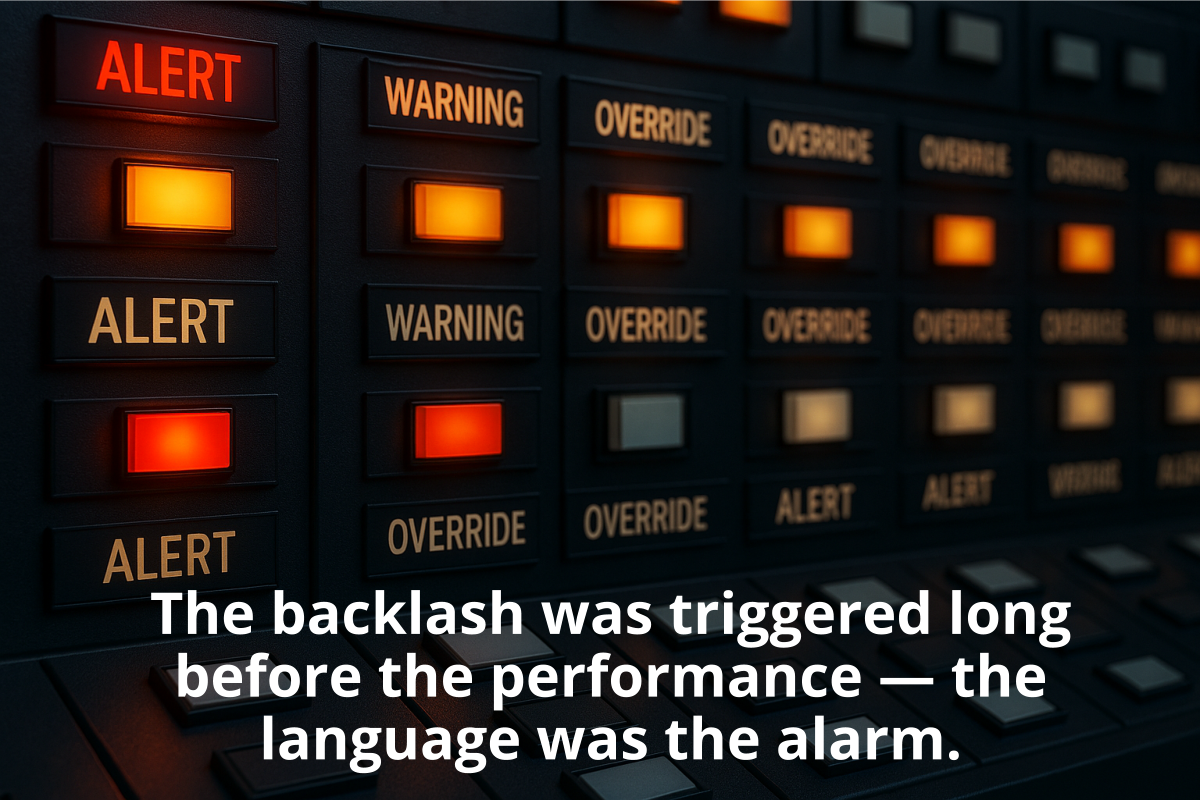
Control panel wall with rows of blinking indicators labeled ALERT, WARNING, and OVERRIDE. Some lights are lit, others dark. No people or screens. Visual metaphor for manufactured outrage and panic as a system.
USA Protect Your Vote banner with bold civic message and blue wave icons. Accessibility Text: A rectangular banner with the words “USA PROTECT YOUR VOTE. MAKING WAVES. NAMING NAMES. DEFENDING DEMOCRACY.” in bold blue capital letters on a white background. Below the text are three stylized blue wave icons, framed by a rough hand-drawn border.

When Culture Speaks, Power Panics

When culture asserts itself with clarity and confidence, power often responds not with understanding but with fear. What should have been a moment of celebration becomes a manufactured crisis, engineered through selective framing, primed outrage, and a choreography designed to turn identity into threat. The panic isn’t organic. It’s constructed — a reaction to visibility, not harm — revealing far more about the insecurities of those in power than about the culture they claim to fear.

Soft, faint gray single line divider, low-contrast and gently blurred, symbolizing quiet resilience and reflection.

In their coverage of the GOP’s reaction to the Super Bowl Halftime Performance, multiple outlets documented how conservative commentators and elected officials escalated outrage before the show even aired, framing the use of Spanish as a cultural affront rather than an artistic choice. As one commentator put it, “This wasn’t a performance — it was a provocation.” This page draws from reporting and analysis across those sources to examine how language itself became the trigger, revealing a familiar pattern in which cultural expression is treated as a threat, and the outrage machinery activates on cue. The blinking‑alert motif in the HERO image reflects that mechanism: a system primed to panic the moment culture speaks in a voice it cannot control.

“The outrage wasn’t a reaction.    It was a strategy.”

Blue wave motif flowing across the screen—symbol of civic vigilance, legacy protection, and unstoppable movement.

Control panel wall with rows of blinking indicators labeled ALERT, WARNING, and OVERRIDE. Some lights are lit, others dark. No people or screens. Visual metaphor for manufactured outrage and panic as a system.
Design Notes

Why This Image Looks the Way It Does

This image captures the exact mechanism that defined the backlash: a system already wired for alarm before a single note was sung. The Panic Switchboard visualizes the infrastructure of outrage — the buttons, triggers, and warning lights that were primed long before Bad Bunny announced his performance would be in Spanish.Symbolic function:
The illuminated controls symbolize a narrative machine waiting for activation. Nothing in the image reflects the performance itself; instead, it reflects the conditions that made the backlash inevitable. The switches and alerts stand in for the political, cultural, and media actors who treat language, identity, and visibility as threats requiring escalation.

Civic meaning:
The HERO establishes the civic thesis: the panic was not spontaneous. It was engineered. The outrage that followed the Spanish‑language announcement wasn’t about content — it was about a system predisposed to treat cultural expression as provocation. This image makes the mechanism visible, showing how power manufactures crisis through pre‑set alarms rather than genuine reaction.

Why it opens the page:
This image sets the reader’s frame before they encounter the grid. It tells them: the story begins before the performance. By opening with the machinery of panic rather than the cultural moment itself, the page makes clear that the backlash was never about what happened onstage. It was about the infrastructure of fear that was already humming in the background — and the machinery built to control the narrative.

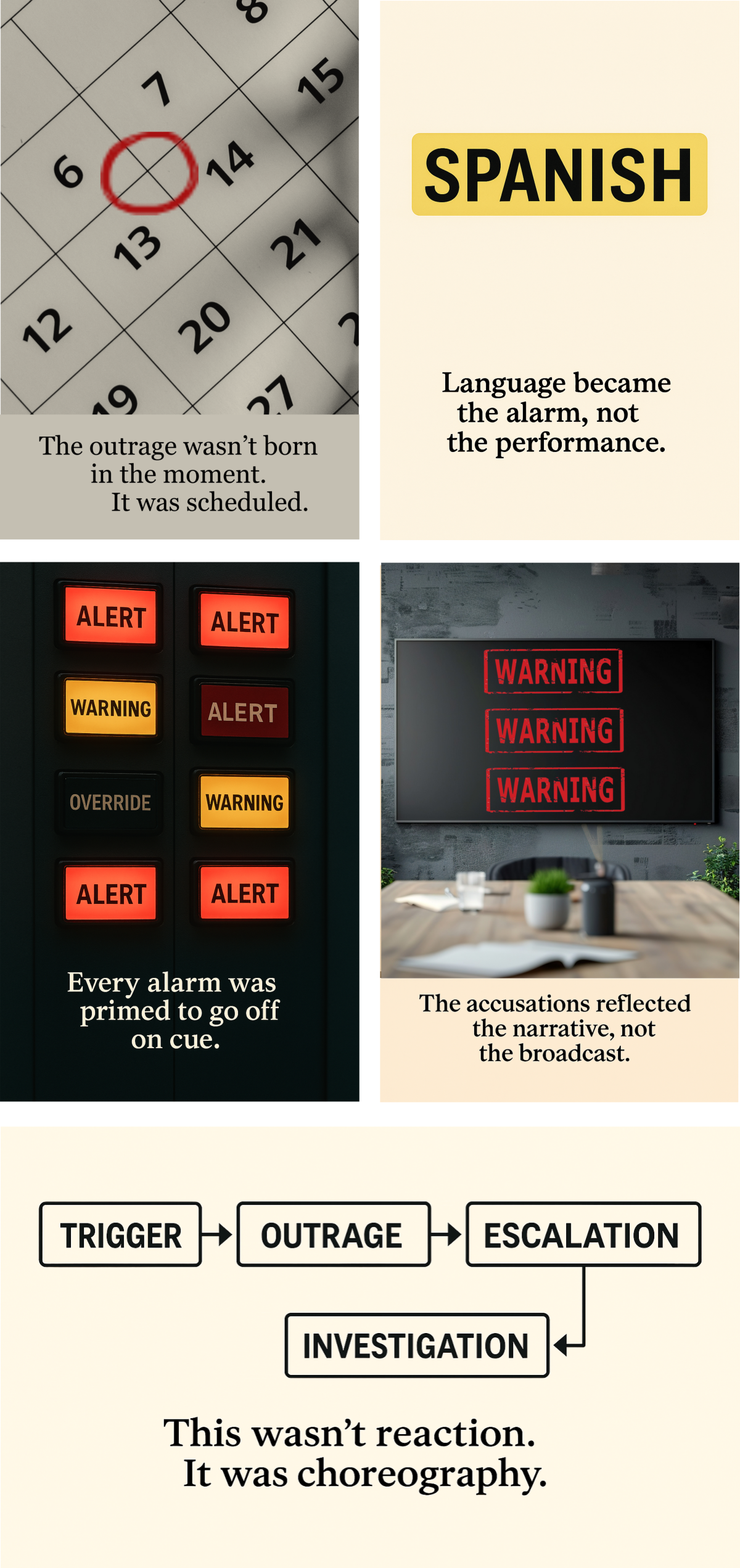
A five‑panel civic image grid illustrating how outrage is manufactured and choreographed. Panel 1 shows a clean calendar page with a red circle drawn between two dates, symbolizing pre‑planned outrage rather than spontaneous reaction. Panel 2 displays the word “SPANISH” highlighted like a flagged keyword, representing how language itself was framed as the alarm. Panel 3 features a vertical control panel with blinking indicators labeled ALERT, WARNING, and OVERRIDE, suggesting a system primed for activation. Panel 4 shows a blank television screen overlaid with exaggerated WARNING graphics, emphasizing projection rather than evidence. Panel 5 presents a simple flowchart reading Trigger → Outrage → Escalation → Investigation, with a loop returning to the start, revealing the pattern as deliberate choreography rather than genuine response.

Blue wave motif flowing across the screen—symbol of civic vigilance, legacy protection, and unstoppable movement.

A brief note about the post that sparked this page

A closer look at the reaction behind the alarms

Source Summary

The Pre-Staged Outrage
The GOP’s response to the halftime performance didn’t begin with what happened on stage — it began weeks earlier, when conservative media figures and political operatives were already promoting an “alternate halftime show.” An event of that scale requires planning, booking, production, and coordination, revealing that the backlash was not spontaneous but pre‑engineered. The language choice — Spanish — became the first trigger, framed as a cultural provocation long before the Super Bowl aired. This early narrative primed audiences for outrage, ensuring the alarms were blinking before a single moment of the performance existed to react to.

The Manufactured Aftermath
Once the show aired, the preloaded narrative escalated into a full‑blown moral panic. Several Republican lawmakers and commentators demanded investigations, alleging “smut,” “gay sex acts,” and other claims that were not supported by the broadcast itself. These accusations weren’t responses to the content; they were extensions of a storyline already in motion. The performance became a surface onto which predetermined grievances were projected, allowing political actors to amplify fear, redirect attention, and reinforce cultural division. The outrage wasn’t about what viewers saw — it was about what the outrage system was built to produce.